
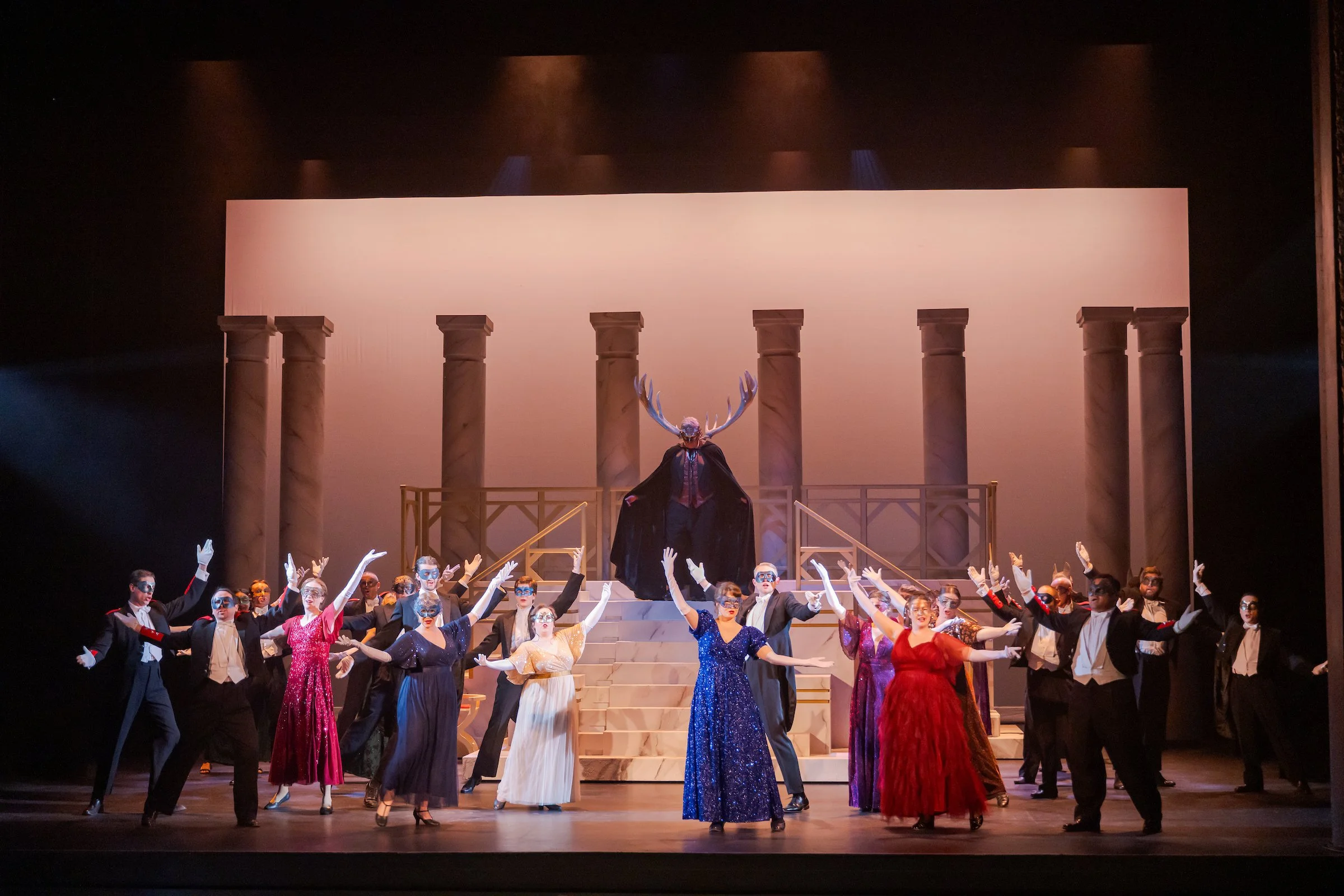
The Wellington Opera Chorus in Act 3 of Un Ballo in Maschera (A Masked Ball) by Giuseppe Verdi
Image credit: Stephen A’Court
Stealthy pizzicato strings and little questioning phrases from a flute quietly open the Overture to Un Ballo in Maschera (A Masked Ball). In Wellington Opera's current production of Verdi's opera, the curtain rises on a darkened stage as the orchestra relaxes into the melody of an upcoming aria, a ghostly stag's head floating above.
A hunter arrives, with servant and two lean, handsome dogs (yes, live ones). It's King Gustavo of Sweden, well-pleased with his bounty, stag's antlers in the sack he carries from the stage. But after a recent and bloody coup d’etat, his enemies lurk, and this hunter is about to become the hunted.
This year, Wellington Opera has reached beyond the box office security of an annual selection from the operatic ‘top ten’ to present two operas, a successful world premiere in July of New Zealand composer Gillian Whitehead’s Mate Ururoa (reviewed here) and this production of Un Ballo in Maschera, a lesser-known Verdi work, drawn from a true story of regal assassination.
It’s a thoughtful and imaginative production, set in Sweden, as was Verdi’s original, and moving the period to the late 19th century, a time, Director Jacqueline Coats tells us, of both social change and explorations of psychoanalysis and spiritualism. Inspired direction, design and lighting work beautifully together to evoke the shifting scenes and emotional states of a story both unpredictable and inevitable in its move to a fatal dénouement. And, for once, it’s not the woman who dies in the end.
Wellington Opera has again stayed true to its commitment to feature New Zealand voices on its stages, and the star cast of Un Ballo in Maschera, like that of their enthralling Tosca last year, is an outstanding team.
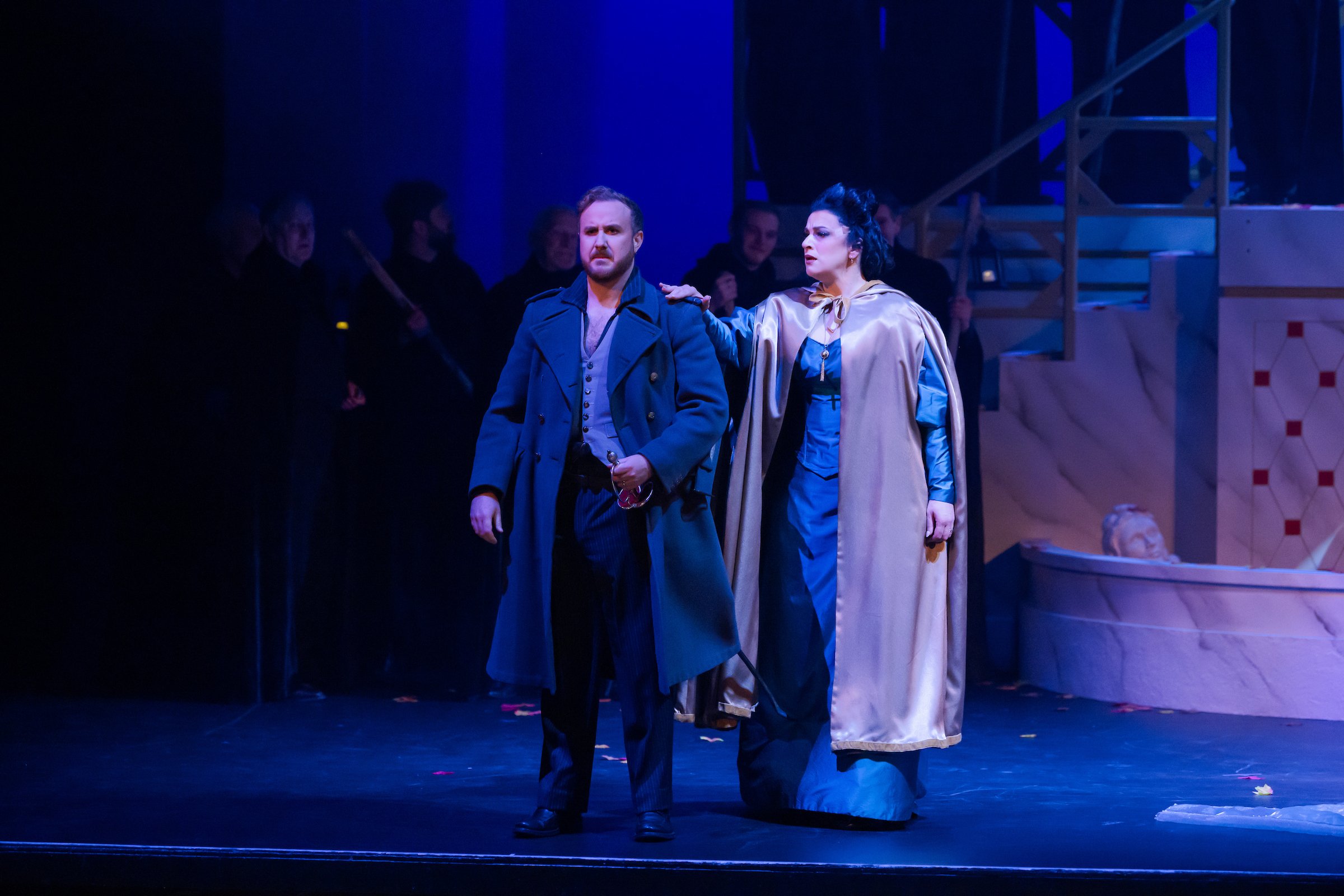
Baritone Julien van Mellaerts (Anckarström) and soprano Madeleine Pierard (Amelia)
“…in Un Ballo in Maschera Wellington Opera has maintained its commitment to feature singers from New Zealand.”
Image credit: Stephen A’Court
Tenor Jared Holt brings his lovely ringing tenor voice and authoritative presence to the role of the doomed Gustavo. The King has made enemies, though his soldiers and courtiers remain mostly loyal. The first Act begins with a chorus of appreciation behind a gauze screen, and as the singers become visible, we’re aware of a hostile quartet of men within the group singing darkly of the monarch’s failings.
The King’s young page, Oscar, heralds his arrival. German-based New Zealand soprano Natasha Te Rupe Wilson (Te Arawa, Ngā Puhi) sings this ‘breeches’ role with brilliance and agility, enlivening the scene with knowing charm and the vocal beauty and ease that has taken her to international stages. Her colourful presence is heightened by her costume, a vibrant red against darker hues elsewhere.
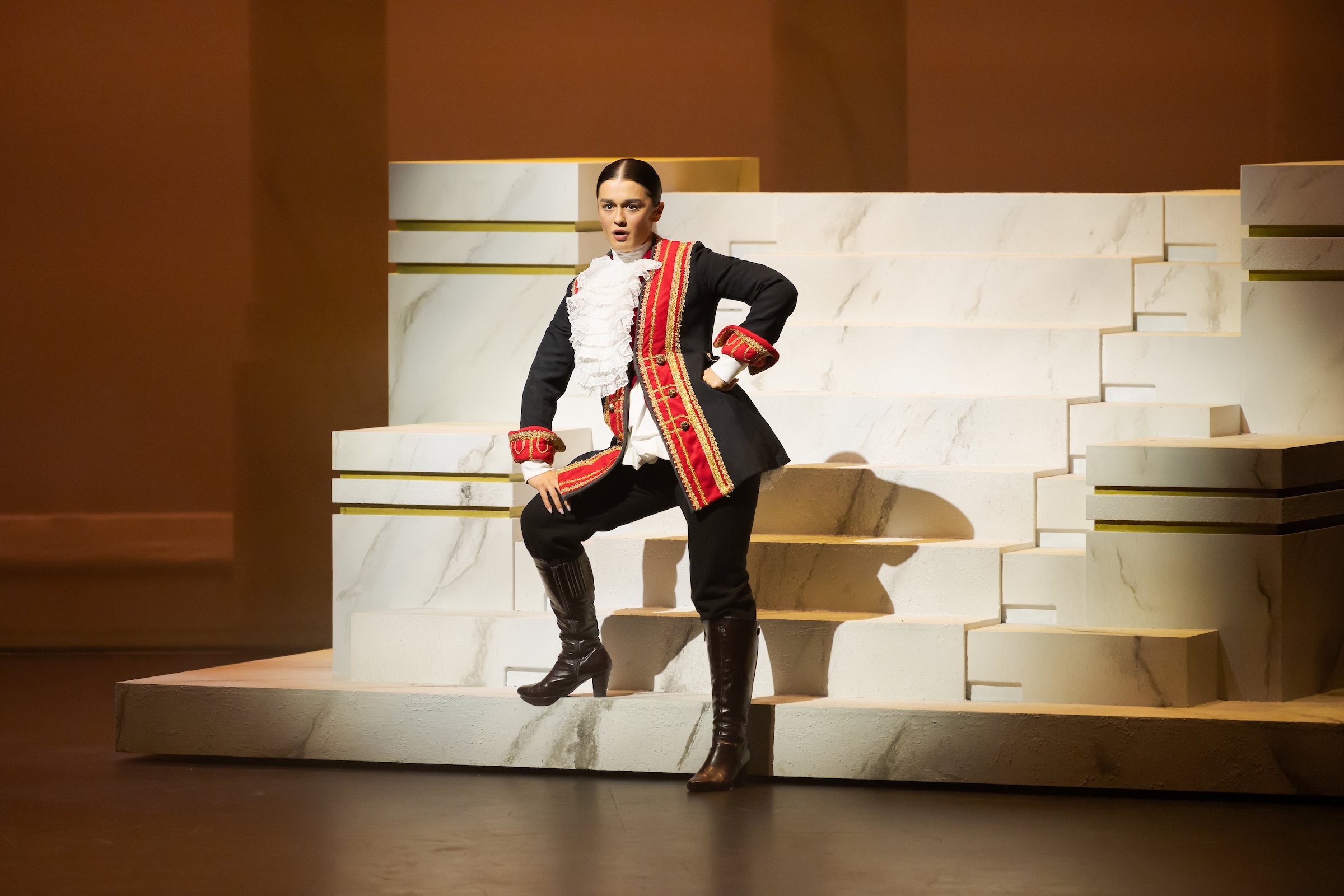
Soprano Natasha Te Rupe (Oscar)
“…sings the ‘breeches’ role with brilliance and agility.”
Image credit: Stephen A’Court
We hear first about the upcoming masked ball of the title when Oscar presents Gustavo with the guest list for the event. There the King sees the name of Amelia, his secret love, and the wife of his dear and loyal friend, Count Anckarström. The crux of the action centres on this unhappy love triangle.
London-based baritone Julien van Mellaerts is Anckarström, a complex role he sings with not only clarity and beauty of voice but subtlety and variety of tone and character, compelling throughout the three Acts. These qualities were evident at once in his first Act aria Alla vita che t'arride (“To the life that smiles on you”), sung to the King to persuade him of the threat against him.
Van Mellaerts is a marvellous musician, using the Italian language beautifully to shape every phrase. He’s utterly convincing, first as a loyal husband and friend and later, as he believes himself betrayed, a violent and enraged assassin.
Act 1 also introduces the fortune-teller, Ulrica, sung by contralto Kristin Darragh. She plays the role of predictor of doom with dramatic intensity, her voice strong, deep-toned and characterful, though with a little unevenness in her lower, chest register.
The cause of the developing conflict between the two men is Amelia, sung by soprano Madeleine Pierard. Last year as Tosca in Puccini’s famous opera, Pierard revealed her ability to portray a conflicted heroine, and here she brought her gorgeous voice and expressive skill to another unhappy woman, torn between husband and lover.
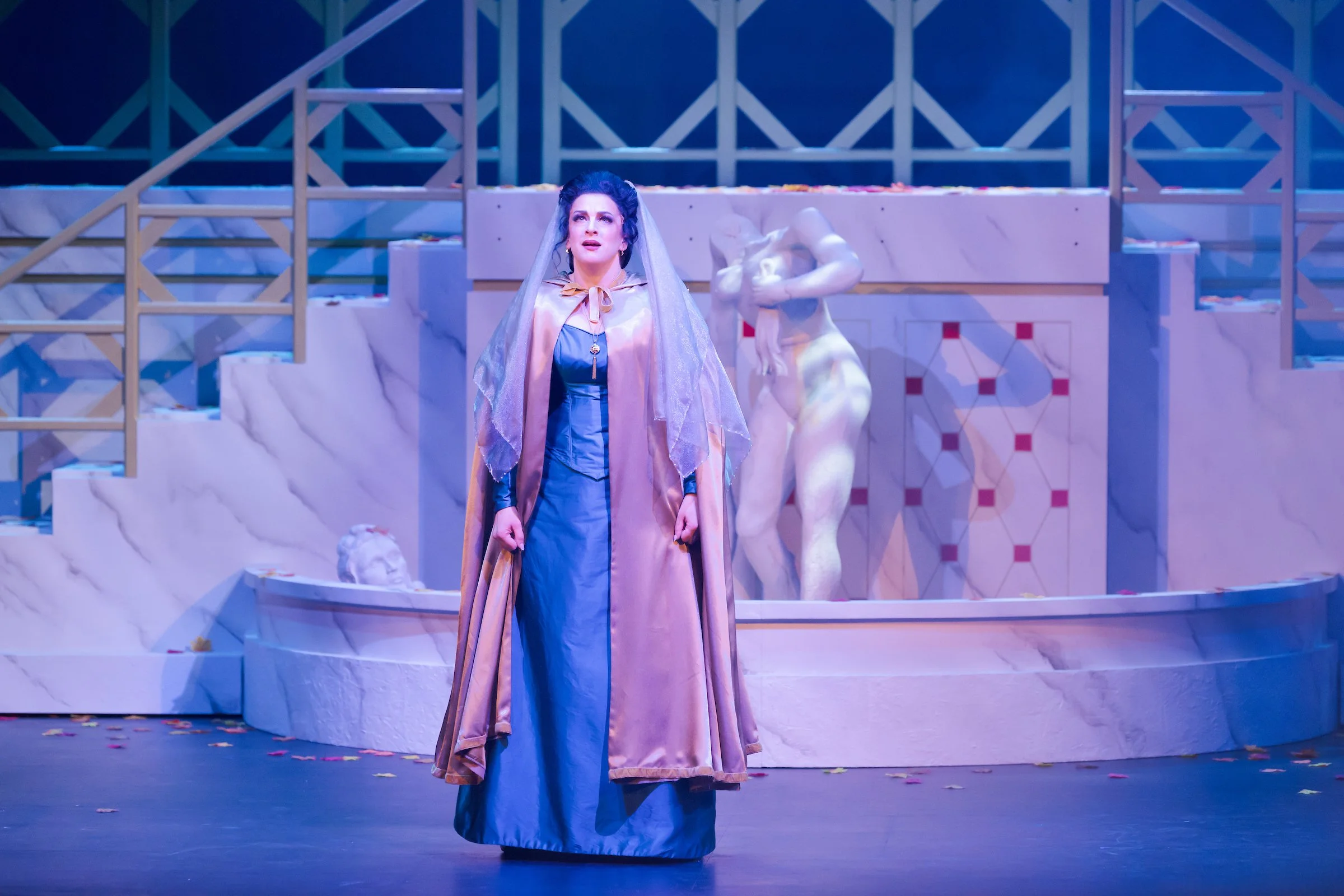
Soprano Madeleine Pierard as the tormented Amelia
“..a gorgeous voice and expressive skill.”
Image credit: Stephen A’Court
The set design is stylish and simple, facilitating nice tableaux of singers with marble textures and geometric forms. Act 2 opens with Amelia praying in a dark and murky scene by a fountain. She’s seeking a herb recommended by Ulrica to quell her love for the King. A lovely plaintive cor anglais solo and clouds of dry ice swirl around her as Pierard sings two beautiful arias. In the second, Ma dall'arido stelo divulsa (“But from the arid stems”), her elegant phrasing is particularly moving.
The arrival of the King leads to a love duet, powerful singing from both Pierard and Holt and affecting, genuine emotion.
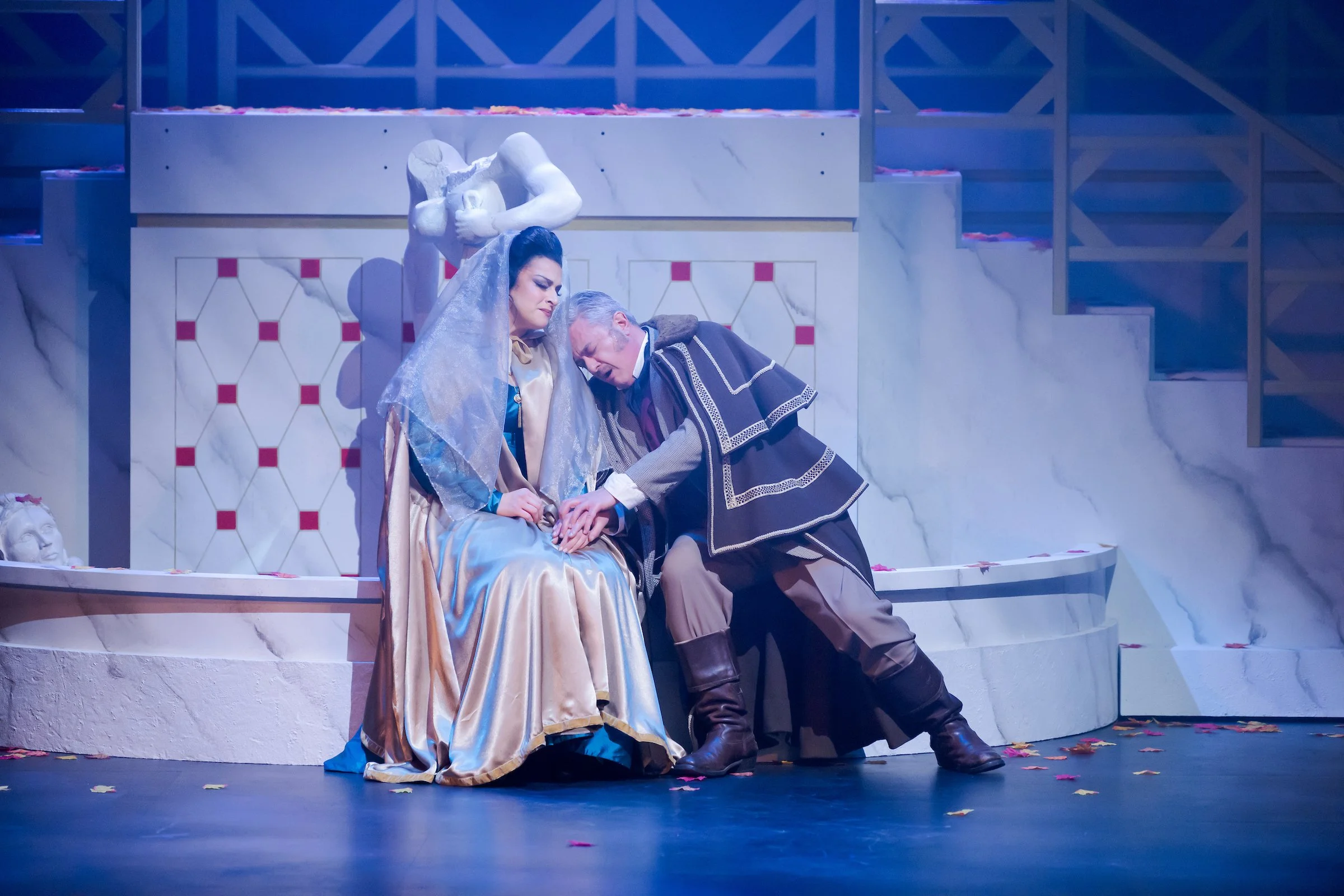
Madeleine Pierard and Jared Holt (King Gustavo)
“…their powerful singing in this tragic love duet is full of affecting, genuine emotion.”
Image credit: Stephen A’Court
Verdi’s accompaniment always leaves space for the voices, and the fine playing of Wellington Orchestra in the pit, under the experienced baton of conductor Brian Castles-Onion, was beautifully sensitive and responsive to the singers throughout the opera.
This central Act is a marvellous display of the emotional variety of Verdi’s art. A rapid edgy trio between the King, the Count and his troubled wife, hiding under a veil, brings a sense of panic and urgency. Torchlit hooded assassins arrive, and Anckarström suddenly understands what is happening. Tragedy turns to comedy with a brilliant laughing male chorus, mocking the Count, while Van Mellaerts finds steely rage and Pierard collapses in piteous remorse.
Act 3 begins with a dramatic showdown between murderous husband and conflicted wife, on the forestage with minimal furniture. Pierard’s touching and passionate aria, Solo un detto ancora a te, in which she begs to live long enough to embrace her son, reveals the glowing loveliness of her voice throughout its range. After she leaves, Anckarström’s anger turns towards the king in the tragic aria, Eri tu che macchiavi quell'anima, Van Mellaerts expressing with powerful emotional singing the Count’s feelings of deep betrayal and loss of joy.
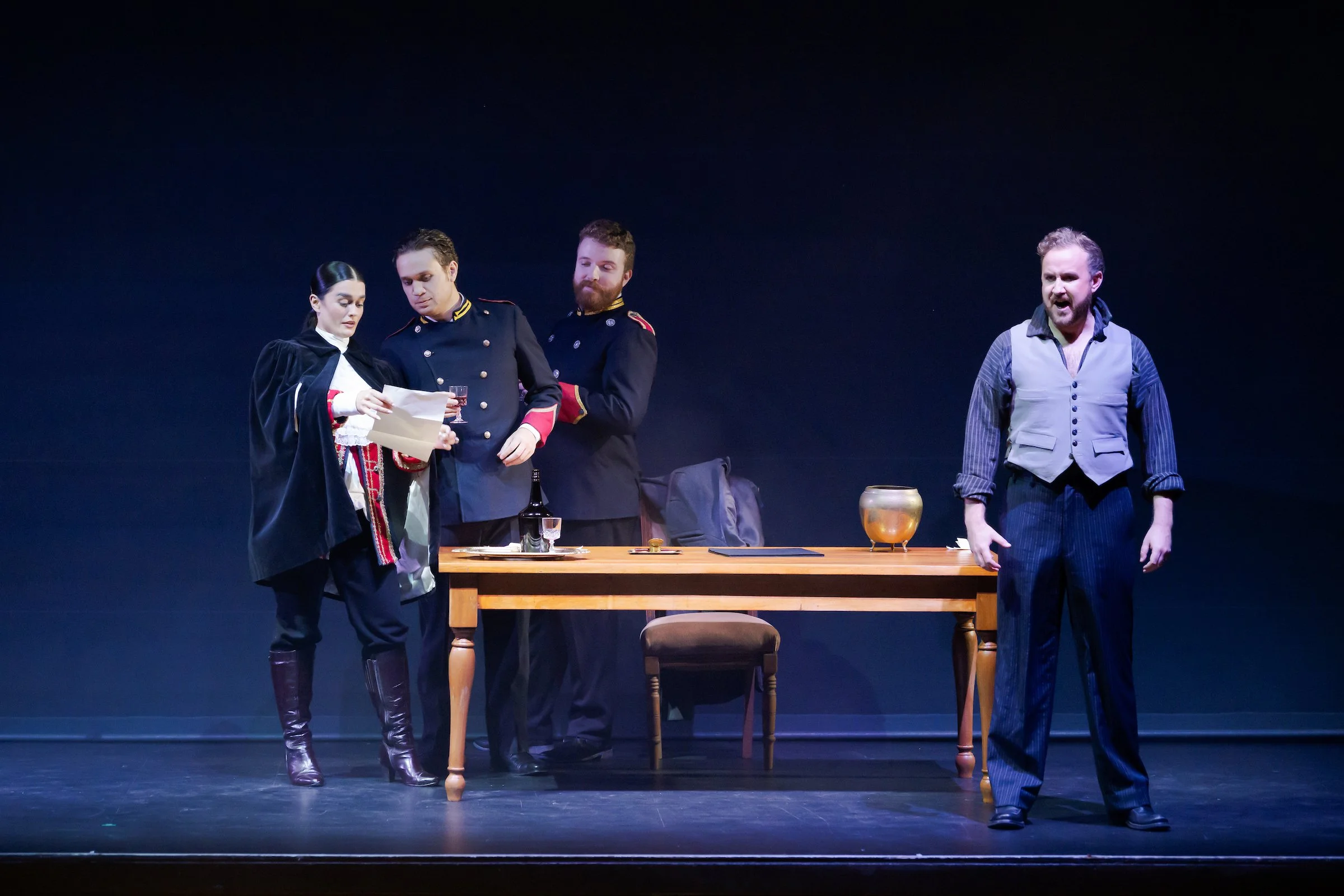
Natasha Te Rupe Wilson (left), baritone Samuel McKeever (Count Ribbing) and bass Morgan-Andrew King (Count Horn) plan the assassination of King Gustavo as Van Mellaerts (the betrayed Anckarström) sings of his rage.
Image credit: Stephen A’Court
A highly theatrical scene follows, setting up the vengeful death. Counts Ribbing and Horn, splendidly sung by baritone Samuel McKeever and bass Morgan-Andrew King, join in a quintet with Pierard, Van Mellaerts and the effervescent Te Rupe Wilson. Amelia is forced to draw lots for the men’s right to deliver the fatal blow, fierce gunshots from the timpani underlining the drama.
And so, finally, to the ball itself. It is, of course, a glittering occasion, the masked chorus in dark reds and black, dancing gracefully to Verdi’s ironically light music and Lucy Marinkovich’s expert choreography. Guests in in dog masks hint at the menace of the hunt. A sotto voce dance theme accompanies the masked King’s arrival, and as they dance together, Amelia, resplendent in pearly grey, attempts to warn him of the revenge plot. Ulrica watches enigmatically from above.
After the Count’s ruthless stabbing of the monarch, the dying King reveals his humanity, declaring Amelia’s innocence, blessing all, forgiving and farewelling his friends and enemies. Holt’s portrayal of Gustavo is masterly, allowing the King both vulnerability and warm authority. Verdi’s characters are authentic, often flawed, but revealing good qualities alongside jealousy or ambition. Musically, the composer treats them with sympathy and nuance and this final scene ends with a rousing outburst of appreciation from the consistently excellent Wellington Opera Chorus, with full orchestra, ending the work on a buoyant note. The audience responded with a whole-hearted ovation.
Wellington Opera raised the curtain on Mozart's Don Giovanni in 2021 as a fledgling company. Since then, it has held its nerve with stretched resources through various disruptions, maintained its industry development strategy to feature New Zealand singers and provide opportunities for them and other creative professionals, and, year by year, developed into today’s high quality presenter of works from the operatic mainstream. On the way, it has earned the loyalty of the Wellington audience and the respect of the local opera scene. Congratulations to Artistic Director Matthew Ross and his team – I’m looking forward to your 2026 programme.
Wellington Opera A Masked Ball by Giuseppe Verdi Madeleine Pierard (Amelia), Jared Holt (Gustavo), Julien Van Mellaerts (Anckarström), Natasha Te Rupe Wilson (Oscar), Ulrica Arvidsson (Ulrica), Brian Castles-Onion (Conductor) Jacqueline Coats (Director), Michael Zaragoza of Risposta (Set Design), Wellington Opera Chorus, Orchestra Wellington. At the Opera House, Wellington, 6-10 August, 2025.