
Mataatua and Beethoven: Opus Orchestra brings powerful musical stories to Waikato and Bay of Plenty
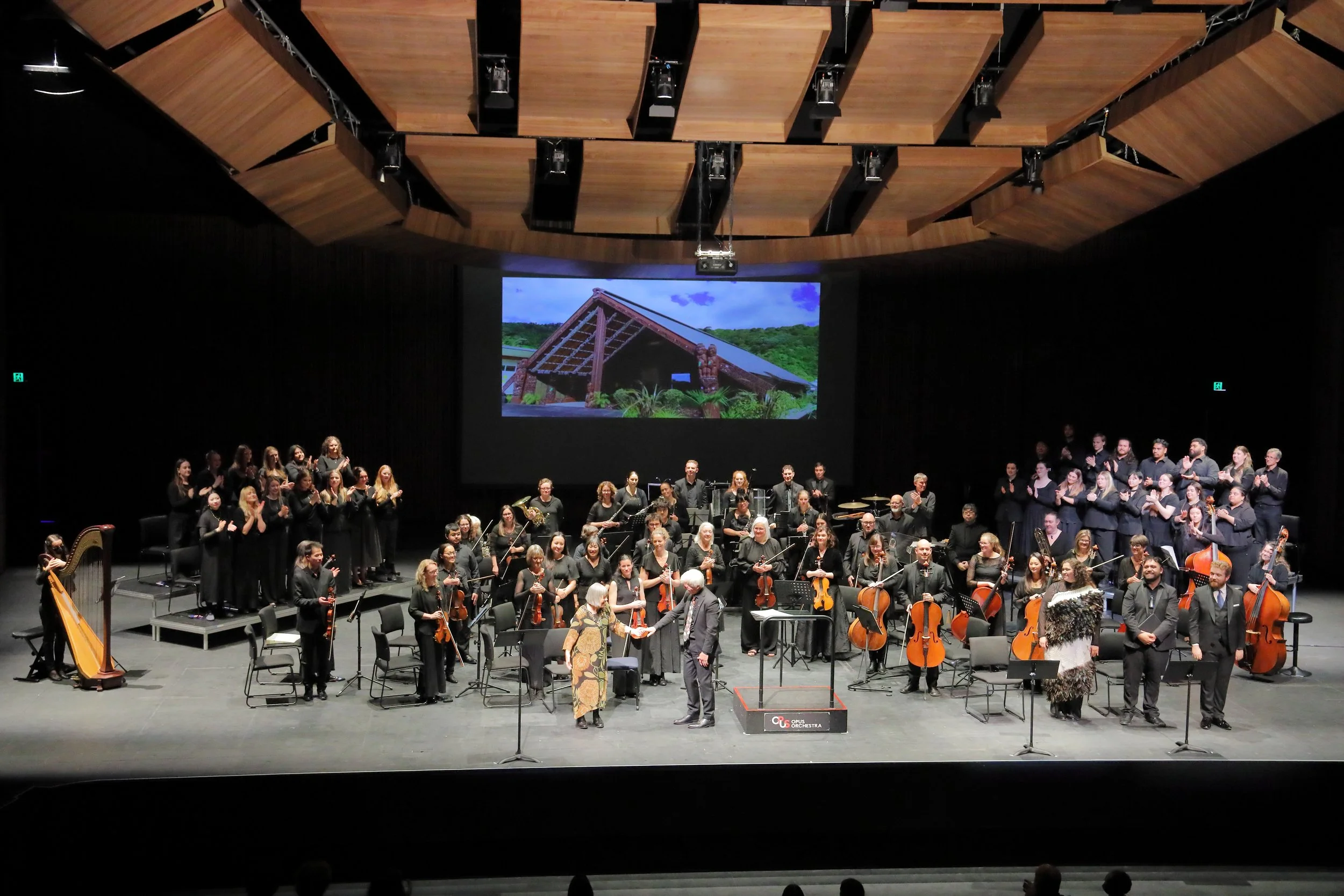
Conductor Peter Walls (right) with composer Dame Gillian Whitehead at the conclusion of her opera The Journey of Mataatua Whare
Photo credit: Richard Lummus
There were many reasons for a great sense of occasion and heightened emotions at the recent concert by Opus Orchestra in Hamilton. It was presented in the splendid new BNZ Theatre, built on the banks of the Waikato River in central Kirikiriroa, Hamilton a decade after the closure of its predecessor, Founders Theatre. A large audience packed the stalls, while others were still queuing at the box office for door sales.
Opus and its conductor Peter Walls took a bold approach to programming the concert, which they had taken to enthusiastic audiences the previous two evenings in Rotorua and Tauranga. Two major compositions, very different in conception but united by their emotional power, had attracted young and older music lovers to all three events.
The programme began with one of Beethoven's most popular piano concertos, his 5th in E flat major, often known by its nickname 'The Emperor', although that was not the composer's choice. He composed the work in 1809, during the besiegement of Vienna by the French. There are stories that during the fierce bombardment Beethoven took shelter in his brother Caspar’s basement with pillows around his ears to preserve what was left of his hearing.
“If we were to hear in the magnificence of this concerto a tribute to the resilience of the human spirit in time of war, it might explain why this piece speaks so strongly to our own age,” wrote Walls in his programme note.
From the arresting opening of the first movement it was a fine performance. Stephen De Pledge, the soloist, is a lovely pianist, his playing strong and musicianly, with rippling runs and relaxed flexibility. His love for the music is always evident in his playing. He and Walls showed great rapport throughout, their conception of Beethoven’s work one of both grandeur and expressivity, with an unfailing sense of the work’s architecture. The string playing, led by concertmaster Lara Hall, was always crisp and incisive, the winds beautifully melodious.
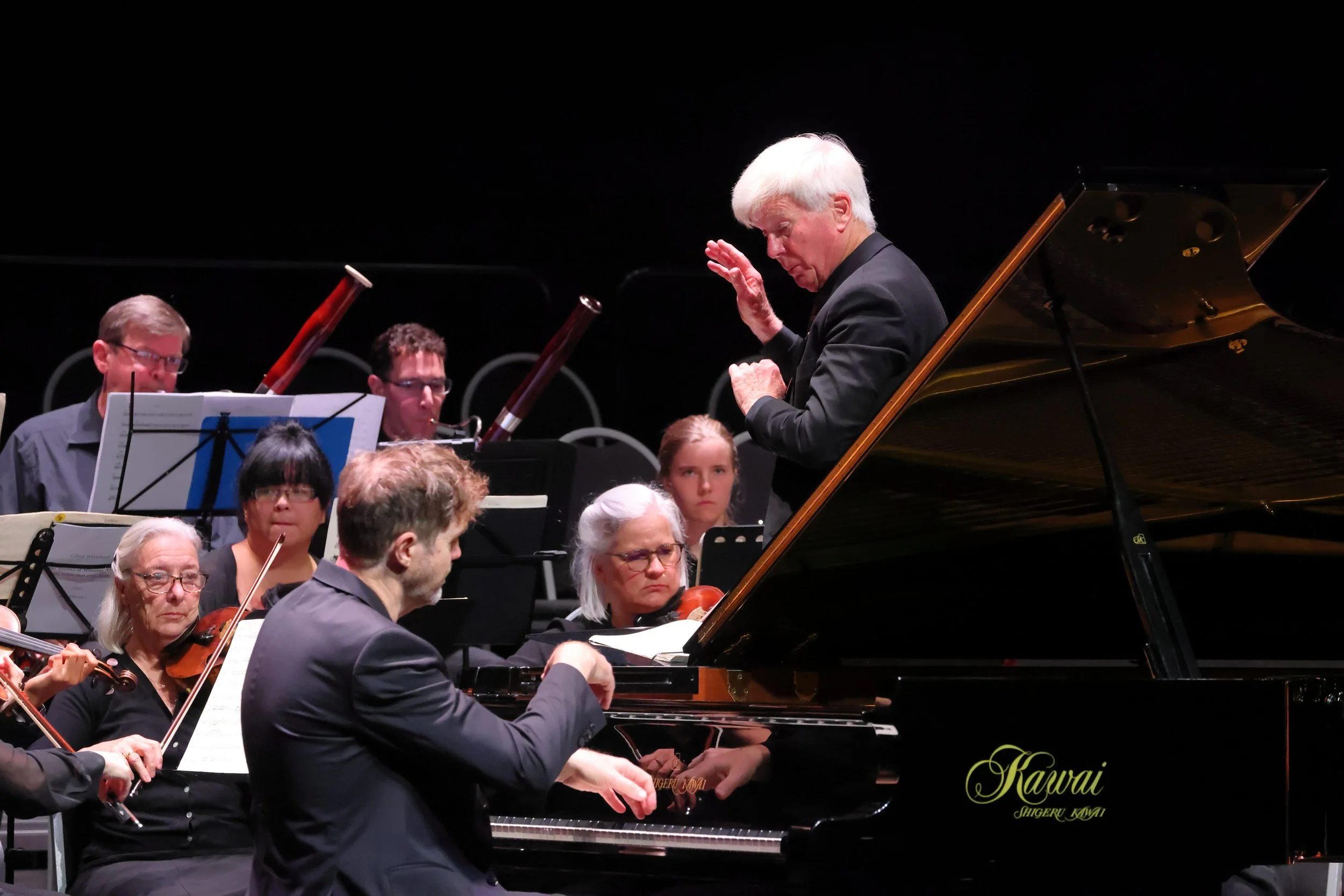
Pianist Stephen De Pledge with conductor Peter Walls and Opus Orchestra
“…a shared conception of the grandeur and expressivity of Beethoven’s 5th Piano Concerto.”
Photo credit: Richard Lummus
The auditorium of the BNZ Theatre was built to be ‘multi-purpose’, but the use of a substantial ‘sound-shell’ with ranks of reflective panels above the stage meant that the acoustics worked very well, at least in the stalls where I was sitting. The piano was set closer to the audience than the string sections, perhaps in preparation for the second work on the programme, which may have been responsible for minor balance issues.
Beethoven’s lovely Adagio 2nd movement opened with beautiful playing from both orchestra and soloist. Walls and De Pledge shared a splendidly romantic conception of the movement, woodwinds picking up the piano’s themes with sensitive expression. Beethoven moves the action without break into the drama and drive of the final Allegro, De Pledge’s playing here wonderfully bouncy, and the whole concerto ending with exuberant energy.
The audience were delighted with both the concerto performance and De Pledge’s encore, Bach’s famous 1st Prelude in C major.
The second half of the programme was a major New Zealand work from composer Dame Gillian Whitehead. Billed as an unstaged opera, The Journey of Mataatua Whare was developed by the composer in close collaboration with Ngāti Awa and violinist Tessa Petersen. The latter discovered the story of the Mataatua whare and took it to Whitehead, suggesting it could be told in music. Last year the work was performed for the first time for Ngāti Awa in the Mataatua wharenui itself in Whakatane by Opus Orchestra, with an official premiere in Ōtepoti Dunedin in June by the Dunedin Symphony Orchestra, of which Petersen is concertmaster.
Now Opus Orchestra has again brought this musical representation of the Mataatua story close to its home, with public performances this month in Rotorua, Tauranga and Hamilton. It is a profound work, weaving together major themes of Aotearoa New Zealand, the importance of place and ancestry, the destructive impact of colonisation and centuries-old cultural misunderstandings, the ongoing significance of our history and the need for Pākehā to understand and acknowledge both that history and powerful concepts from te ao Māori.
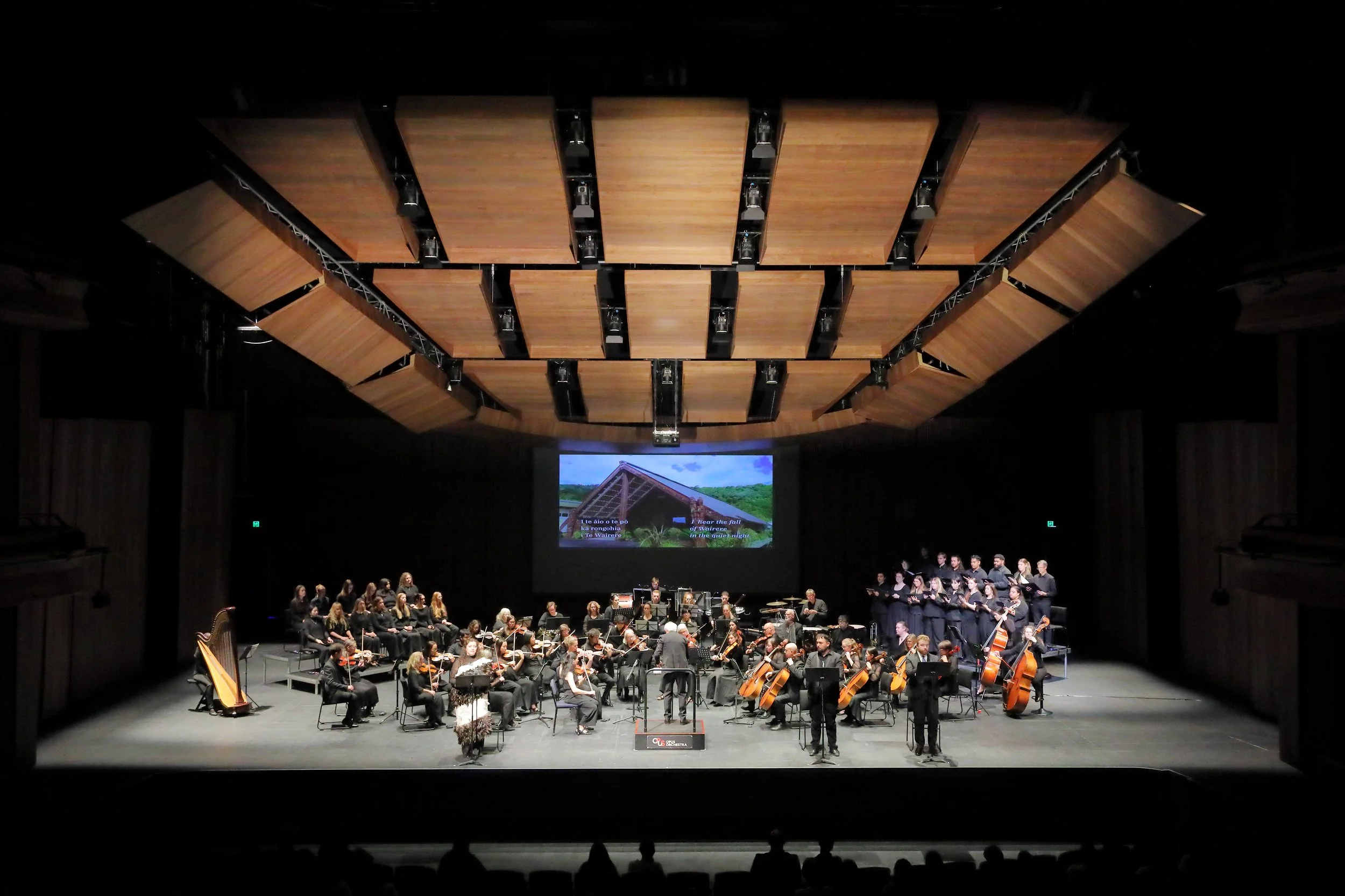
The combined forces for the concert opera The Journey of Mataatua Whare on stage at the BNZ Theatre in Kirikiroa Hamilton
Photo credit: Richard Lummus
The performance begins with a karanga, the fine mixed choir of young singers from the University of Waikato seated behind the large orchestral forces on the stage, with two male soloists, baritone Tomairangi Henare and bass Samuel McKeever, standing in front. Behind the assembled musicians, a big screen provides surtitles, translations and images illustrating the story.
The music begins with sustained low strings, tapped stones from the percussion, the choir, chant-like, singing in te reo Māori. On screen is an image of Pūtauaki (sometimes called Mount Edgecombe), the ancestral maunga (mountain) of Ngāti Awa.
Part 1 of the story begins in Whakatane in 1871. After the peaceful birdsong of woodwinds and horns, martial trumpets and drums take over, depicting the “thousand white men” who marched on Bay of Plenty, razed crops, stole treasures and damaged the population with both war and disease.
McKeever’s fine, resonant bass voice and authoritative demeanour represent implacable colonial forces, accompanied by shrill woodwinds, while Henare’s lovely, grief-laden baritone sings for local Māori, deploring “wanton anger, wanton death”. The choir, in te reo, sings of sorrow and anguish - “what will become of us?” – their sadness echoed poignantly in a long, expressive cello solo beautifully played by Callum Hall.
And so the story is told, Whitehead weaving together words and music, te reo and English, soloists, choir and orchestral music, birdsong and waiata. After the war-torn times, Ngāti Awa plans to build a wonderful carved wharenui, Mataatua, that will reunite the iwi divided by war, restore mana and allow hope to return.
A marvellously effective aspect of the work’s creation is the inspired artistic and theatrical decision to personify the house, the wharenui, a role sung with deeply moving beauty by soprano Katherine Winitana. As building plans begin, she takes the stage, wearing a splendid cloak, as the voice and presence of Mataatua whare.
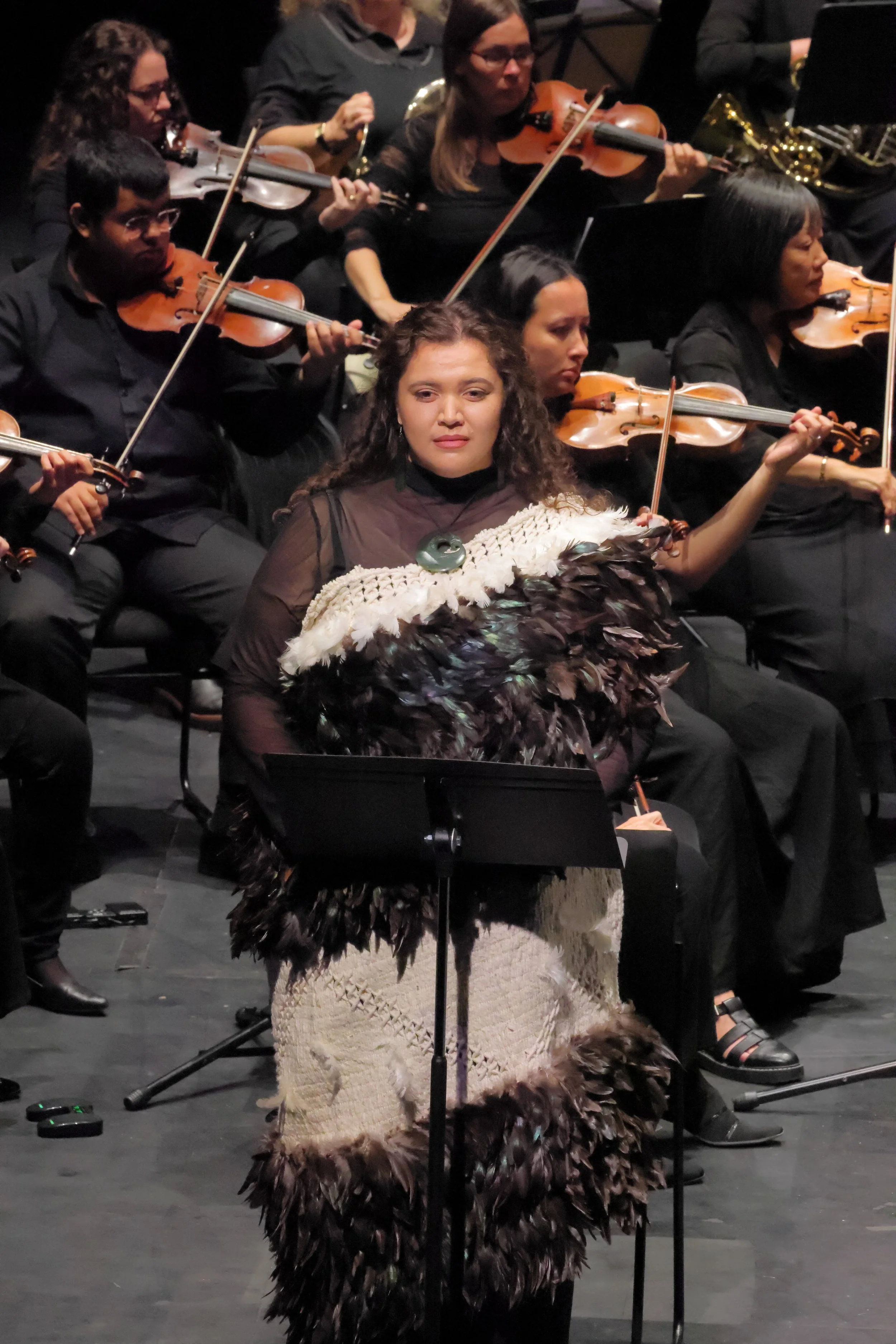
Soprano Katherine Winitana
“…the voice and presence of Mataatua whare, the role sung with deeply moving beauty.”
Photo credit: Richard Lummus
Just a few years later, while Mataatua is beginning to fulfil its restorative purpose, foreboding orchestral music hints at imminent disaster. Accompanied by martial brass and drum, McKeever, representing the colonial government, brings “salutations”, and announces that the government wants to “borrow” the carved meeting house for display at a British Empire exhibition in Sydney. “Do you consent?” “No!” sings the choir, “we will not sell or lend Mataatua. This is our turangawaewae!”
Sadly, the government prevails, “just for six months”. Accompanied by the keening voices of the grieving choir, the wharenui is dismantled, the sacred ridge pole cut in three to fit into a steamship, and the house transported to Tauranga, and thence from Wellington to Sydney. An image of an empty ocean on screen and plaintive woodwind illustrate the journey.
It is many decades before the house returns to Aotearoa. From Sydney it is taken, in pieces, to another exhibition in Melbourne. Whitehead uses brassy fanfares and a chillingly sprightly Victorian march in contrast to Henare’s touching wordless lament, accompanied by solo violin. Parts of the house, its woven and carved panels, are displayed separately, and then, apparently without the iwi's permission, the whole wharenui, in pieces, is taken to London, set up for a short time on display and then dismantled and stored in a basement.
Expressive glissandi illustrate the sadness of the house, alone in basement storage. Winitana as Mataatua sings with such grief in her voice, in darkness, in pieces. The audience holds its breath in horror, as 40 years pass in this underworld. Low strings, high wailing violins, wooden percussion…"this is death!" sings Winitana, as string instruments slide in grief.
In 1923 the pieces of the wharenui are discovered in the basement of the Victoria & Albert Museum in London. The two male singers change character, donning workers' caps. They seem to understand that the parts of the house "must go home". In 1925 the wharenui is sent back to New Zealand, but not to Ngāti Awa; it goes instead to Dunedin for the South Seas Exhibition. The choir wave little New Zealand flags, while the orchestra, band-like, plays another brisk and ironic British march.
In a patriotic song, colonial ignorance of te ao Māori is on full display. After the exhibition, the whare is cleaned up and ‘given’ to Otago Museum. Kai Tahu cares for the house, seeing it as a taoka, for which they have aroha, but they also acknowledge that it belongs to Ngāti Awa. The issue goes to the Waitangi Tribunal, which rules on a dispute between Ngāti Awa and the Crown, the former believing the wharenui should return to stand on its turangawaewae, and be cared for by its own iwi. Otago Museum claims title, because they have cared for it, and it has been an attraction for the people of Dunedin for 60 years.
Whitehead wrote her own libretto for The Journey of Mataatua Whare, (as she did for her opera Mate Ururoa, premiered last year), brilliantly expressing the essentials of the story in economical language, and using her own marvellously crafted musical language for much of the narrative. Shapely melodic lines for singers and orchestra and colourful, descriptive instrumentation contrast with martial sounding brass and percussion, which represent colonial forces and Pākehā decisions. There are many historical, emotional, and musical threads to hold together, and conductor Walls did a marvellous job of guiding and integrating his disparate musical forces.
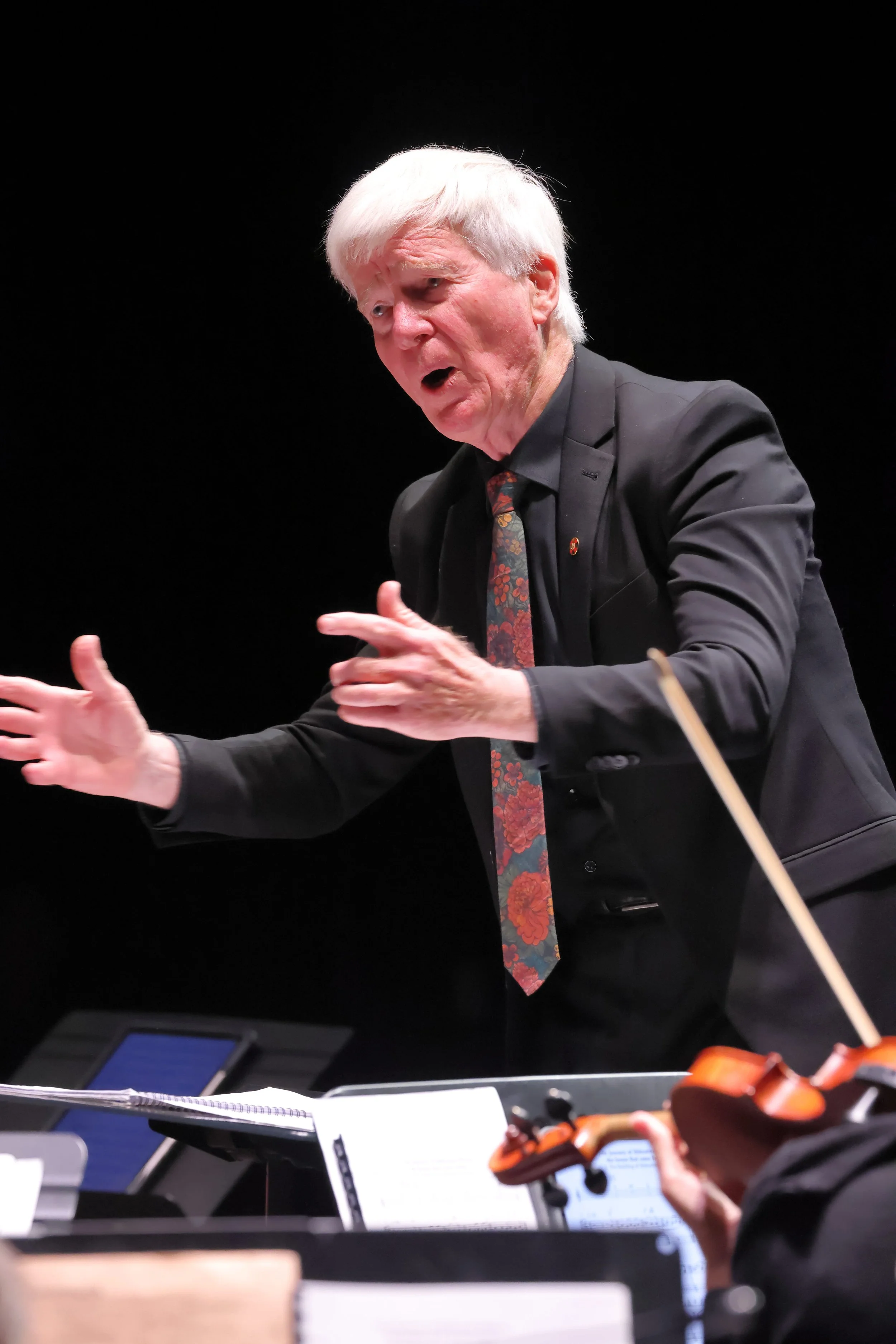
Conductor Peter Walls
“…guiding and integrating his disparate musical forces.”
Photo credit: Richard Lummus
The final chapter of the painful story of Mataatua brings us an optimistic ending. In 1996 a decision was made to return the wharenui to its iwi. “It has always belonged to Ngāti Awa,” the singers tell us, “generations of Ngāti Awa have lost connection with their tipuna.” A beautiful cello solo expresses the deep feelings around the decision.
In the last scene, in 2011, the house is restored and back on its turangawaewae in Whakatane. It is pictured on screen, and stones are tapped quietly within the musical texture as they were at the beginning of the opera. “Back with the iwi that dreamt me, built me, waited for me”, sings Winiata with the choir. There is birdsong again in the music, the choir chants, while on screen members of Ngāti Awa sing a joyous, celebratory waiata.
Then choir, soloists and orchestra all join the singing and the beautiful arch-shape of the opera is movingly completed. Audience members stand, many with tears in their eyes, and an extended ovation acknowledges musicians, soloists, conductor, choral directors and the composer herself.
Opus Orchestra “Mataatua and Beethoven” Beethoven’s Piano Concerto No. 5 and Dame Gillian Whitehead’s The Journey of Mataatua Whare
Peter Walls (conductor) Stephen De Pledge (piano) Katherine Winitana (soprano), Tomairangi Henare (baritone), Samuel McKeever (bass), University of Waikato Singers. BNZ Theatre, Kirikiroa/Hamilton May 17, 2026
You can read a Five Lines review of Dame Gillian Whitehead’s opera Mate Ururoa here and a Five Lines profile of the composer surveying her operatic compositions here.