
Violinist James Ehnes: serendipity, special friends and a Strad
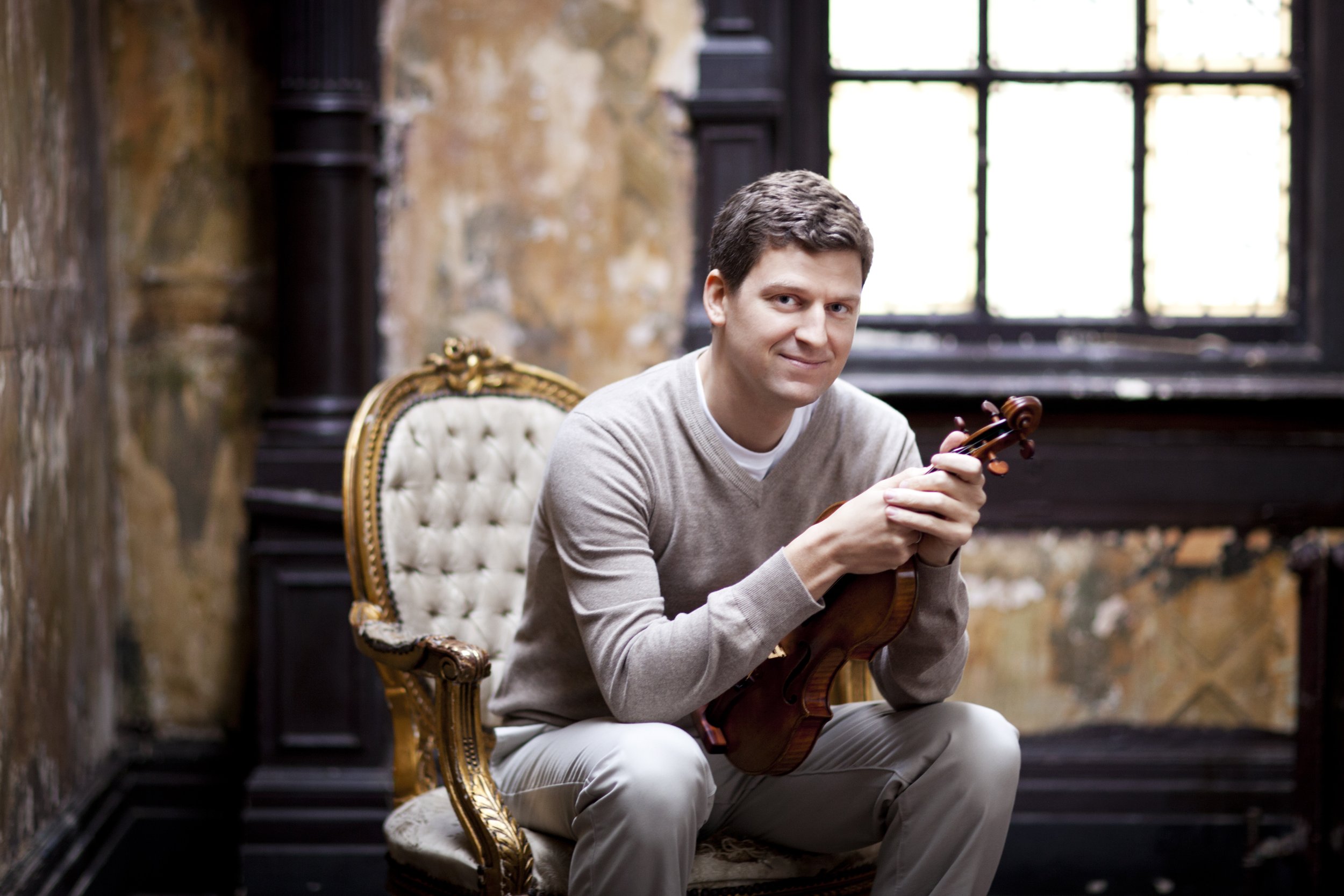
Violinist James Ehnes
Photo supplied
James Ehnes describes his early determination to play the violin as “a family mystery”. He remembers seeing Itzhak Perlman playing on Sesame Street “and thinking he was a pretty great guy” and he began asking for a violin when he was four. The pre-schooler had two sticks he played with. “One was my violin and one was my bow”, he says, laughing. “I eventually got a violin for Christmas that year and violin lessons for my 5th birthday about a month later.”
Ehnes is treating his 50th birthday this year as “an excuse to have a lot of fun.” When he talks to Five Lines from Florida, his current home, he’s about to pack up his family and embark on a 50th Birthday Canadian recital tour of smaller centres. He grew up on the Canadian prairies in Brandon, Manitoba and wants to give back to the country that gave him so much musically.
Straight after the Canadian tour, Ehnes and his family are heading to New Zealand for a stay of almost four weeks. He describes this country as “special” to him. He has forged close relationships with musicians and audiences in Aotearoa since his first concerto performance with the Auckland Philharmonia in 2008. On this visit he’ll play with the Philharmonia for the sixth time and make his debut with the New Zealand Symphony Orchestra in concerts in Wellington and Christchurch. He’ll then join the panel of judges for the Michael Hill International Violin Competition, his fourth time in that role.
Ehnes came from a performing arts family, his father a trumpet player and professor at Brandon University, his mother a professional ballerina. Winters in Manitoba are long and cold, and he remembers as a small child being perched on the top of a radiator beside the stereo speaker and listening to music. “It was a good way to keep me out of trouble,” he says, smiling.
Growing up in Brandon, Ehnes was guided and encouraged by three people at the University there. “One was my dad. The others were Francis Chaplin, my violin teacher, and my piano coach and teacher Donald Henry. They were my big musical influences.”
The talented Ehnes was also sent by his mentors to the intensive summer programme in strings at Meadowmount, in the heart of the Adirondacks in upstate New York, where he met his teacher, Sally Thomas. “I worked with her for four summers at Meadowmount and then continued with her for four more years at Juilliard, and remained close to her until the end of her very long life in 2024.”

Violinist James Ehnes
“…a starry and award-studded international career.”
Photo credit: Ben Ealovega
The strong musical foundations of his youth have led to a starry and busy international career, studded with many awards including two Grammys, two Gramophone Classical Music Awards and 11 Canadian Junos. Ehnes has performed as a soloist with all the major orchestras in North America and a large number of top-level European orchestras, as well as his regular visits to New Zealand and Australia. He also plays chamber music, as leader of the Ehnes Quartet, and has been artistic director for a dozen years of the Seattle Chamber Music Society, which presents annual summer and winter festivals.
When I ask about turning points in his musical life, he smiles. “The most significant things in my life were not necessarily the obvious ones like my Carnegie Hall debut or my first recording.” An early serendipitous meeting was with Walter Homburger, a great Canadian impresario, who managed the Toronto Symphony Orchestra for 25 years and famously discovered and became career-long agent for the young Glenn Gould.
“I won a competition that had nothing to do with him,” Ehnes explains, “except that his wife was chair of the board. So, when I came back to play a year later, I met him and he took me under his wing. When Walter, who had found Gould as a teenager, started calling people saying ‘I’ve found this teenage violinist’, they listened. It was amazing having someone of that reputation and character speaking for me. And he taught me how to navigate the business in a dignified and honourable way.”
Early in his career, Ehnes began playing his violin, the ‘Marsick’ Stradivari of 1715, through another unexpected connection. “I tell this story to students to remind them that ‘you never know’. In a chamber music festival I played a very obscure piece by American composer Henry Cowell, a work I never expected to play again, but I did my best. Through a strange turn of events, David Fulton, a great music-lover and arts philanthropist, heard a recording of that performance. He was then the most important violin collector in the world. He reached out to me, we met and became good friends. He recognised that I needed a great instrument to realise my potential, so he bought this Stradivarius, loaned it to me for many years and then made it possible for me to acquire it from him.”
Ehnes’ violin was created in Stradivari’s ‘golden period’, when the master was at the height of his powers. What’s special about it? “It has the potential to be anything you can imagine,” Ehnes says. “People who hear me play a Shostakovich or Bartók concerto will say ‘it’s really ideal for this music because it’s broad and gruff and full of earthy tones and colours’. Then someone else will hear me play a Mozart concerto and say ‘it’s a good Mozart violin, it’s pure and silky and soprano’. In fact it can be all of these things. And to have decades to get to know a really great violin, to understand its intricacies, is a privilege few people have and I don’t take it lightly.”
Audiences in Auckland will hear the Strad’s ‘Mozart’ voice when Ehnes plays the composer’s Violin Concerto No 4 in D major with the Auckland Philharmonia next week. He describes the concerto as “spectacularly beautiful”, especially the central Andante Cantabile movement. “I love the whole piece,” he says. “The 3rd movement is a quirky rondo with fun little episodes and an unusual drone effect, the 1st is rollicking and fun, but the slow movement is the heart of the work.” Mozart wrote his violin concertos aged just 19. “It’s legitimate,” Ehnes suggests, “to say that the 3rd, 4th and 5th concertos were the first real masterpieces of Mozart’s maturity.
For his NZSO debut this month, Ehnes will play a work he first learned as a teenager, Erich Korngold’s Violin Concerto, a lyrical composition that has become one of the Austrian composer’s most-performed works. Ehnes, who has played the concerto often and recorded it with the Vancouver Symphony Orchestra, is excited by the renaissance of Korngold’s music over recent decades. “It’s a fabulous piece, immediately appealing, and the melodies are so rich.” Korngold, who had great success as a composer of lush, romantic film scores, borrowed melodies from several of his film works for the concerto. Ehnes describes him as a genius. “It almost gets lost how well-written the Concerto is and how hard it is to create a work of concert music with such perfect proportions from re-cycled material.”
The concert, which opens with music by the remarkable contemporary British composer Thomas Adès, and ends with Symphony No 1, Titan, by Mahler, one of Korngold’s mentors, will be conducted by the NZSO’s Artistic Adviser and Principal Conductor Gemma New.
“Gemma’s a good friend,” says Ehnes. “We’ve played together for many years. When we met, she had just come to Canada to be Music Director of the Hamilton Philharmonic, so we met on my home turf - and now I get to be with her on her home turf.”
After his concerto performances, Ehnes will join the Michael Hill Competition panel. I asked him about the value of such competitions for young musicians. “Competitions are a way to be heard, a way to be noticed,” he says. “And for young people, it’s something to work towards, which you need when you’re just getting started in your career.”
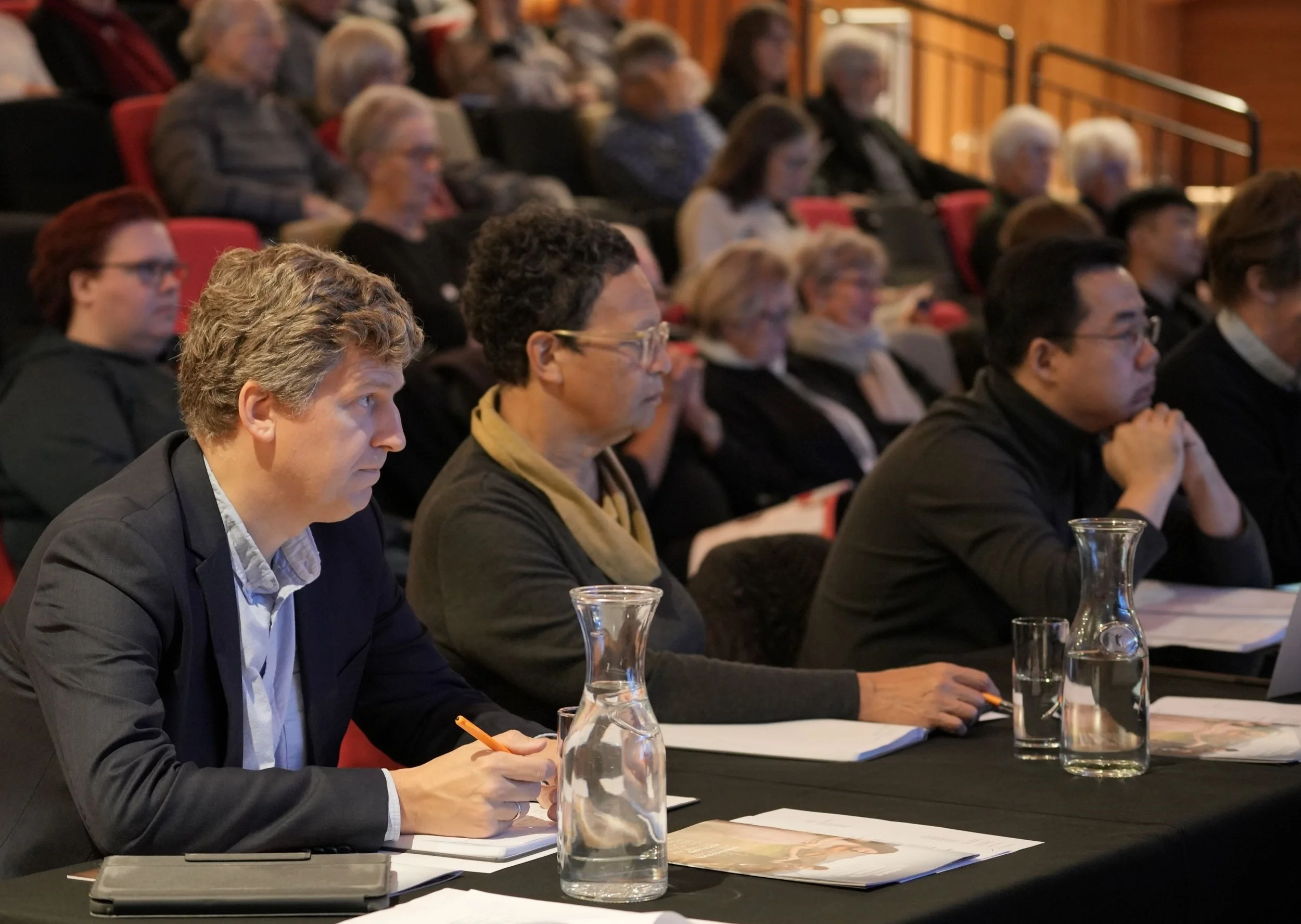
James Ehnes (left) judging the Grand Finale of the 2023 Michael Hill International Violin Concerto in the Auckland Town Hall with fellow judges Wilma Smith and Ning Feng
“Competitions are a way to be heard, a way to be noticed.”
Photo credit: James Roberts
Competitions can also be negative for those who don’t make the cut. “They can be rough and brutal,” Ehnes agrees, “but the thing I love about the Michael Hill is that it’s a violin festival masquerading as a competition, and that’s kept me involved. At all competitions that have live rounds involving travel to get there, they say ‘you’re all winners just being here.’ But I’ve always felt that at the Michael Hill Competition it actually means something, each of the competitors is celebrated for what they have to offer. No-one can come out of that Competition and say ‘I didn’t have a chance to show myself.’ They each play a lot, the equivalent of a full recital with all sorts of variety. And even for those who don’t advance to the final rounds, they make professional connections that often lead to important things and they have extraordinary experiences. The support network of the Michael Hill extends beyond the winner – there’s a sense of family.”
Auckland Philharmonia ‘Ehnes plays Mozart’ with Samy Rachid (conductor), James Ehnes (violin) Mozart Symphony No. 35 ‘Haffner’, Mozart Violin Concerto No. 4, Chausson Symphony in B flat Auckland 14 May, 2026. Information and tickets here
NZSO ‘TITAN’ with Gemma New (conductor), James Ehnes (violin), Thomas Adès The Origin of the Harp, Korngold Violin Concerto, Mahler Symphony No. 1 ‘Titan’
Wellington 22 May, Christchurch 24 May 2026. Information and tickets here
Michael Hill International Violin Competition Quarter-finals, Semi-finals and Grand Finale with the Auckland Philharmonia
Queenstown and Auckland 29 May to 6 June, 2026. Schedule and bookings here