
Karen Grylls: celebrated musical storyteller steps off the podium
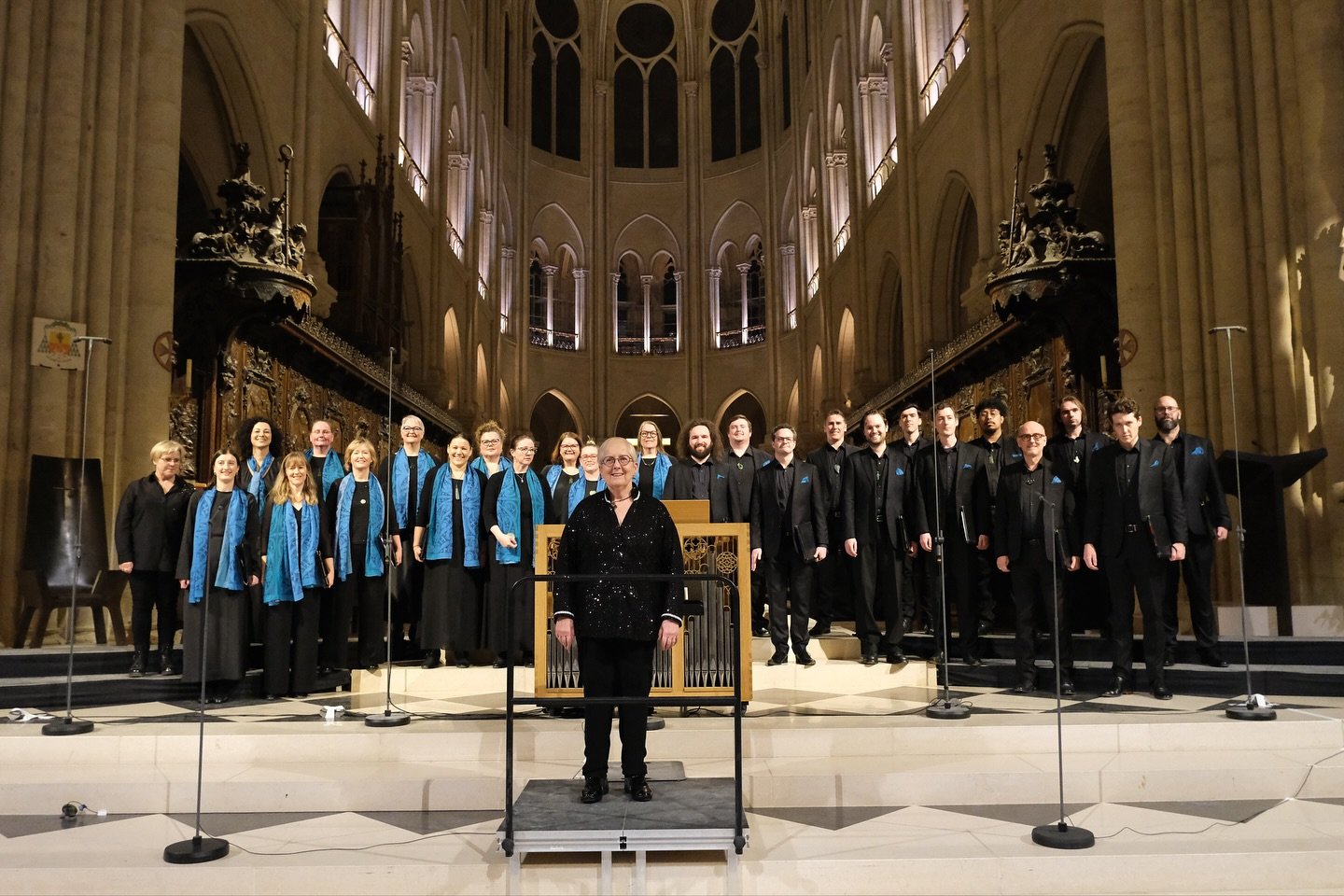
Dr Karen Grylls with Voices New Zealand in Notre Dame de Paris in November 2025
Photo supplied
When I ask Dr Karen Grylls about influential people in her life, she talks about her piano teacher, May O'Byrne, who later became May Jones. "May came into my lesson one day," Grylls tells me, "and said 'dear, I think you should conduct.' I thought 'is that your way of saying I'm a really terrible pianist?'"
In 1970's New Zealand, almost no-one considered conducting as a career, certainly not choral conducting, and especially not if you were female. Jones was convinced she was right about her pupil’s future, however, telling Grylls' mother "I know she's going to do it; I just want tickets to her first concert."
Everyone wants tickets to what may be one of Grylls' last concerts this week, as she steps down from the podium as Music Director of Voices New Zealand, the ensemble she founded almost three decades ago. The concert Ara Hura – A Visionary Journey in the Aotearoa NZ Festival of the Arts celebrates the legacy of the woman now described as Aotearoa’s most influential choral conductor.
The early years of Grylls' life did not point to her later career of national and international acclaim. "Very, very small-town New Zealand, no choirs, no orchestras, no music in schools," she remembers. Born in Pahiatua, first year of school at Eketāhuna, then Clive Primary School, Napier Girls' High, Westland Girls' High in Hokitika and the small town of Nightcaps in Southland, from where she went to Central Southland College. "Dad was a postmaster," she explains, "and in those days you shifted around if you wanted to make progress."
She was also hampered in her early years by a major visual impairment that was not picked up. "I never saw much more than a few inches past my face, never saw a leaf on a tree till I was six," she says. "But I was listening; hearing was the sense that got me through life, and my serious short sight also helped me to be curious."
In the fifth form Grylls was warned against going to university because of her visual challenges, but luckily that advice was ignored and she arrived at the University of Otago in Dunedin aged 17, the year the university was celebrating its 100th anniversary. "I thought I'd died and gone to heaven," she remembers. "Suddenly, there was a symphony orchestra, which I'd never heard before."
One of her first encounters was with the Professor of Music, English musicologist Sir Peter Platt. "I walked into Marama Hall, and there he was with his sleeves rolled up and his socks off sitting on the stage playing a sitar", she laughs. In spite of her skimpy background training in music thus far, he recognised her potential and curiosity and took action.
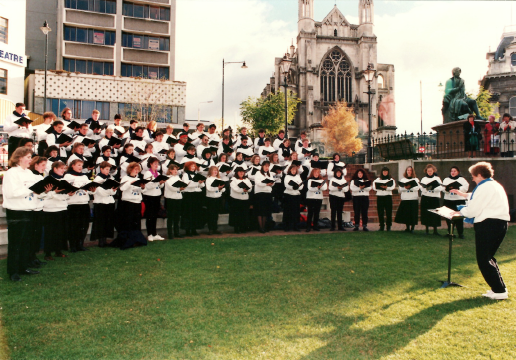
Karen Grylls back in Dunedin
…conducting the National Youth Choir in a lunchtime sing in the Octagon in May 1991.
Photo supplied
"I had so many red marks on my chorale for harmony, so many mistakes, that he sent me off to adult education for extra work so I could catch up,” she says, ruefully. “Going from 'failing' to getting an "A" didn't take long. I just didn't know things."
After graduating with an Honours degree in music, she remained in the south, teaching music and French at Southland Girls College and continuing piano lessons with May Jones. After two years, Jones told her "I can't teach you any more; you have to go to Auckland," and she embarked on a Masters Degree in the city that has been her New Zealand base ever since.
"It was all a hustle up here," she says now. Choral conductor Peter Godfrey was important on the scene and at the University of Auckland, where he became Professor of Music in 1974. "I said 'who's he?', Grylls remembers. "I wasn't Anglican, it was another world. But it didn't take long before I was booted in through the door and Peter gave me stuff to conduct. I joined the University Choir, and auditioned for the Dorian Choir, but he didn't take me because he said I sang sharp." She laughs. "My grandmother was a singer, but I'd never had any lessons. I could tell you how to fix that now."
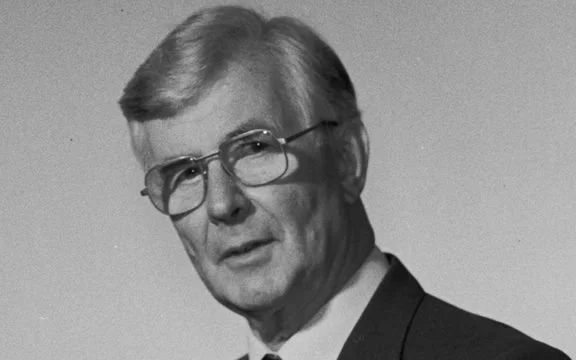
Choral conductor Peter Godfrey
“…big boots to fill” when Grylls took over the Dorian Choir.
Photo credit: Jay Berryman
With a junior lectureship at the University she was able to "pay back" a teaching studentship she'd needed for her university studies in Dunedin. [Being bonded by a studentship in New Zealand during the 1970s was common for trainee teachers, a free university education in exchange for compulsory service in state education.] Godfrey encouraged her to go overseas for study. "I'd never been overseas and I was nearly 30. My bond was paid back and so I was off. I suppose it was always in me; I didn't like sitting in a lonely piano room, I much preferred making music with somebody."
Where to study choral conducting overseas was the next issue for Grylls. Having discovered she liked university teaching, she was advised she’d need a PhD. “England wasn’t an option,” she believed. “I wasn’t male, I wasn’t Anglican and I didn’t play the organ. If I had that time over again, I’d explore Scandinavia. But I didn’t know about it soon enough.” In the end, she was attracted by the United States. “At that time, and probably still today, it had excellent pedagogy.”
Grylls was accepted at the University of Southern California, where now-legendary choral conductor Rodney Eichenburger was teaching, but couldn’t afford to take up the place. Instead, she went to the University of Washington in Seattle, where she was able to work on her doctorate while also studying choral conducting. “I was working 26 out of 24 hours a day so I could do both. The choral director there, [Israeli-born] Abraham Kaplan, was a mate of Leonard Bernstein. They’d been together in New York doing the premiere recordings of Bernstein’s Chichester Psalms and Kaddish and so on. The university programme was ‘this or that’ but it was Kaplan I was interested in. He was a real artist.”
Grylls was studying choral conducting, which included some orchestral conducting and voice studies, but wasn’t intending to finish that degree. Her objective was the Seattle PhD, with her eye on a future role back at the University of Auckland. Her doctoral topic was, of course, related to choral music, The aggregate re-ordered: a paradigm for Stravinsky's Requiem Canticles.
“It took many years before there was a position in Auckland, so after four years in Seattle, ’81 till ’85, I returned to Auckland for nearly nine years of contract work at the University,” she tells me. When an academic role eventually came up at the University of Auckland, she was very glad she had that PhD. “It was a competitive piece of paper, and I was lucky enough and got the job.”
Meanwhile, her reputation as a choral conductor was developing in New Zealand and overseas. When Eichenberger was brought to New Zealand by the new Choral Federation of New Zealand, he gave her good advice. “Karen,” he said, “the grass is always greener on the other side, but if you’re smart, you’ll work here and make sure you travel and keep up with what’s going on elsewhere.” Grylls heard him. “That,” she tells me, “is exactly how my life has been.”
Shortly after her return from the States, Grylls took over the Auckland Dorian Choir, when Peter Godfrey moved south. “His were big boots to fill, and I had a lot to learn,” she says. But people were watching her thoughtful and skilled work on the podium, and she was appointed to conduct the National Youth Choir (NYC) in 1989, a group of outstanding young singers making an impact in New Zealand and overseas for the quality of their work.
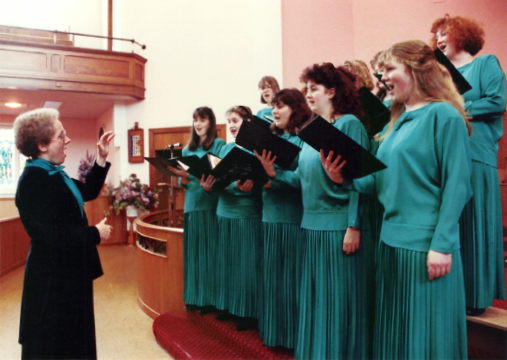
Grylls working with the soprano and alto sections of the National Youth Choir in First Church in Invercargill in 1991.
“…demanding high standards from her singers.”
Photo supplied
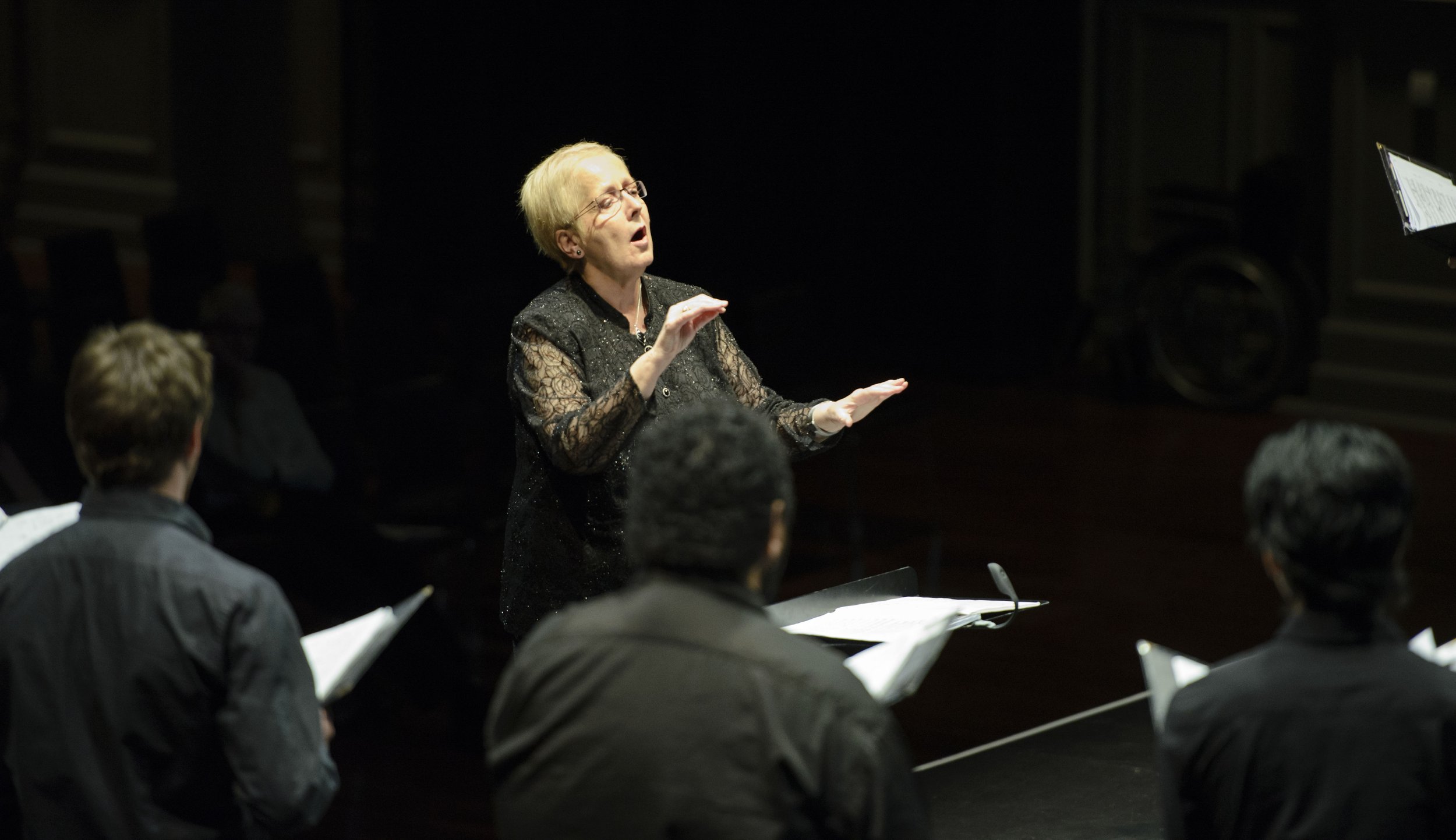
She soon developed a reputation for requiring high standards from her singers. What is it she demands of them? “I have a vision of what I want the piece to be, and I know that they can do it, so I’m giving them the tools,” she explains. “To be fair, I know a lot more now than I did when I started, and can probably get there faster. I’m demanding about the text, mostly, and also the basic sound world of the instrument, the voice itself. Our sound is vowels; if you get the vowels right, you’re 90% on the way to getting the intonation right, and then you get blend and integration.”
Karen Grylls with choral singers
“…if you get the vowels right, you’re 90% on the way to getting the intonation right, and then you get blend and integration.”
Photo credit: Pieter du Plessis
She remembers a moment with the Youth Choir in the early 1990’s when a young tenor put up his hand. “It was a Mendelssohn piece, we were working with the sound and it was kind of stuck. He said ‘look, we really want to do it, but we’re not quite sure what you want!’” The penny dropped for Grylls. “I thought ‘I know what it is, they don’t know, because it’s not in their body’– so we began to move, to dance. I am demanding, but people choose to come to choir. If they’re not prepared, I’ll be a bit fussy about that, and I care about how we start something and communicate the word and the story, and therefore the emotions. We always look for that last little bit – ‘have you got 5% more, we’re nearly there’ – out of respect for the story and the language and what the composer’s written. That’s what fires me – if I’m demanding, that’s why.”
In 1998 a group of altos from the Youth Choir came to Grylls, concerned that after their years with the NYC there was no national choir of equivalent standard for alumni to move on to. They wanted national representation of the outstanding choral music they’d enjoyed under her leadership. Grylls went to Jacqui Simpson, then manager of the NYC and announced that they were starting Voices New Zealand. “We just started. We didn’t have a budget or anything.”
Voices NZ Chamber Choir made its debut in the 1998 NZ Festival of the Arts. Later that year it won the first of many international prizes in Spain at the Tolosa International Choral Competition. In the almost three decades since its inception, it has become, under Grylls leadership, New Zealand’s premier national and professional choir, regularly performing at arts festivals and with this country’s major orchestras, performing and competing international, and participating in special projects with new music and innovative presentation approaches. The list of acclaimed performances by this outstanding choral ensemble is a long one and their repertoire stretches from Renaissance and Baroque music to the present day.
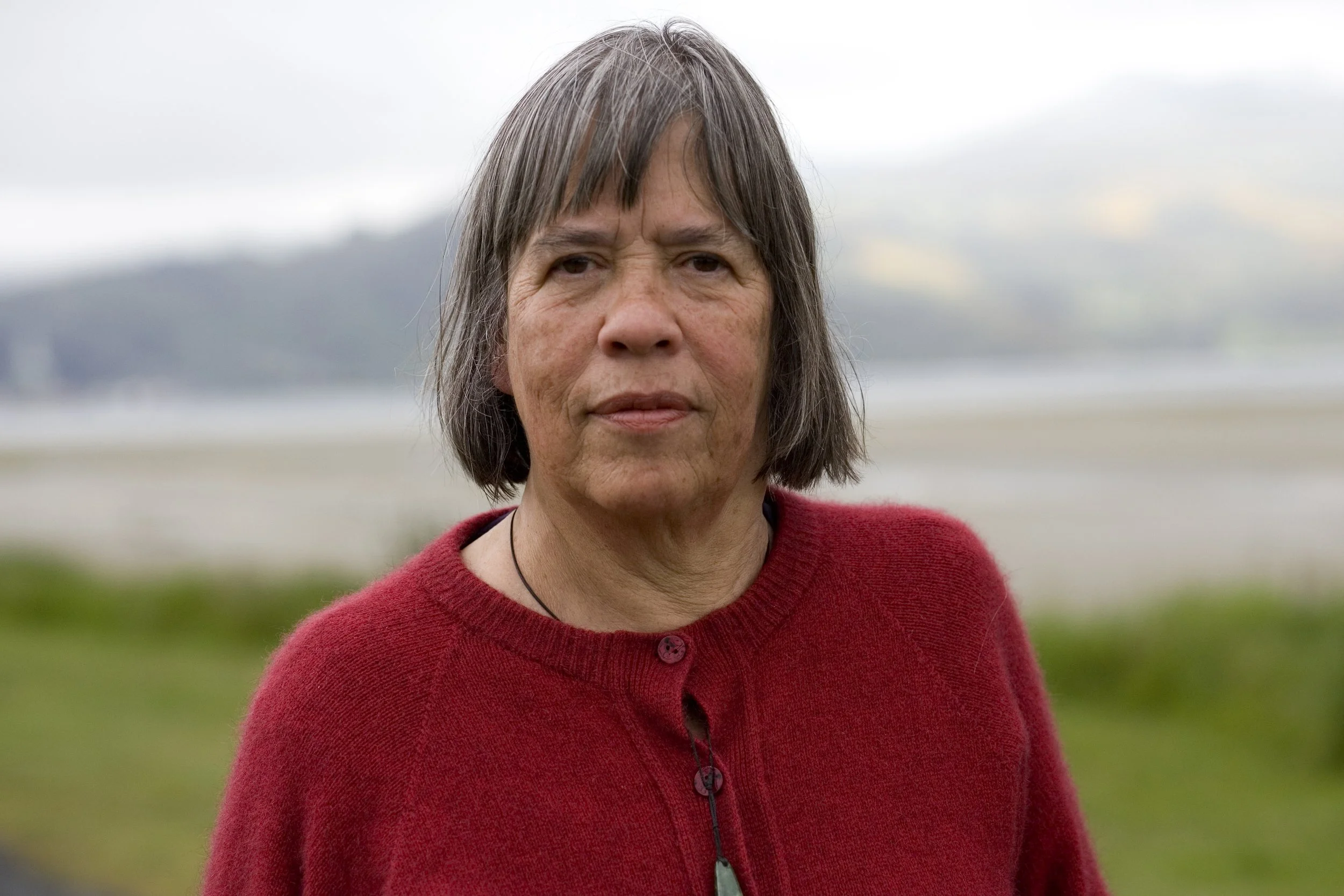
Dame Gillian Whitehead
…in her work with Voices New Zealand, Karen Grylls has valued working collaboratively with New Zealand composers.
When asked about highlights of her time with Voices, Grylls mentions several works by New Zealand composers. “I remember those moments when you talk to the composers,” she says. “Those moments of exchange have meant a lot to me over the years. They’ve been collaborative relationships. There was a Gillian Whitehead work we premiered at the Otago Festival in 2004, Taiohi Taiao, a setting of a waiata by Aroha Yates-Smith. I said to Gillian ‘there are a lot of springs and water in the music’ and she looked at me and said ‘Karen, there aren’t any corners in this piece’. It was all lovely, flowing curves. I remember moments like that with composers.”
Choral music, Grylls says, can tell a story. “The recent Stabat Maters by Rossini and New Zealander Victoria Kelly are a case in point.” The two works were performed by Voices NZ with the NZSO in 2025. “I was able to talk to Victoria about it. And for both the choir and the audience, the Kelly made more of an impact than the Rossini.”
Voices NZ and Grylls have both built big international reputations, and she is often in demand for overseas workshops and adjudication of competitions. When we talk she has just returned from work in Hong Kong, and while there she performed with a choir a work by New Zealand composer Leonie Holmes, called Nana’s Measure,for 8-part women’s choirwith harp. “For me personally the work I’ve commissioned from Leonie over the years has been really interesting,” says Grylls. “She challenges us on every level, as the fine musician she is.”
In 1994, Grylls spoke at an event called SOUNZ Choral in Auckland. “I think,” she said back then, “one of the great riches will be, if we can make it happen, bringing the spiritual side of our Māori people and joining that with some of the tools of the West. I say that because I have more and more young Māori and Polynesian singers in the National Youth Choir and the depth they bring, both in the expansive sound, and in their being, is something unique to New Zealand. We have a chance to make that very significant.”
When I ask if she thinks progress has been made towards this, she responds cautiously. “I don’t think we’re there yet. We’ve been through a patch, there’s been sharing, but the relationship I had with Te Waka Huia [a pan-tribal urban kapa haka established in 1981] was with those two, Dr Ngāpō and Pimia Wehi. It was a meeting; it’s never a transaction. The relationship is in its infancy.”
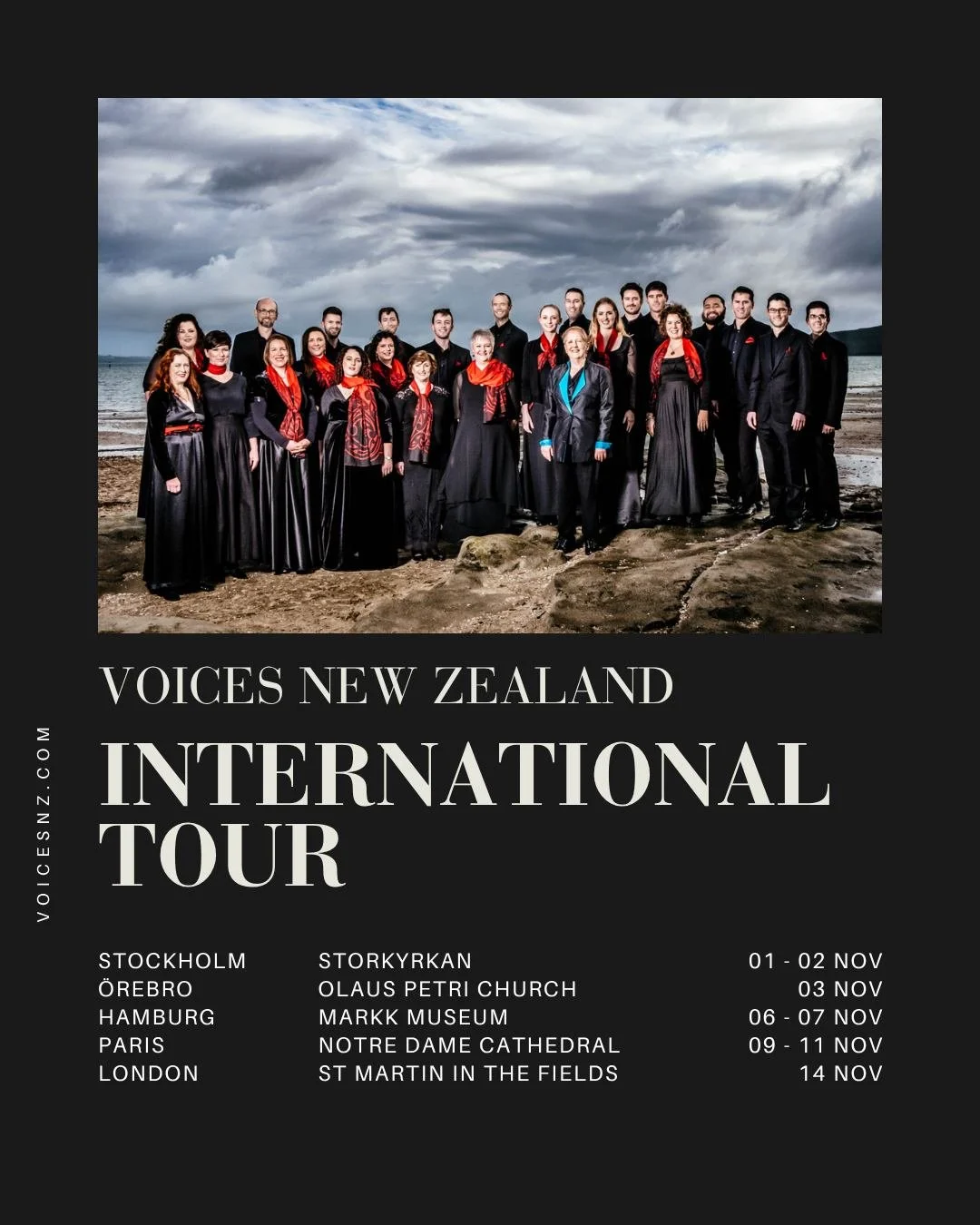
Karen Grylls took Voices New Zealand on a major European tour in November 2025
At the end of last year, Grylls took the choir on a major European tour for the last time. They performed in Stockholm, Hamburg, Paris and London, acclaimed in every centre for their choral excellence. Highlights included performing in Notre Dame Cathedral and joining the BBC Singers for a performance at St Martin-in-the-Fields.
Swedish-born choral conductor Sofi Jeannin, who directs the BBC Singers, first heard Voices and met Grylls when she visited New Zealand to conduct the choir with the Auckland Philharmonia in an Easter programme in 2019. Jeannin said then to Grylls “you know, Karen, you should bring the choir to London and sing with the BBC Singers” and a seed was sown. COVID intervened, but Grylls eventually followed up. “It took a while for it to happen,” Grylls says now, “but it finally went ‘click’ on 14 November last year in the St Martin-in-the-Fields series and that was really great. During a rehearsal break, one of the sopranos from the BBCS said to me ‘your singers have so much soul in them. I replied ‘and our singers are standing next to you, in admiration of your unbelievable ability and facility’ and she smiled and said ‘we learn from each other.’ I thought that was pretty cool from a hard-bitten professional singer.”
The Voices programme with the BBC Singers, jointly conducted by Grylls and Jeannin, was recorded by the BBC and included the world premiere of Takerei Komene’s Ranginui, the BBC Singers’ first ever commission in te reo Māori. The programme also included Robert Wiremu’s Erebus: Reimagining Mozart, a moving tribute to the 1979 air tragedy that weaves into its soundscape fragments of Mozart’s Requiem.

Karen Grylls and Voices New Zealand performing Robert Wiremu’s Erebus: Reimagining Mozart in Auckland a few years ago
The deeply moving work was performed by the choir in Europe and will be featured again in the upcoming concert “Ara Hura – A Visionary Journey”, celebrating the legacy of Grylls as she steps down as Music Director of Voices New Zealand.
Both works will be performed in the upcoming Festival tribute concert for Grylls in Wellington this month. The programme also features waiata by Ngāpō and Pimia Wehi, acknowledging their long collaborative relationship with Grylls, and includes Der Weg by Leonie Holmes, based on Bach’s motet Komm Jesu Komm, which will precede it in the programme. Der Weg sets fragments of Bach against clusters and piano swirls, performed by pianist Rachel Fuller. Voices NZ will be joined for the programme by a chamber ensemble from the NZSO and taonga pūoro artist Horomona Horo.
Ara Hura — A Visionary Journey, a gala concert and tribute to conductor Dr Karen Grylls, presented by Voices New Zealand in the Aotearoa NZ Festival of the Arts
March 15, 2026 - information and tickets here.
You can read other Five Lines articles about Voices New Zealand and their inspiring conductor below:
Voices New Zealand: Mozart’s Requiem tells a tragic story
Making Waves