
Lucas and Arthur Jussen, piano duo: dazzling virtuosity with miraculous rapport
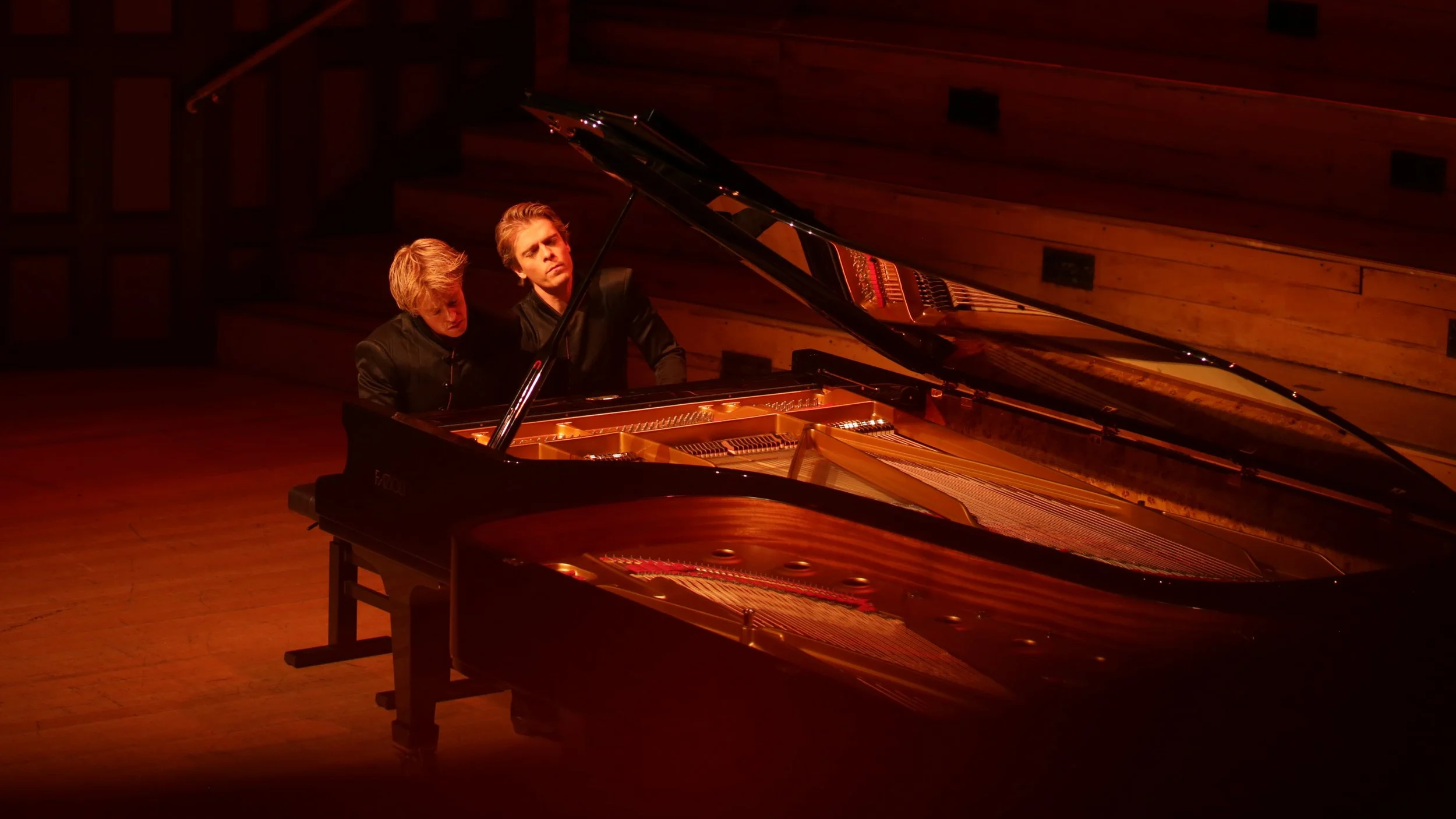
Duo pianists Lucas and Arthur Jussen
Image supplied
When the rock star piano duo of the Jussen brothers took the stage in Wellington recently, it was the first concert in a five-night, five concert whistlestop tour of New Zealand, en route to an Australian tour that includes performances with major orchestras. Nattily dressed in matching jackets, they took their piano stools side by side at one of the two Steinway pianos on stage and ripped into Mozart’s Sonata in D major KV 381. It was an astonishing experience.
These two musicians play as one. This is not merely highly-developed rapport, it is as if their four hands are attached to a single brain, in a synchronous effect that is almost comical in its perfection. Their light and sparkling performance of Mozart’s Sonata, written when the composer was about 16 for himself and his sister Nannerl, was superbly balanced with a pearly evenness of tone. The two musicians shared a great sense of phrase, rhythm and articulation that revealed both their innate musicality and impeccable technique.
The Andante slow movement was a little more introverted, effortless ornamentation and subtle rubato never interrupting the gentle melodic flow, enhanced by their lovely sound and great control of dynamics. The Allegro molto third movement bounced along with easy, fleet-fingered and infectious delight.
These much-admired Dutch musicians, Lucas and Arthur Jussen, now aged 33 and 29 respectively, have been playing together since their childhood and have a world-wide following. Many of the pianists, student, amateur and professional in the Wellington audience had no doubt encountered them through their many recordings for Deutsche Grammophon or on their well-subscribed YouTube channel.
Mozart was followed in their programme by one of the most beloved masterworks of the piano duet repertoire, Schubert’s Fantasie in F minor D 940 Opus 103. Here the two pianists’ commitment to the composer’s intentions was beautifully evident. All began calmly, the two parts perfectly balanced and the melodic line of the Primo part played with marvellous lyricism by Lucas Jessen, the older of the brothers.
In 2020, after a period of 111 days without concerts due to the Coronavirus in the Concertgebouw, Lucas and Arthur Jussen were the first musicians to play an official concert in this famous hall. This video captures their performance of this beautiful duet by Schubert.
The work is in four linked movements, and all transitions and harmonic shifts were beautifully managed, first the crescendo into the dramatic Largo 2nd movement and later the tiny pause before the graceful triple-time dance of the Scherzo. Schubert marks the pianissimo Trio section Con delicatezza and it was indeed miracle of lightness, the two musicians weaving their lines in and out before the return to the Scherzo dance.
Schubert wrote the Fantasie in the last year of his life and, though he was just 31, his genius had a wonderful maturity, evident in the marvellous fugue of the final movement. The Jussen brothers used their formidable yet unobtrusive technical skills to express the music’s expansive grandeur, showing again their magical rapport with tiny expressive hesitations and perfectly timed crunchy harmonies as the work reached its dramatic conclusion.
The first half of the programme ended with Ravel’s La Valse, subtitled Poème Choréographique for two pianos. The work is a tribute to Johann Strauss ll, but the ominous bass trills and oscillations of the opening hint, perhaps, at World War 1, which ended the previous year. Ravel wrote in the score "Whirling clouds give glimpses, through rifts, of couples dancing." The Viennese-flavoured waltz that emerges from those clouds is luscious in its romanticism, and the rippling synchronicity of the Jussen brothers’ playing is enchanting as the dance takes off. They capture the impression that Ravel is poking gentle fun at the waltz, with playful glissandi and astonishing chromatic runs, the glissandi becoming wilder, the mood more frenetic as the layers pile on. We can imagine a ballroom with exploding chandeliers as these two virtuosi revel in this light-hearted programming choice.
The whole second half of the programme is devoted to Stravinsky’s famous, even notorious ballet The Rite of Spring. The Jussen brothers played two of Stravinsky’s own arrangements of the work on their New Zealand tour, the one for two pianos that we heard in Wellington and a version for four hands on one piano, which they played in Napier and Dunedin. The latter version was composed for rehearsal use and published in 1913 before the ballet’s original performance. Debussy famously played it at his home with Stravinsky himself before the controversial 1913 orchestral premiere for Diaghilev’s Ballets Russes.
The two-piano version we heard is as intense and technically demanding as the duet version, while allowing a little more elbow room for the pianists. The Jussen’s performance was extraordinarily riveting in its propulsive power. Also striking were the marvellous colours the brothers conjured from the piano, from plaintive opening bassoon melody though shrill woodwinds in the dawn chorus to the pounding percussive chords of the Dance of the Adolescents and right through to the full orchestral power of the work’s terrifying conclusion.
In 2021 the Jussen brothers released The Russian Album, which included Stravinsky’s Concerto for Two Pianos. The album’s cover was inspired by the famous painting Colour study: Squares with Concentric Circles by the Russian artist Wassily Kandinsky, a contemporary of the composers on the album. “During the recording sessions, the relationship between Russian music and colour finally became clear to us,” Arthur has said. “Kandinsky always insisted there is a close similarity between music and colour.”
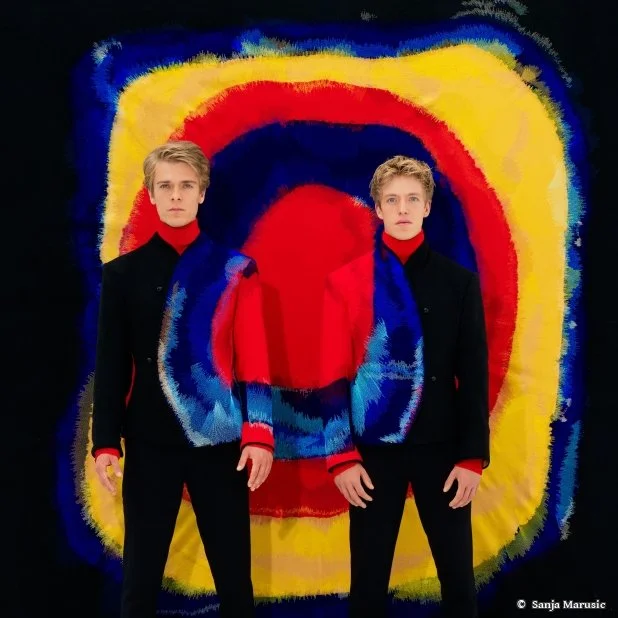
Cover image for The Russian Album, a collection of works by Russian composers performed by Lucas and Walter Jussen.
“…the relationship between Russian music and colour became clear to us.”
Image by Sanja Marusic
In the recent Wellington concert they performed The Rite of Spring from memory, as they did their whole programme, an almost unbelievable feat for the orgiastic Rite, in the face of Stravinsky’s constant changes of time signature, asymmetric rhythmic intricacies and multi-layered textures. Facing each other from opposite keyboards, they made frequent eye contact as they managed the complex transitions with impeccable timing. The discordant harmonies seem even more telling on piano, contrasted with magically quiet and peaceful moments with delicate trills.
Stravinsky’s innovative approach to rhythm, metre and accent combined with his savage, pagan musical storytelling ensured a place for The Rite as one of the most significant compositions of the 20th century. Perhaps no composer since has been able to follow the lead he offered with this cataclysmic work. The Jussen brothers, however, were undaunted by either the work’s history or its technical challenges, delivering a brilliantly ferocious performance that held the audience’s rapt attention.
Prolonged applause called them back to the stage, where Lucas Jussen commented that Stravinsky’s intensity made choosing an encore challenging. To end the evening, reaching back to J S Bach, a composer they see as “the beginning” for so many musicians, the brothers played his Sonatina from "Gottes Zeit ist die allerbeste Zeit" (arranged for four hands by György Kurtág) with serene, beautiful restraint and the perfect timing that characterised the whole concert.
Lucas and Arthur Jussen, piano duo, on tour for Chamber Music New Zealand, playing music by Mozart, Schubert, Ravel and Stravinsky. Wellington August 18, 2026