
The John Psathas Group: pianos, percussion and technology
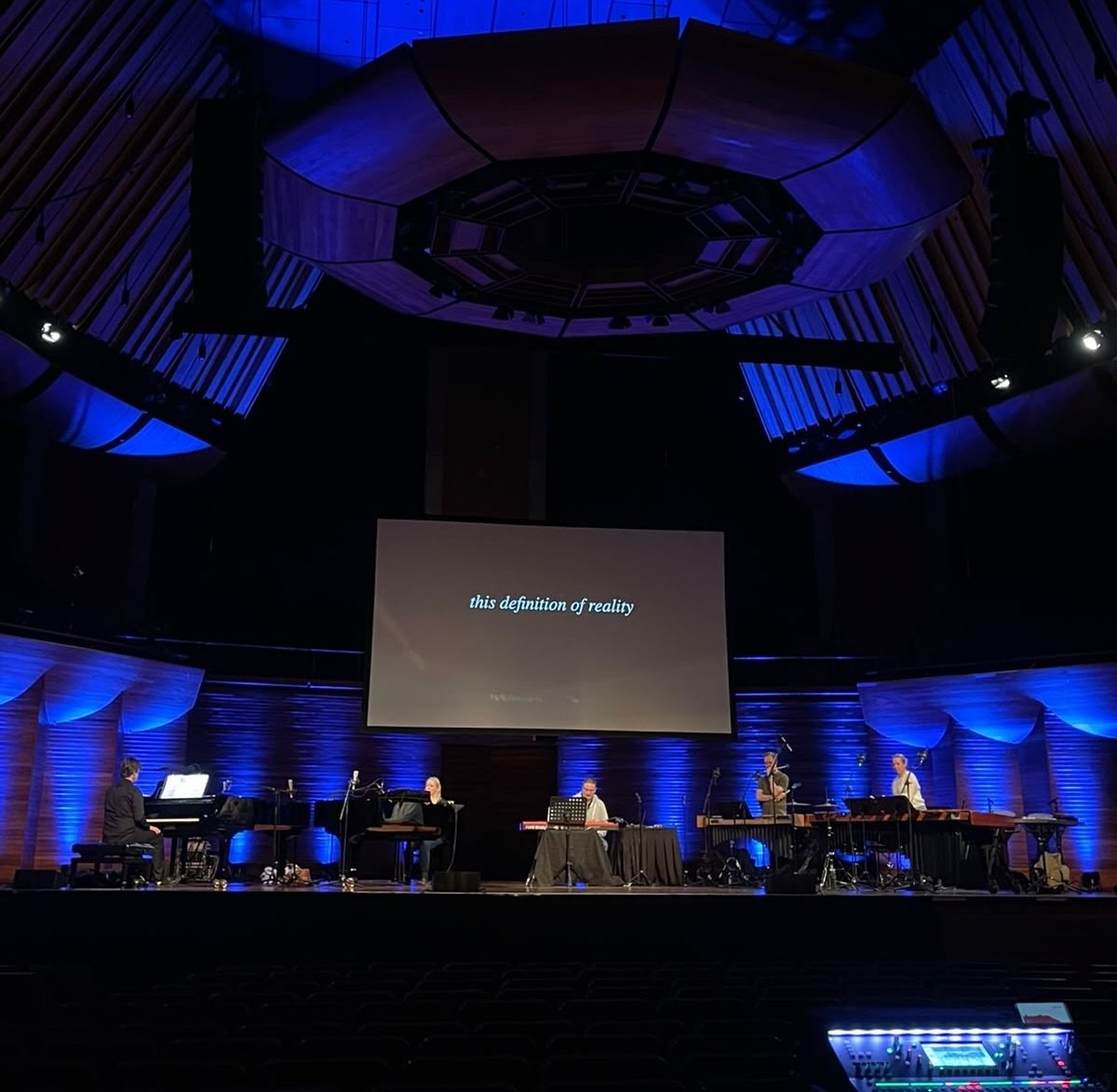
The John Psathas Group in performance in Wellington’s Michael Fowler Centre
Image supplied
Composer John Psathas has developed a highly individual musical path amongst New Zealand composers, one inextricably connected to his international collaborations with virtuosic performers, and one that increasingly reflects his thoughts, feelings and readings about the global zeitgeist and where this world may be heading. He is, he told me a few years ago, in a "dark place" about the latter.
This month, in a tour for Chamber Music NZ (CMNZ), Psathas launched The John Psathas Group, an ensemble gathered from around the world to perform his music. Two pianists, Dawn Hardwick from Wales and New Yorker Stephen Gosling, and two percussionists, marimba virtuoso Katarzyna Myćka from Poland and Swiss musician Fabian Ziegler, top-notch musicians who have collaborated with Psathas, in some cases for many years, came together to tour a launch programme of 11 short Psathas works from the past seven years of his oeuvre. Some were single movements of longer compositions, and some had been performed in New Zealand before, the programme including new versions of music that had originally been played by soloists or other groupings.
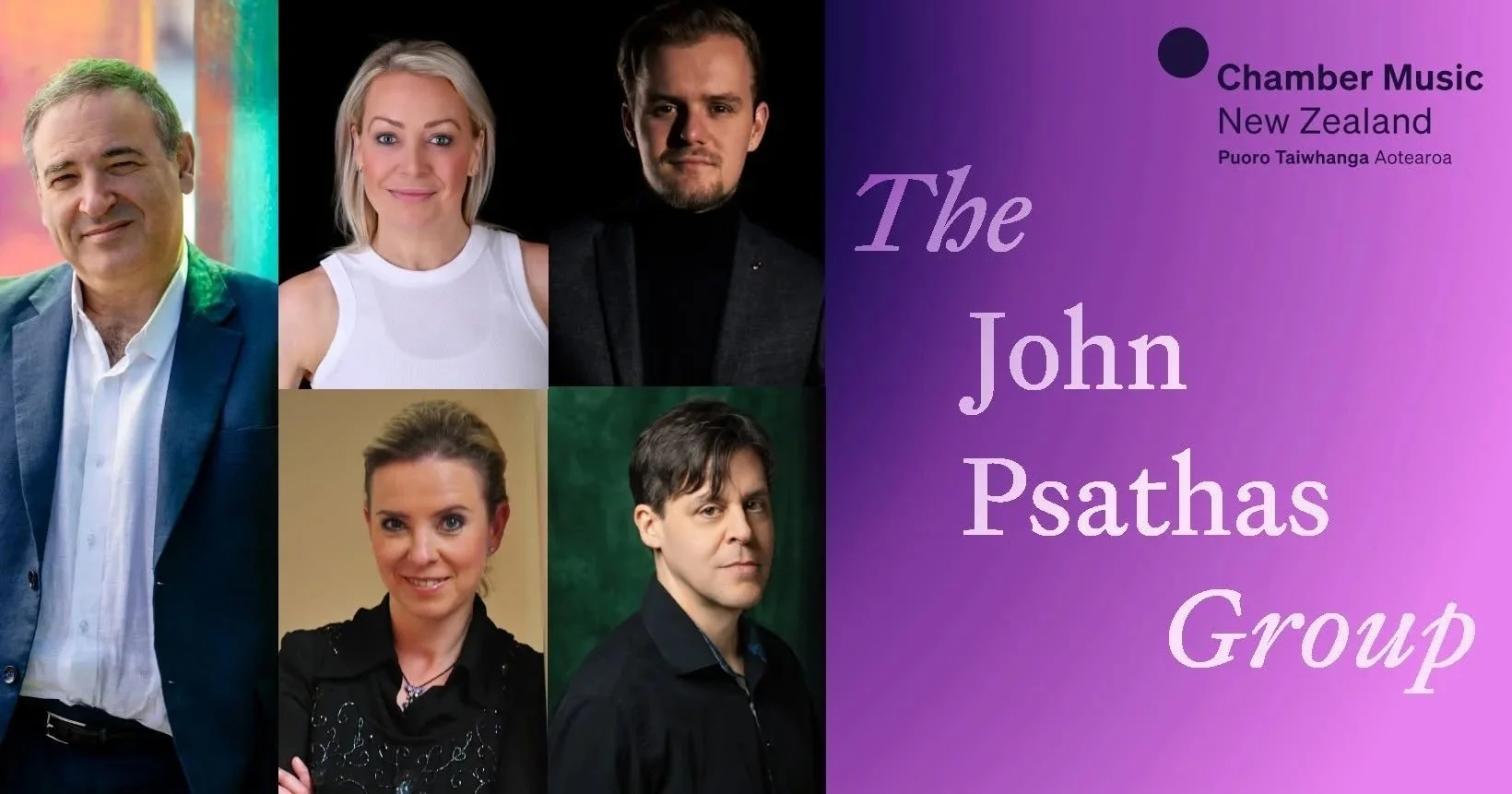
The John Psathas Group
(clockwise from left) Composer John Psathas, pianist Dawn Hardwick, percussionist Fabian Ziegler, pianist Stephen Gosling and percussionist Katarzyna Myćka.
The debut of the John Psathas Group also makes explicit the direction that the composer has been following for some time. He describes it as “social commentary, using a range of live performance formats and technologies.” Psathas is, he explains, “weaving the strands into new work that integrates virtuosic live performance with video, text and cinematic soundscapes.” Paradoxically, one of his social concerns is about the negative impacts of technology and the internet on our lives and relationships – but more of that in a moment.
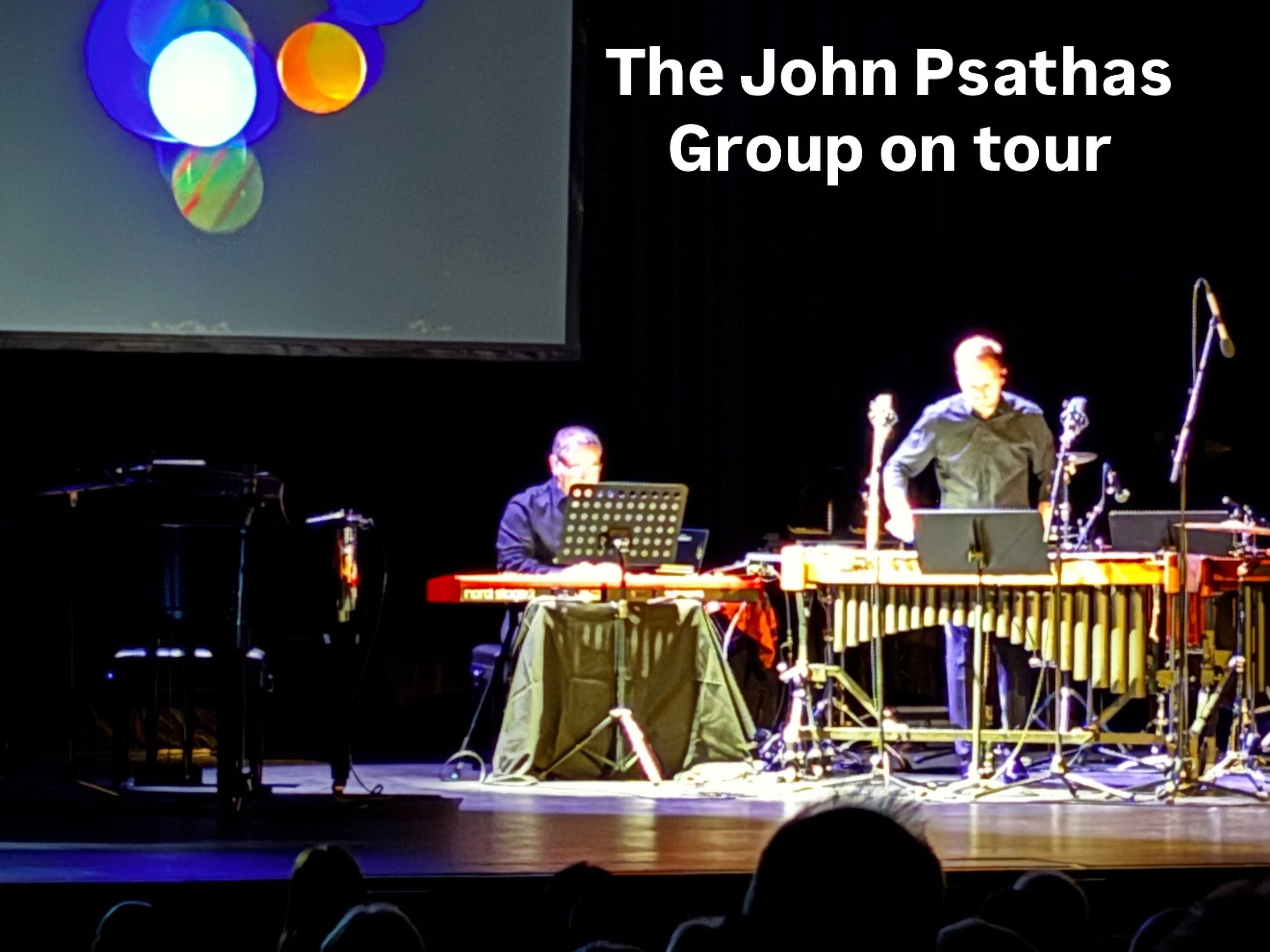
When the somewhat sparse CMNZ audience took their seats in the large auditorium of the Michael Fowler Centre for the Wellington concert, they faced a full stage with two grand pianos stage-right, a bank of percussion stage-left and a keyboard in the centre in front of a large, suspended screen. Technological equipment including numerous microphones was part of the complex set-up, with a good-sized mixing desk in the centre of the audience.
The programme began with Trimetrical Hub (2020), the third and final movement of a work called Koolish Zein, originally an “orchestra-less” concerto for solo percussionist, a percussion quartet and a track of richly layered audio. This version is for two pianos , two percussionists and a backing track, driven by Psathas who is seated on stage at a keyboard in the middle to the action, pianos to the house-left, percussionists to the house-right, a dramatically symmetrical arrangement.
Musically it's the Psathas "high-octane virtuosic style”, repetitious, over a unvaried beat. The rhythm, the programme notes tell us, is based on a Macedonian dance in 17/8 (4+6+7) and I assume the musicians are working to a click-track in their ears. Everything is amplified and managed from the mixing desk and the complex rhythmic material becomes simple through repetition, high-paced and driving forward as we've come to expect from Psathas’ music.
The work that follows is called Relentless (2023), played by Polish marimba player Katarzyna Myćka, known as "she who dances with the mallets". Here Psathas’ interest in music in the service of social commentary is explicit. The work was composed with and for Greek percussionist Zoi Argyriou, who told Psathas that what made her truly angry was “the treatment of women, by men, in Greece.”
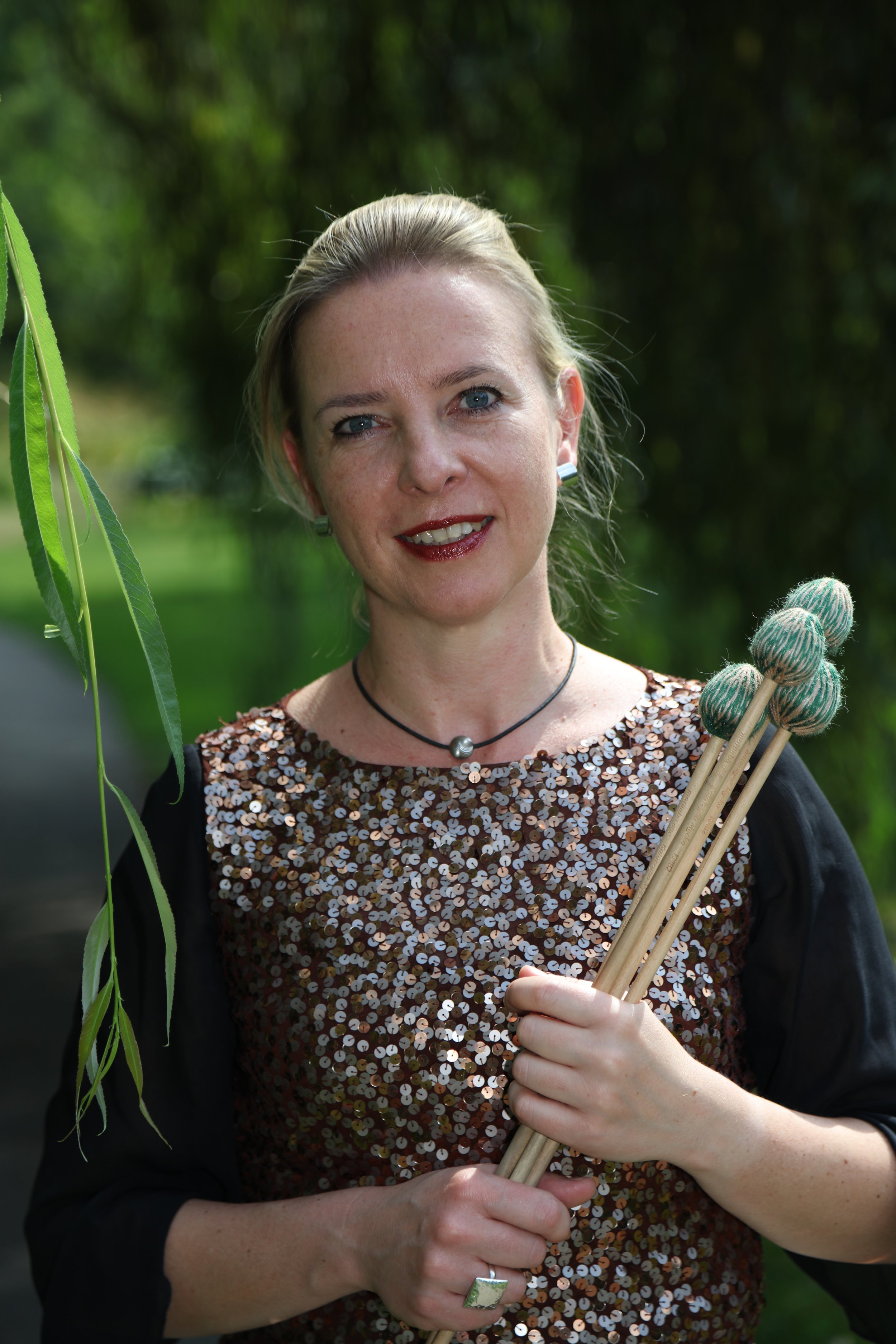
Marimba virtuoso Katarzyna Myćka
“…she who dances with the mallets.”
Image supplied
The text on screen was written by another Greek artist, Eleni Petridi, and translated and converted to a “haiku” format. The result is a torrent of angry feminist rage accompanied by a nice range of percussion colours performed by a virtuosic female percussionist alongside a wordless vocal part on tape.
I wondered what this changes, if anything? Certainly the issues laid out on the screen were no surprise to any woman in the audience and the compositional process inspired some fierce playing. But does such explicit “social commentary”, which carried an ultimately unsophisticated message, have a useful social or even artistic purpose? Would the work have had even more impact without the text on screen?
In 2018, Psathas worked in the United Kingdom with the multi-piano ensemble, Piano Circus, a group which included Hardwick. The result of that collaborative process was his Voices at the End for six grand pianos and immersive tape, premiered in 2020 at the Auckland Arts Festival by a crack team of New Zealand pianists. I wrote about that performance for NZ Listener before its radio broadcast, a story you can read on Five Lines (see the link below).
That work certainly included social commentary, including vocal parts on tape, but no screens were used to hammer the message home - and distract from the music - and it seemed much more musically compelling than subsequent iterations we’ve heard, including a solo piano version performed by Michael Houstoun a few years ago. For this concert, Psathas chose an extract from the third, more optimistic movement, “The Great Turning”, called Ichi-Go Ichi-E. The title, related to a Japanese tea ceremony, means “One time, one meeting”, and the backing track includes shakuhachi. Any deeper meaning from the video, with images such as astronauts floating in space and planets in rotation, is unclear, and serves only, for me, to distract from the performance by the two pianists. Again, the performers are synchronised by click-tracks and amplification seemed heavy-handed for two nine-foot Steinways.
Predator (2019) was the first part of Voices at the End, played later in this concert. It’s another high energy piece, musically using a lot of repetition of notes, short figures, longer motives and harmonies, with an unrelenting beat like the techno-thud of a dance party, and repetitive rapidly morphing images on screen with occasional moments of wry, grotesque humour. As it all drives forwards, the musicians offer bright solos on pianos and tuned percussion, but the speeeded up, almost kaleidoscopic screen images draw attention away from the music.
In 2024, to mark the fifth anniversary of the tragic Christchurch terror attacks on March 15, 2019, the NZSO presented a deeply moving concert called “Beyond Words”. (See link below for my review of the event.) Psathas played a major role in the planning and presentation of that concert, and, in the second half, a highlight was the premiere of his work Ahlan wa Sahlan, composed with the two soloists, Moroccan vocalist Oum El Ghaït and Cypriot oud virtuoso Kyriakos Tapakis. It was an outstanding example of Psathas the collaborator at work, and in the performance, the emotional singing of OUM (as the singer is known) with the driving playing of piano and oud, was wonderfully effective.
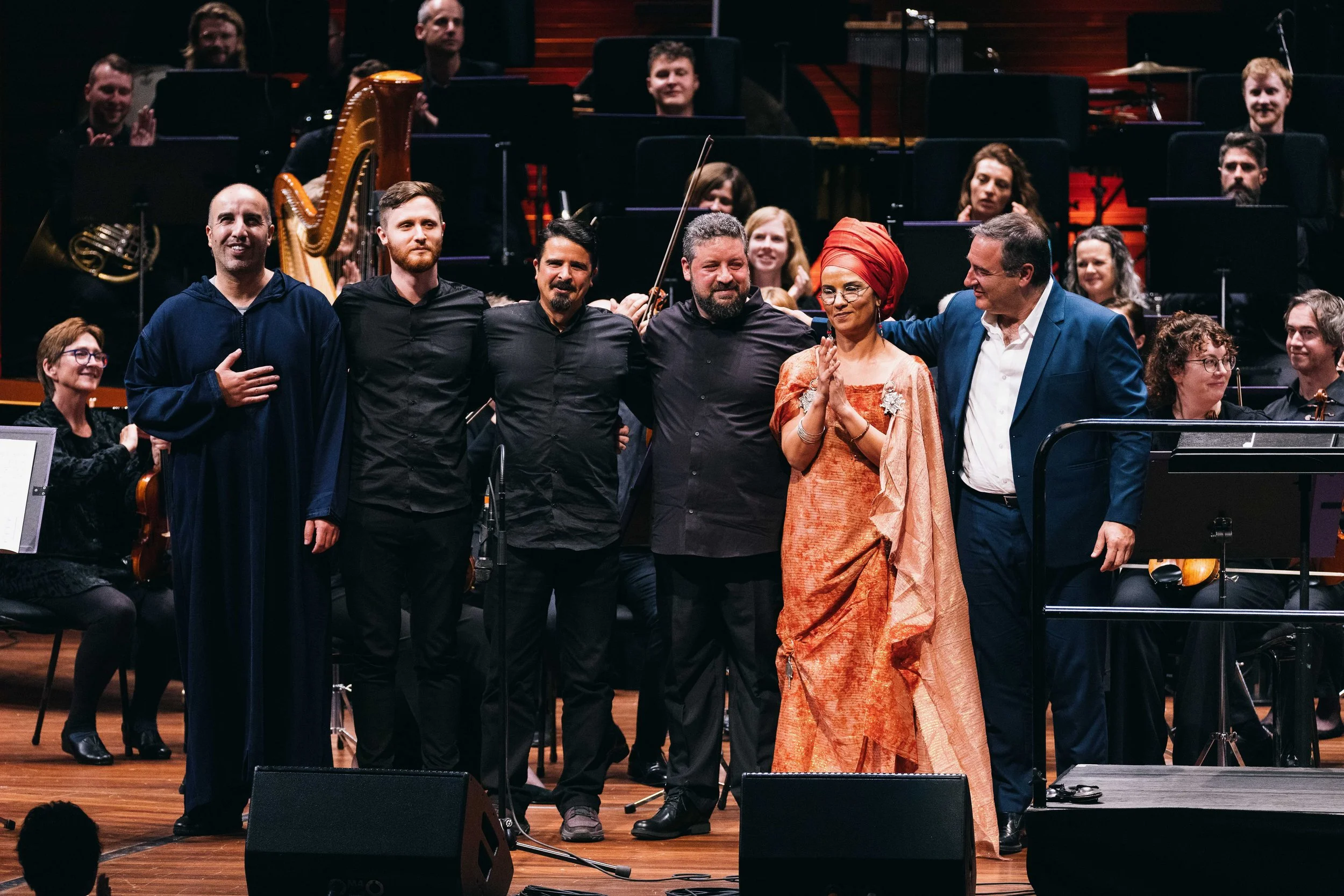
The soloists in the NZSO Beyond Words concerts with composer John Psathas (right) beside vocalist OUM
“…a deeply moving concert.”
Image credit: NZSO/Jono Tucker
For this 2026 concert by the John Psathas Group, the central movement Hijra represented Ahlan wa Sahlan, using recorded voice, but the magic of the live performance with the two solo musicians was lost and a skilfully produced video of road and railway tracks, with urban scenes speeded up, nature scenes of birds in slow-motion, was again a distraction. I can’t remember a video during the premiere – it may have been there but attention was on the compelling performers, particularly the singer OUM. In this iteration, the recorded music and live performers were almost relegated to a background track for the visual effects.
At the 2024 Adam Festival of Chamber Music, percussionist Justin DeHart performed the premiere of Psathas’ composition Infinite Mind, a work based on a recording of Noam Chomsky talking in a chilling interview about global existential threats. A year earlier, the first allegations about the linguist and public intellectual’s connections with Jeffrey Epstein had surfaced. Much more has since been learned about that relationship between Chomsky and Epstein, and it now seems highly inappropriate to continue to feature the now 97-year-old’s views in works of art. It is surprising that Psathas and Chamber Music New Zealand chose to include the two movements of Infinite Mind, called Terminal and Noam, in this concert, particularly in the same programme as Relentless.
The John Psathas Group
John Psathas (centre) with Fabian Ziegler (percussionist).
Image credit: CMNZ
This inaugural tour of the John Psathas Group was marketed as “shaping a vision for the future of chamber music.”
For me, the essence of chamber music is found in the intimate musical conversations between the musicians, listening to each other and responding with flexibility and subtlety, with the emotions and narratives of the work contained in the music itself, its melodies, harmonies, dynamics, textures and rhythms. Chamber music programmes, as we’ve experienced every week this concert season, can acknowledge the art form’s past, present and future with a huge range of repertoire, including contemporary, forward-looking new works. It can also readily collaborate with a range of other art forms, styles and genres.
But if the “future of chamber music” involves a stage full of tech gear, unrelenting amplification, musicians with click-tracks in their ears to ensure they play together on an unvarying pulse, a mixing desk to ensure all is well-balanced, and screens with texts or images to explain the music’s purpose to the audience, it is a future so far from that essence that I for one do not want to sign up for it.
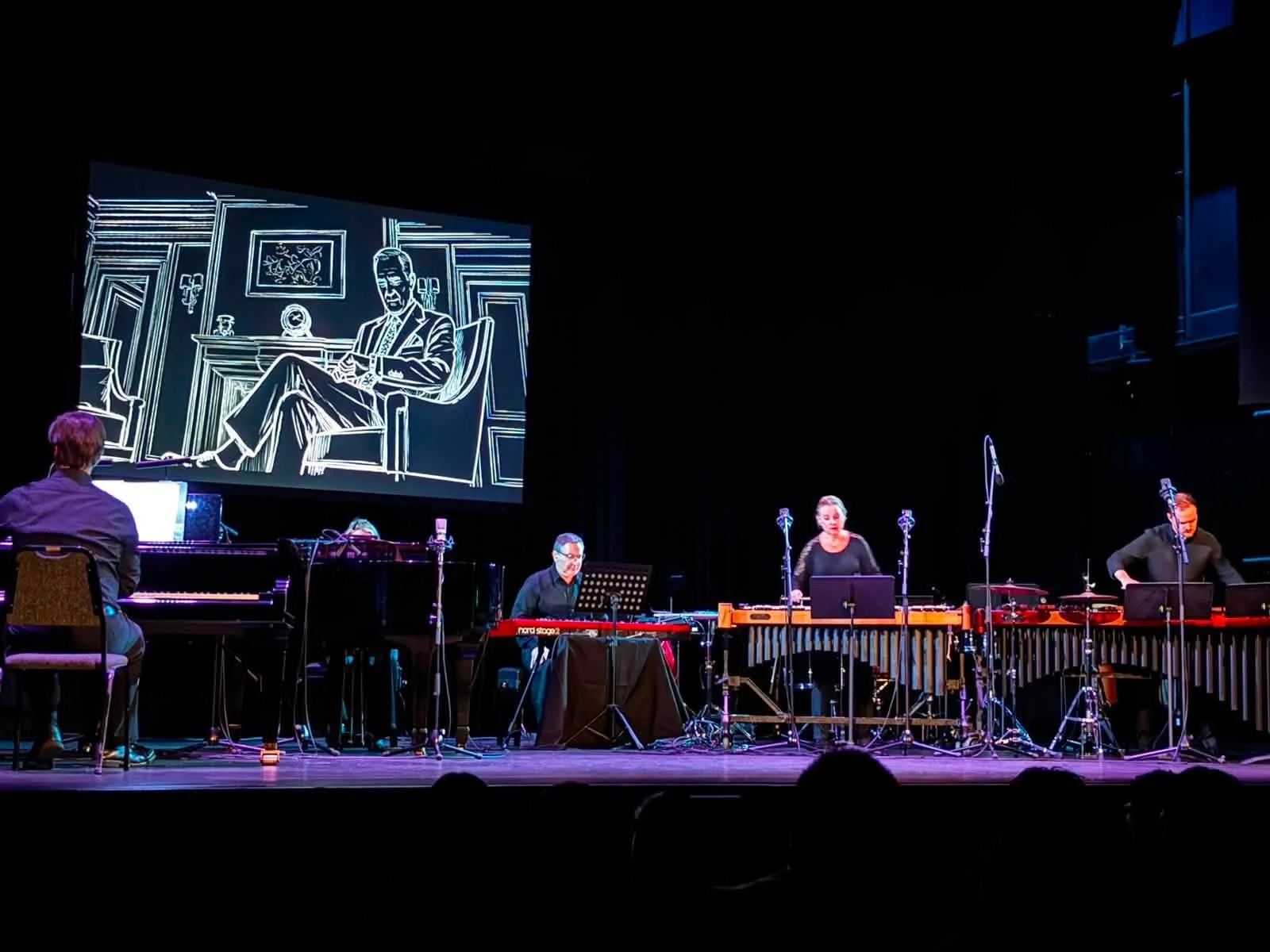
The John Psathas Group performing in Wellington
“…a stage full of tech gear…and screens to explain the music’s purpose.”
Image credit: CMNZ
I have admired many works by Psathas over the decades I have known him and have written positively about them. I have also admired his generosity to his fellow composers and his sincere, thoughtful and patient approach to collaboration with many artists and performers in New Zealand and around the globe. I fear, however, that his current work with its focus on social commentary may prove an artistic dead-end, and sincerely hope he can use his huge talents in future to create music that acknowledges the full range of musical expression available to him when expressing his thoughts, feelings and ideas.
Coda: This week the John Psathas Ensemble ended its New Zealand tour with a performance of Bartók’s Concerto for Two Pianos and Percussion with Orchestra Wellington (OW). It was the centrepiece of an OW concert called “Creation” within their 2026 Collaborations season, which began with Milhaud’s jazz-inspired La Creation du Monde for chamber orchestra, performed with Tanemahuta Grey’s unique new choreography for Ballet Collective Aotearoa, telling in dance the creation stories of Te Ao Māori.
There were some personnel changes in the John Psathas Group for Bartók’s work, pianists Hardwick and Gosling replaced by New Zealander Michael Houstoun and Lithuanian Swiss-based Akvilė Šileikaitė, both previous Psathas collaborators.
It was an exuberant and exciting performance of a terrific, virtuosic work, which features the quartet of soloists front and centre, on stage and musically. Freed from the click track, percussionist Myćka showed her full range of movement, “dancing with the hammers” with smiling delight. All musicians, including conductor Marc Taddei and the Orchestra, seemed exhilarated at the end.
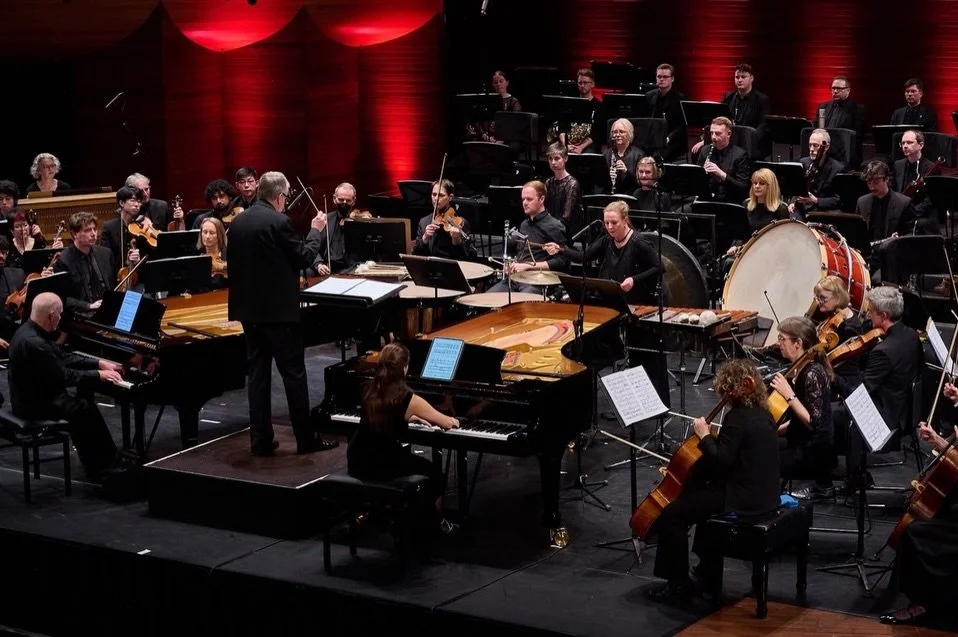
The John Psathas Group with Orchestra Wellington
“…an exuberant and exciting performance of Bartók’s Concerto for Two Pianos and Percussion.”
Photo credit: Adrian Vercoe
The audience, too, responded with enthusiasm and the evening ended with a marvellous performance of Carl Nielsen’s 4th Symphony, “Inextinguishable”, a mighty work written during the dark days of World War 1. Taddei and Orchestra Wellington played with a big, extrovert sound, communicating the work’s grandeur with power and energy. “The symphony,” wrote the composer, “evokes the most primal sources of life and the life feeling…..Life is indomitable and inextinguishable.” The music’s message was clear.
The John Psathas Group, touring a programme of music by John Psathas for Chamber Music New Zealand 4-15 August 2026.
Orchestra Wellington “Creation” with Ballet Collective Aotearoa and The John Psathas Group, Wellington 22 August, 2026.
You can read more Five Lines stories about the music of John Psathas in John Psathas: Voices at the End, album reviews Confronting the Modern Gods and Voices at the End: an impressive reimagining, reviews of the NZSO concert Beyond Worlds: united by music, the percussion works The All Seeing Sky played by Orchestra Wellington The All-seeing sky: the inspiration of friends and Leviathan in Psathas’ Leviathan: steel, drums and determination.