
NZSO’s Four Seasons: Kuusisto’s virtuosic showmanship wins the audience prize
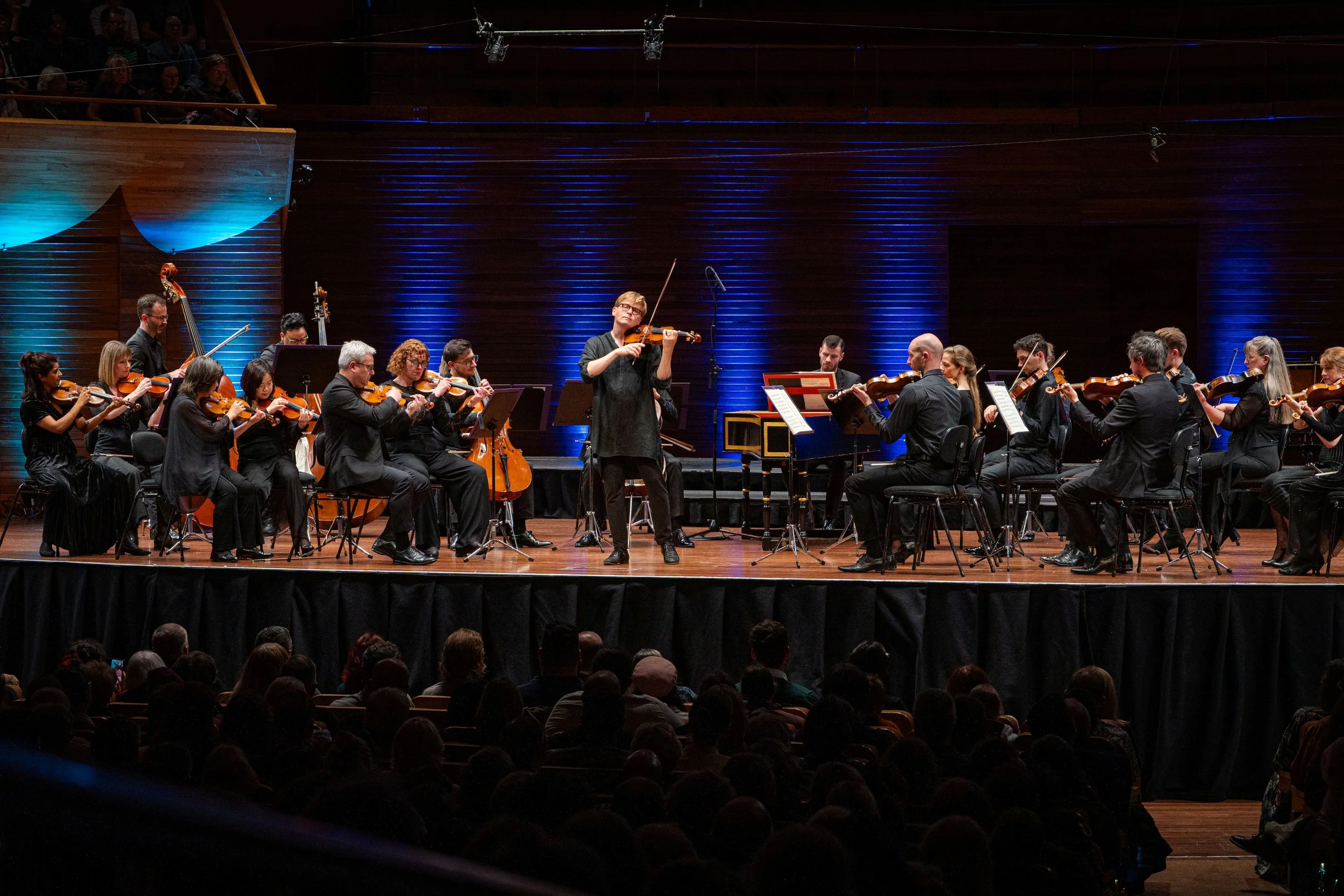
Violinist/conductor Pekka Kuusisto performing Vivaldi’s The Four Seasons with the NZSO
Image credit: Phoebe Tuxford/NZSO
Vivaldi's The Four Seasons, particularly the first of the four concertos, Spring, or La Primavera, ranks as among the most popular and often played works from the classical canon. So ubiquitous is the beautiful first movement of Spring that it has sadly become almost 'wallpaper' or 'elevator' music.
Finnish violinist/conductor Pekka Kuusisto wants to bring a fresh approach to The Four Seasons to audiences, one that "brings out the characters, smells and tastes in the music."
Vivaldi himself had expressed in four sonnets his descriptive “programme” for the work, a sonnet for each concerto, and he also wrote some text in the score to emphasise his descriptive seasonal narrative.
Whether they came to hear a "re-imagined" Four Seasons, or just the work they knew and loved, concert-goers packed the Michael Fowler Centre to the gunwales in Wellington last week for the NZSO's concert with Kuusisto. Did everyone get what they wanted?
The classically-sized orchestral set-up on stage at the beginning of the NZSO concert looked unremarkable. Kuusisto's bouncing arrival on stage, however, suggested something less conventional, his cool haircut, clothes and general demeanour communicating a somewhat eccentric and casual style. "Hello", he said, disarmingly. "My name is Pekka. I'm from Finland. How are you doing?" The large audience, including many young people, was immediately charmed.
Kuusisto took the stage first as conductor. The programme began with a work little-known to audiences and perhaps the players too, the 3rd Symphony of 19th century French composer Louise Farrenc. In an interview the day before the concert, Kuusisto referred to the work, composed in 1847, as a "fascinating glimpse into music we as a musical community have decided to forget about", that is, music by women composers. From the podium he described it as a "passionate, funny, often loveable symphony."
The performance, unfortunately, seemed a little perfunctory. Kuusisto's relaxed approach extended to a lack of attention to detail and neglect of the flexibility needed to negotiate the musical corners of phrases and gestures of what is undoubtedly a fine work of Romanticism. Farrenc's writing is tuneful and graceful, her orchestral texture often full, rhythms occasionally syncopated, the orchestration effective and colourful. I was surprised to hear a less than impeccable performance of the first two movements by the NZSO, whose players are capable of much cleaner playing, with more unified string sections.
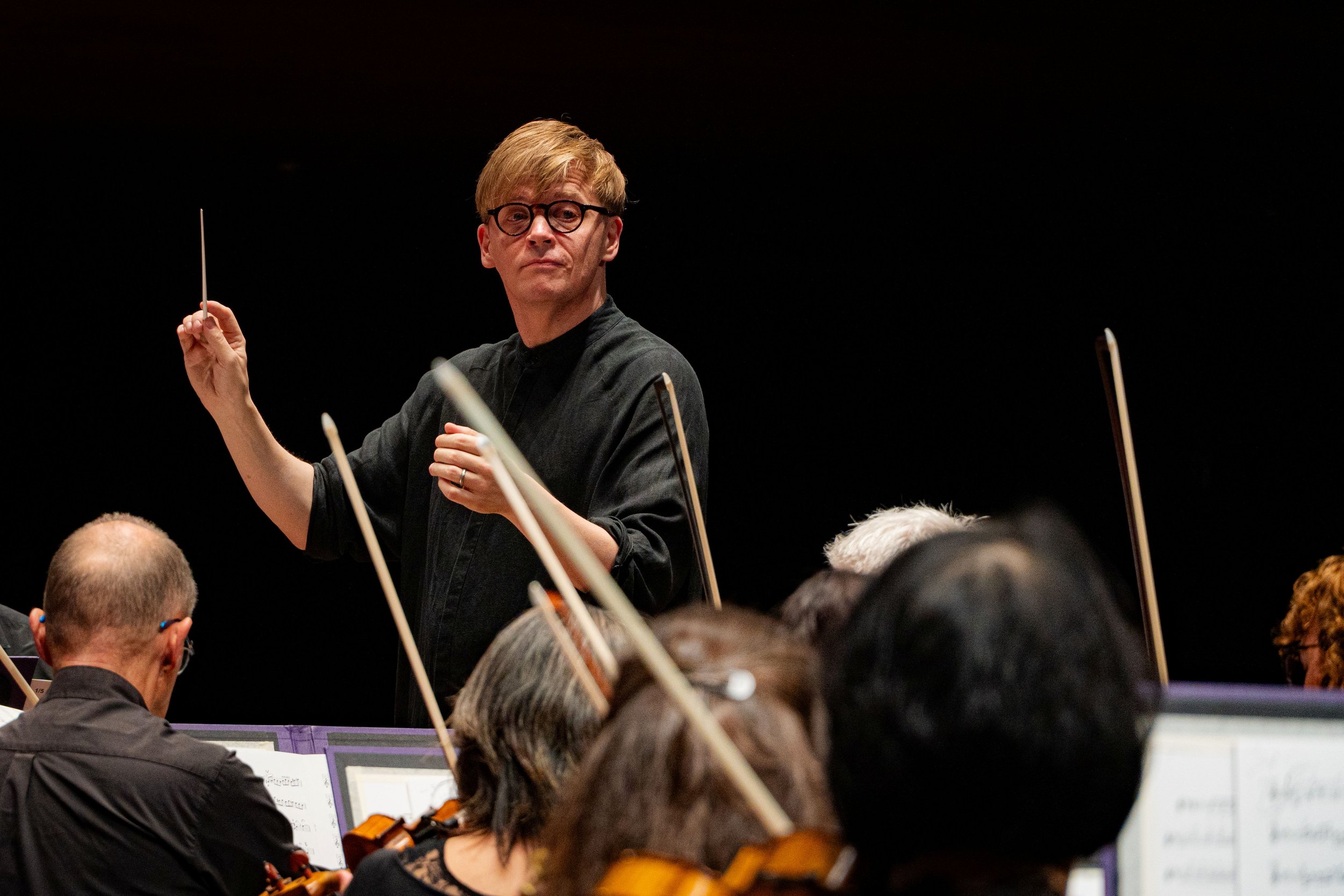
Pekka Kuusisto conducting the NZSO in French composer Louise Farrenc’s 3rd Symphony
“… an unfortunately perfunctory and less than impeccable performance.”
Image credit: Phoebe Tuxford/NZSO
The 3rd and 4th movements are faster and were played with nice pace and lightness, the Scherzo an urgent moto perpetuo with witty asymmetrical accents, lovely wind and horn playing in the Trio and a Finale much more precise and dramatic than the opening of the work.
After the interval, the stage arrangements changed to accommodate a small Baroque-sized string orchestra grouped around the harpsichord. Kuusisto's arrival as soloist-conductor, his recently acquired "long Strad" in hand, seemed more energised and focussed, and the Spring concerto began with nice dynamic contrasts. His solo playing strongly emphasised the bird-song that Vivaldi referred to in his sonnet and it was clear at once that Kuusisto's Seasons were his own idiosyncratic interpretation, subverting Vivaldi's rhythms and playing with a freedom I'd missed in the Farrenc, his solos flashy bird-infused affairs full of virtuosic showmanship.
The audience loved it, and, having clapped after every movement of the Farrenc, proceeded to do the same for the Vivaldi. I often celebrate a little clapping between movements as evidence of new audience for a symphony concert. But, as you probably know, The Four Seasons is not one but four concertos, so this meant applause after all twelve short concerto movements, significant interruptions that began to remind me of the many items in a school concert.
In the second movement of Spring, marked Largo e pianissimo sempre, Vivaldi wrote on the score that the short-long figures in the viola part were "a yelping dog". In this performance, violist Julia Joyce's usual beautiful sound became loud and coarse barking, an odd contrast to the exquisite pianissimo of the other strings. It seemed an overly literal approach to the narrative.
In the Allegro Pastorale, Kuusisto again took Vivaldi's "programme" music literally, with extravagant bird-like imitations and very virtuosic playing alongside his sensitive leadership of the ensemble. The sonnet for this movement mentions bagpipes and there they certainly were, along with some unusual pitch-bending and other novelties in a performance determinedly breaking with performance traditions.
All this unpredictability was, of course, quite compelling. As the concert continued, Kuusisto’s violin seemed like a character in a creative story he was narrating to the audience. The forte ensemble work in the Allegro non molto first movement of Summer was thrilling, the tempo more molto than non, the communicative solo part of echoing melodies full of lovely rubato. I was getting used to the complete absence of “tradition” – this was Kuusisto’s show and he was exploiting his freedom to the utmost, almost dancing on stage. And his audience were with him for every fast and frenetic moment, clapping and cheering at the end of this concerto.
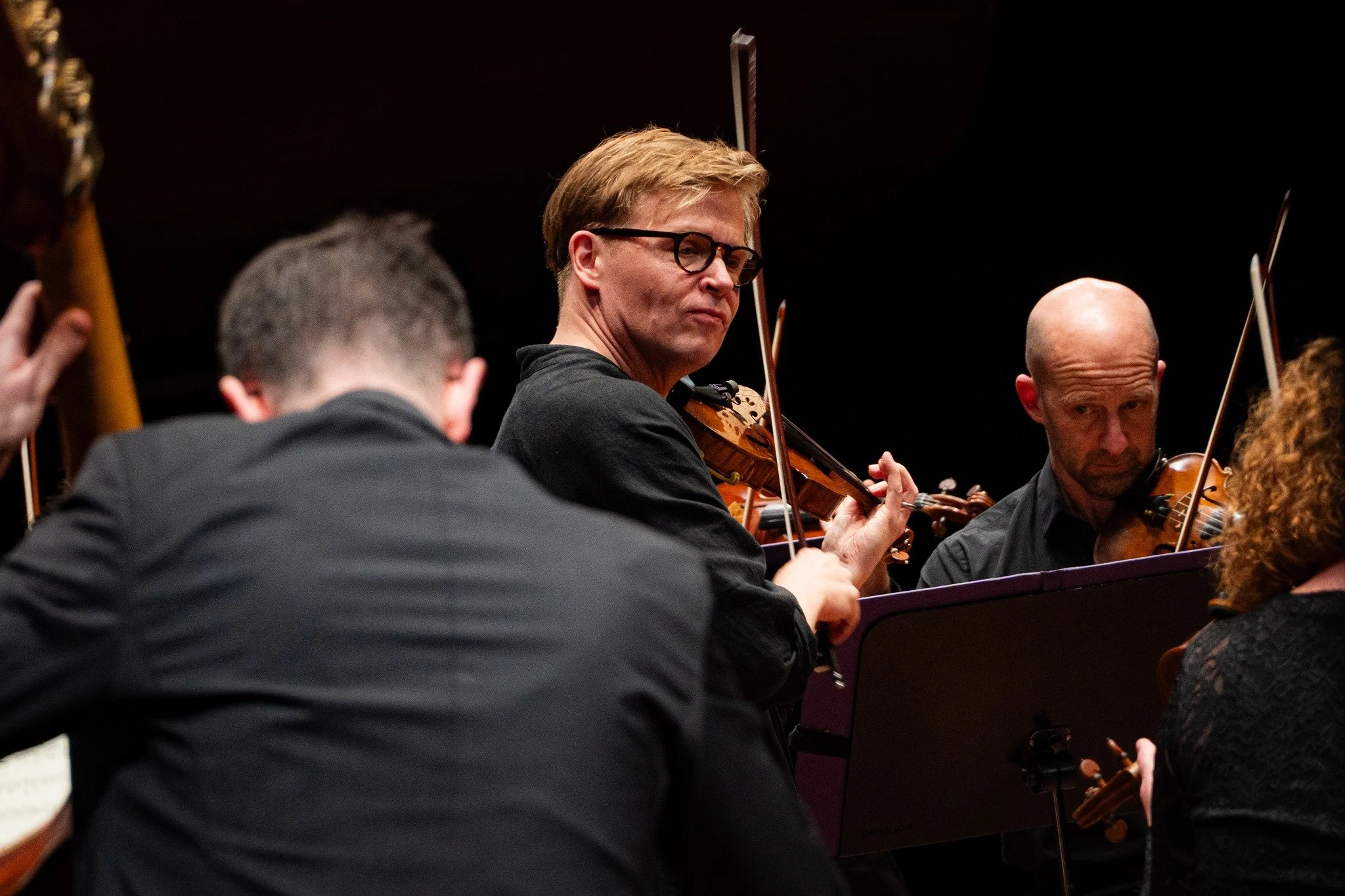
Pekka Kuusisto as soloist in The Four Seasons
“…exploiting his freedom to the utmost, almost dancing on stage.”
Image credit: Phoebe Tuxford/NZSO
In the Autumn concerto he and the orchestra played with the tonal colours with clever bowing. For the second Adagio molto movement, Vivaldi turns the action over to the harpsichord, and Kuusisto left the stage completely while we enjoyed the lovely florid keyboard playing of Nathan Cox, the string players in chordal accompaniment. With cellist Ken Ichinose, Cox also offered fine continuo playing throughout the whole work.
The novelty in the third Autumn movement was around the tempo, which first accelerated oddly and then appeared to send the music up in an eccentrically sliding slow section.
And so we came to the final concerto, Winter, unsure of what to expect in a performance that was anything but boring. Distinctive sul ponticello (on the bridge) string playing from the ensemble evoked the frozen wastes, while Kuusisto, impressively speedy in solo sections, playfully exaggerated dynamic contrasts. The magical Largo is one of my own favourite movements, but rather than revelling in its beauties, Kuusisto took it at a rather lively clip, the orchestra startling everyone by singing the final chord. The final Allegro featured dazzling super-fast solos, the NZSO string ensemble keeping up the pace with nice crisp playing.
Predictably when the end came the audience exploded, many standing and cheering, everyone excited by Kuusisto’s rock-star performance.
I confess I was less impressed than most. It seemed to me that, while illuminating the music with an imaginative and fresh new view of the composer’s popular creation, Kuusisto had also somewhat heavy-handedly wrestled The Four Seasons from Vivaldi to serve his own – and the audience’s – desire for showmanship. His sometimes frenzied virtuosity, clumps of broken hairs spilling from his bow, was in danger of overtaking the musical integrity of the composer’s four beautiful and expressive concertos.
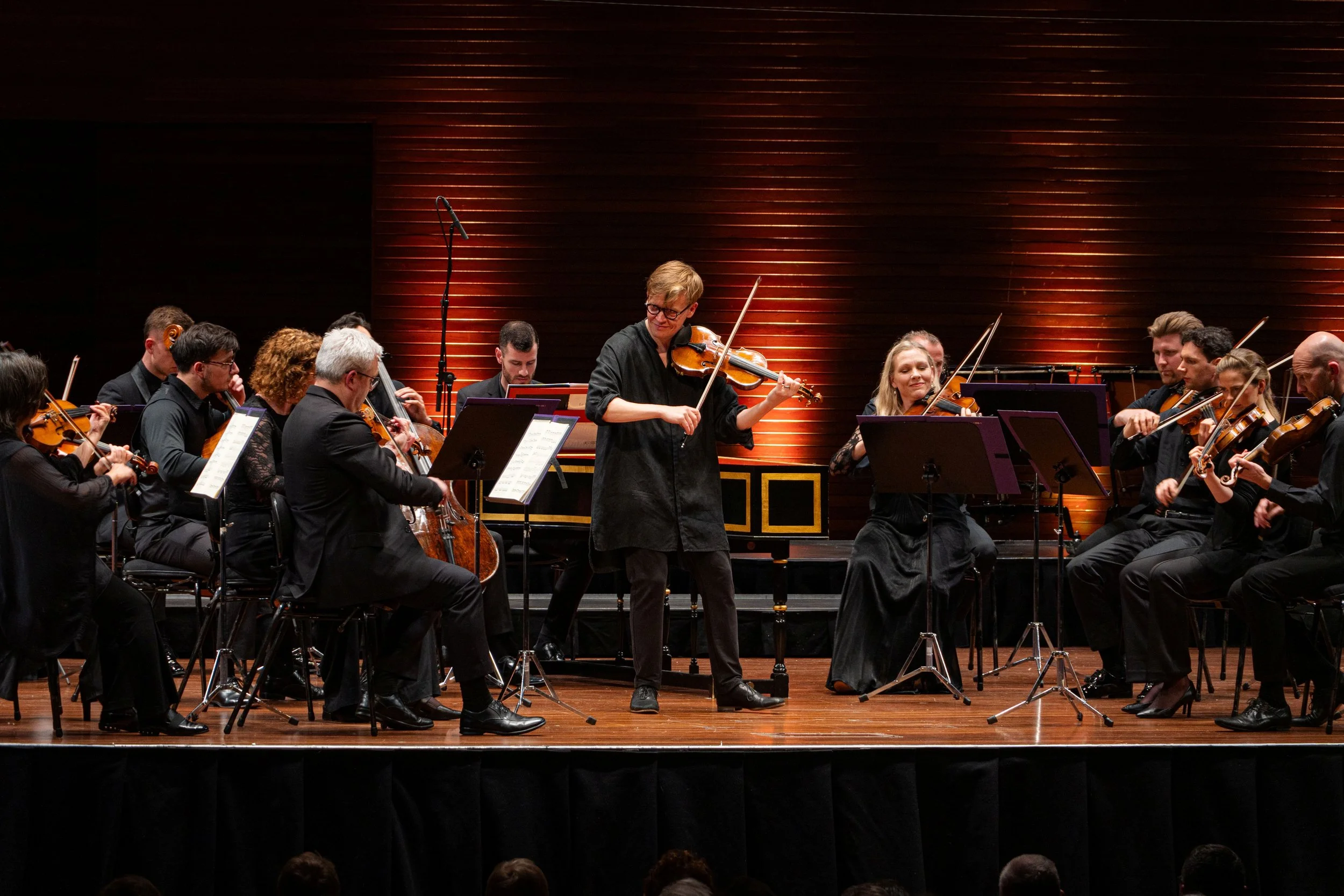
Violinist Pekka Kuusisto with the NZSO
“…playfully exaggerated dynamic contrasts.”
Image credit: Phoebe Tuxford/NZSO
Of course, an encore was demanded and Kuusisto chose a folky fiddle tune from Sweden – “après-ski” fare after Vivaldi’s winter, he suggested – turning his violin sideways to strum while he whistled the tune. He then picked up his bow for some whimsical folky fiddling that drifted to a close before his excited audience spilled out into the spring drizzle of Wellington’s streets.
NZSO “Four Seasons” Pekka Kuusisto Violin/Conductor Farrenc Symphony No 3, Vivaldi The Four Seasons Wellington October 9, 2025