
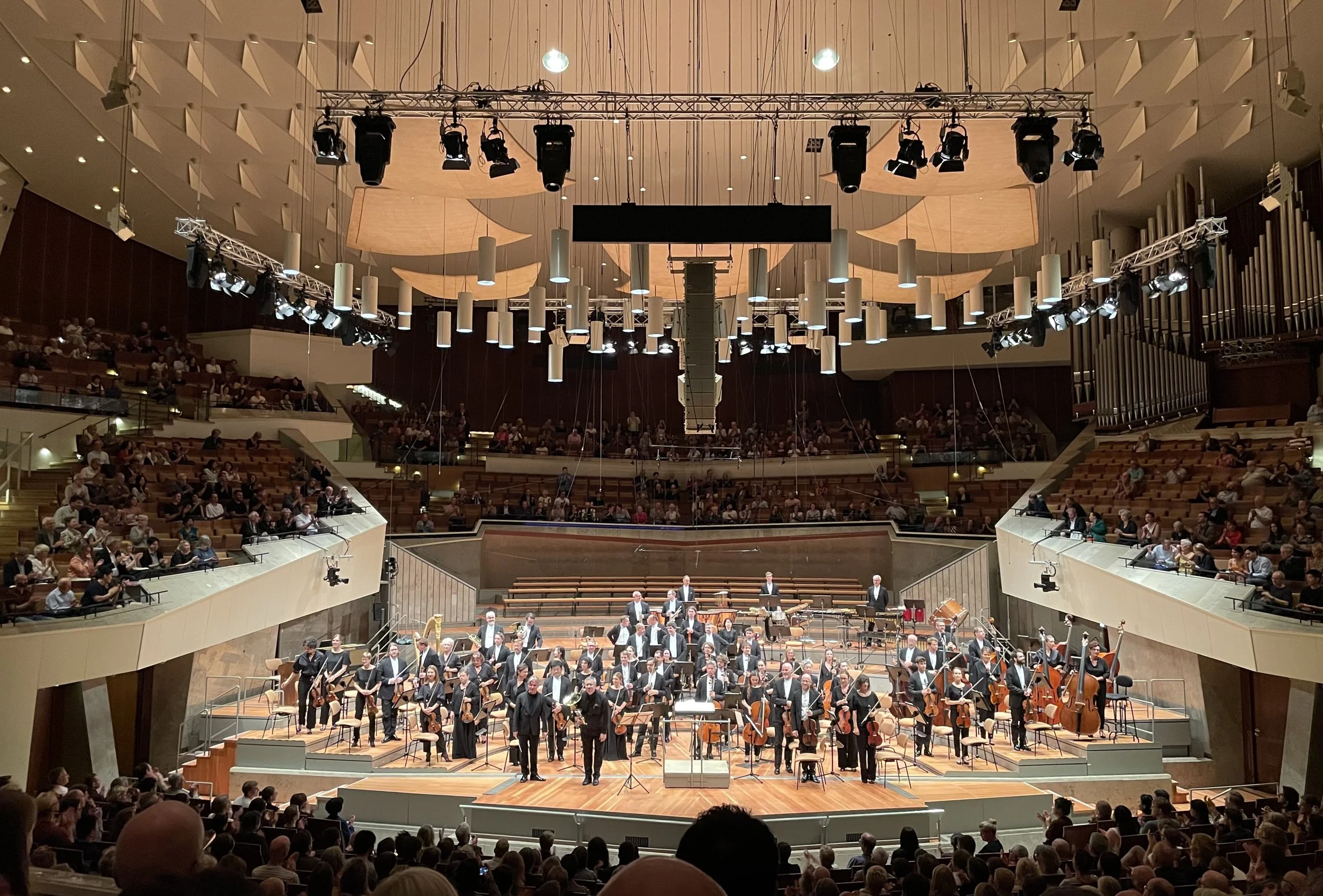
Composer-conductor Esa-Pekka Salonen with French horn player Stefan Dohr, after the Berlin performance of Salonen’s new Konzert für Horn und Orchester, with the Orchestre de Paris in the main hall of the Philharmonie Berlin.
I first visited Berlin in 1973. It was then two Berlins, and we crossed over from the capitalist West to Soviet East Berlin at Checkpoint Charlie, immediately struck by the stark contrast between the two parts of the divided city. I returned in 2005, a decade and a half after the fall of the Wall, to a city still painfully aware of its troubled recent Cold War history, everyone wanting to point out where the Wall had been. A little tattered, with weeds pushing through its pavements, it had nonetheless become a magnet for artists of all kinds.
This year I found a more unified Berlin, though its dark, brooding character still lurks beneath the surface. It has always been, however, a city that values the arts and classical music, and its galleries and concert halls are marvellous symbols of its creative heart.
The history of arts festivals in Berlin is as complicated as the recent story of the city itself. In 2005 the Berliner Festspiele’s music programme became “Musikfest Berlin”. We timed our visit to sample part of the three week event, which kicks off the Berlin concert season in late summer each year.
The Musikfest concerts are held in what must be one of the world's great concert halls, the Philharmonie Berlin. Built in 1963, then on the periphery of West Berlin, its tent-like shape and bright yellow colour made it a landmark in the city's new centre after the fall of the Wall in 1989.
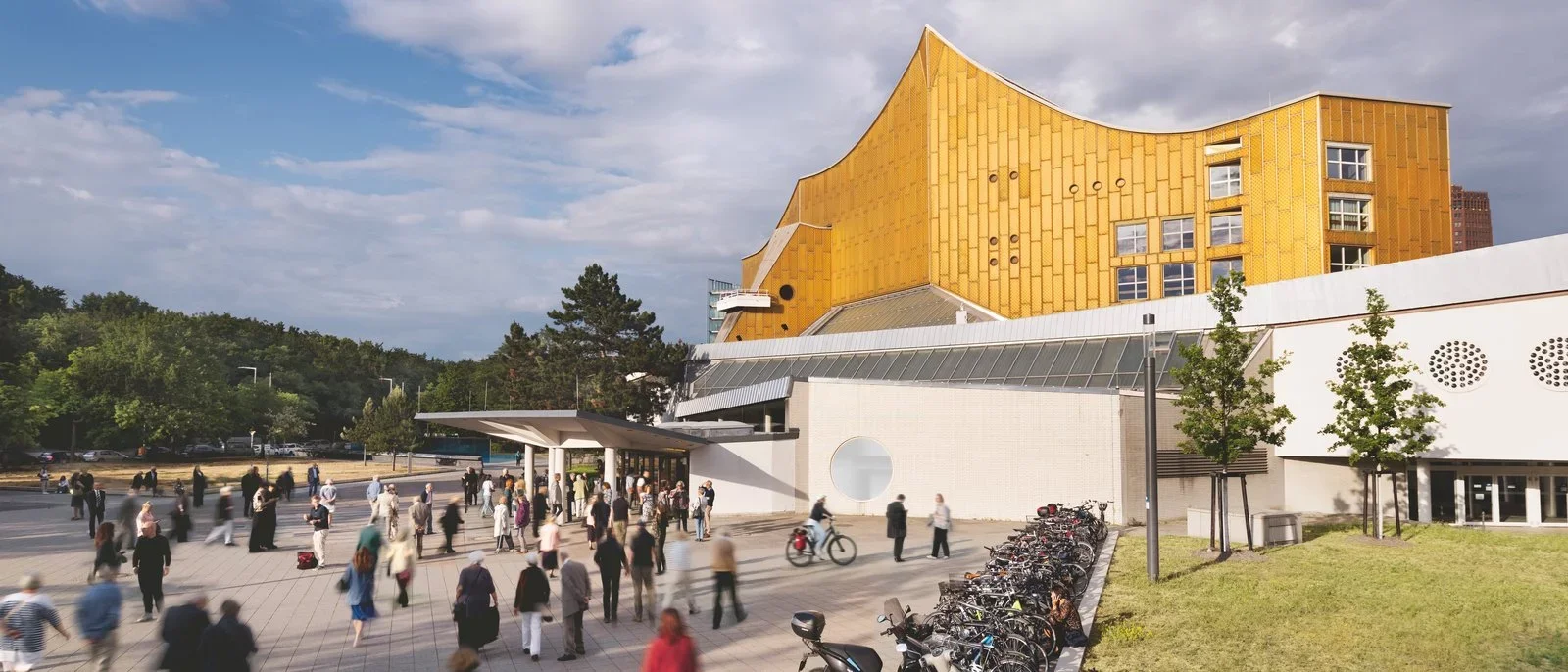
The Philharmonie Berlin
“…its main concert hall is a model for concert halls around the world.”
In 1920 architect Hans Scharoun described his vision for the ideal theatre space as “one person opposite another, arranged in circles in sweeping, suspended arcs around soaring crystal pyramids.” Thirty-five years later, he developed the main concert hall of the Philharmonie from this concept, with the concert platform and musicians the central focal point. Although initially controversial, the beauty and marvellously responsive and intimate acoustics of his design have made it a model for other halls around the world.
It was thrilling to take our seats there for the first concert of our European visit. The Musikfest, marking 2025 as the 100th anniversary of the birth of two titans of 20th century composition, Pierre Boulez and Luciano Berio, acknowledged both composers in its programming this year. As usual, it brought numerous international orchestras to its stages and we heard first the Orchestre de Paris with conductor-composer Esa-Pekka Salonen on the podium.
Conducting first without a baton, Salonen sculpted by hand the finely balanced melodic shapes and seductive colours of Requies by Berio, dedicated to the composer’s first wife, mezzo soprano Cathy Berberian. The exciting centrepiece of the programme was Salonen's own brand-new Konzert für Horn und Orchester, written for soloist Stefan Dohr, principal horn of the Berlin Philharmonic, and premiered in Lucerne just two days earlier.
The French horn was Salonen’s own first instrument and his familiarity with the instrument combined with his admiration for Dohr has produced a marvellous vehicle for the horn, beguilingly melodious with wonderful timbral variety for both soloist and orchestra. Dohr's playing was staggeringly good, and the ovation enthusiastic, many shouting "bravo!" and demanding multiple returns to the stage by soloist and composer.
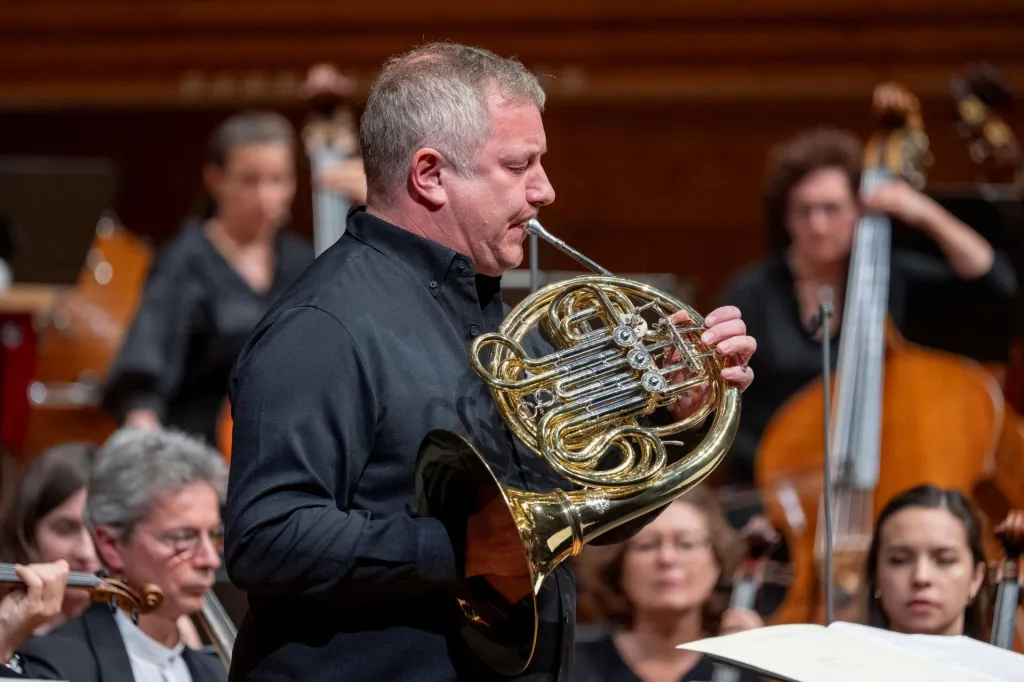
Horn soloist Stefan Dohr
“…staggeringly good playing in Salonen’s new Horn Concerto.”
The programme ended with a great display of Salonen’s conducting virtuosity in his compatriot Sibelius’ 5th Symphony. The maestro and his orchestra were in empathetic communication and the clarity of the Philharmonie’s acoustic allowed us to hear every dynamic subtlety in a brilliant and expressive performance.
It was an auspicious beginning to a month of wonderful concerts, in which we heard eight different orchestras and conductors in three European countries, a dozen concerts, many fine soloists and music spanning five centuries.
At the Musikfest Berlin we also heard two concerts by the classical-sized orchestra Les Siècles, described as an “authentic-sound” ensemble and playing on instruments made during the period of the music they are performing or modern replicas. (Their programme lists all the instruments on stage with makers’ names and dates.)
When my travelling companion and I planned this musical month, German violinist Isabelle Faust was high on our list of artists we wanted to hear, so we were delighted to see her programmed with Les Siècles for Beethoven’s Violin Concerto. It was a subtle, delicate and elegant performance by both Faust and the orchestra, led by young German conductor Ustina Dubitsky. Faust chose to play a cadenza with timpani accompaniment (perhaps composed by Christian Tetzlaff), featuring Les Siècles’ characterful timpanist Camille Baslé.
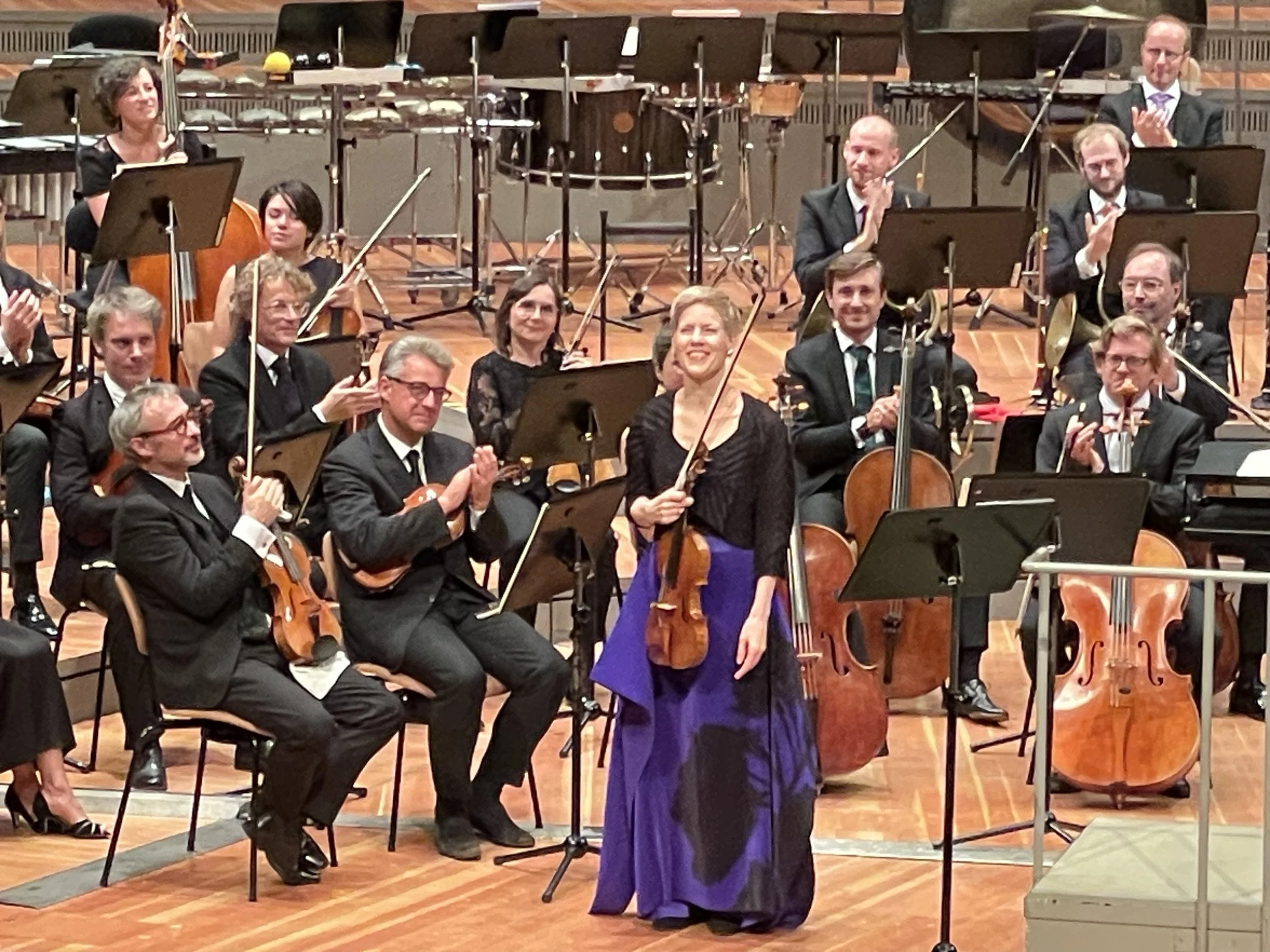
German violinist Isabelle Faust
“…a subtle, delicate and elegant performance of Beethoven’s Violin Concerto with the French ensemble Les Siècles.”
The second half of the programme offered the most insightful performance of Berlioz’s Symphonie fantastique I’ve ever heard – and like most concert-goers, I’ve heard many. The programme note told us it was one of the ensemble’s “internationally acclaimed showpieces” and this was not surprising – played on instruments from the period of its composition (1830), with great care and attention to detail, the performance felt as if Les Siècles were revealing the work to us anew without the accretions of history.
This was Symphonie fantastique in all its theatre, four harps lined up on the front of the stage at the beginning and then removed after the second movement in an exercise that earned the stage hands a round of applause; cor anglais and oboe placed not just offstage but at the back of the big hall to create the echoing pastoral duet of the 3rd movement; the quartet of timpanists creating their own drama with relish; the ‘March to the Scaffold’ building to a splendid frenzy for the decapitation of the idée fixe; and the ‘Witches Sabbath’, less strident on the period instruments but splendidly grotesque, played with visceral delight. It was a fresh and brilliantly coloured performance – how modern the work must have seemed, I thought, to the audience who heard it first just 3 years after Beethoven’s death.
In their second concert Les Siècles moved to French 20th century modernism, with Boulez’s Mallarmé cycle Pli selon pli, sung by soprano Sarah Aristidou and conducted by Franck Ollu. The title means literally fold by fold, “like the opening of a curtain”, in the words of the composer. The language is uncompromisingly atonal, its sensuous colour palette shimmering as the percussion layers part like those curtains to reveal the soprano line. Aristidou was quite brilliant in the challenging and angular vocal lines, alternately floating and emphatic. The fifth movement, ‘Tombeau’, is frenetic and cacophonous and eventually I found it impenetrable and difficult to like. The audience, though, was enthusiastic and appreciative of what was a great performance of a demanding work.
Before leaving Berlin we were able to visit the Pierre Boulez Saal, a personal dream after receiving their email newsletters for many years. This remarkable small hall is attached to the Barenboim-Said Akademie, which grew from the inspiring ideals of the West-Eastern Divan Orchestra, founded jointly by pianist and conductor Daniel Barenboim and the Palestinian literary and cultural scholar Edward Said in 1999. The Orchestra, and now the Akademie, bring together young instrumentalists from Israel, Palestine, Syria, Lebanon, Egypt, Jordan, Turkey and Algeria. The objective is not only music-making but the opening of young minds to the experiences and perspectives of their fellows from different cultures and lands.
When Barenboim told architect Frank Gehry about his plans for the Akademie, the architect offered his services pro bono to design a chamber music hall for the institution, working in collaboration with renowned acoustician Yasuhisa Toyota. Named after Barenboim’s friend and colleague Boulez, the Saal opened in 2017, the year after the French composer’s death.
The elegance and grace of this beautiful oval hall, apparently hovering in space, belie the astonishing logistical feats of its construction. Two ellipses and a rectangle were brought into harmony, the whole eastern section of the original building gutted, a steel-and-reinforced concrete shell inserted into the space, and the auditorium thus acoustically decoupled from the historical building around it, and insulated from the sounds of the outside world.
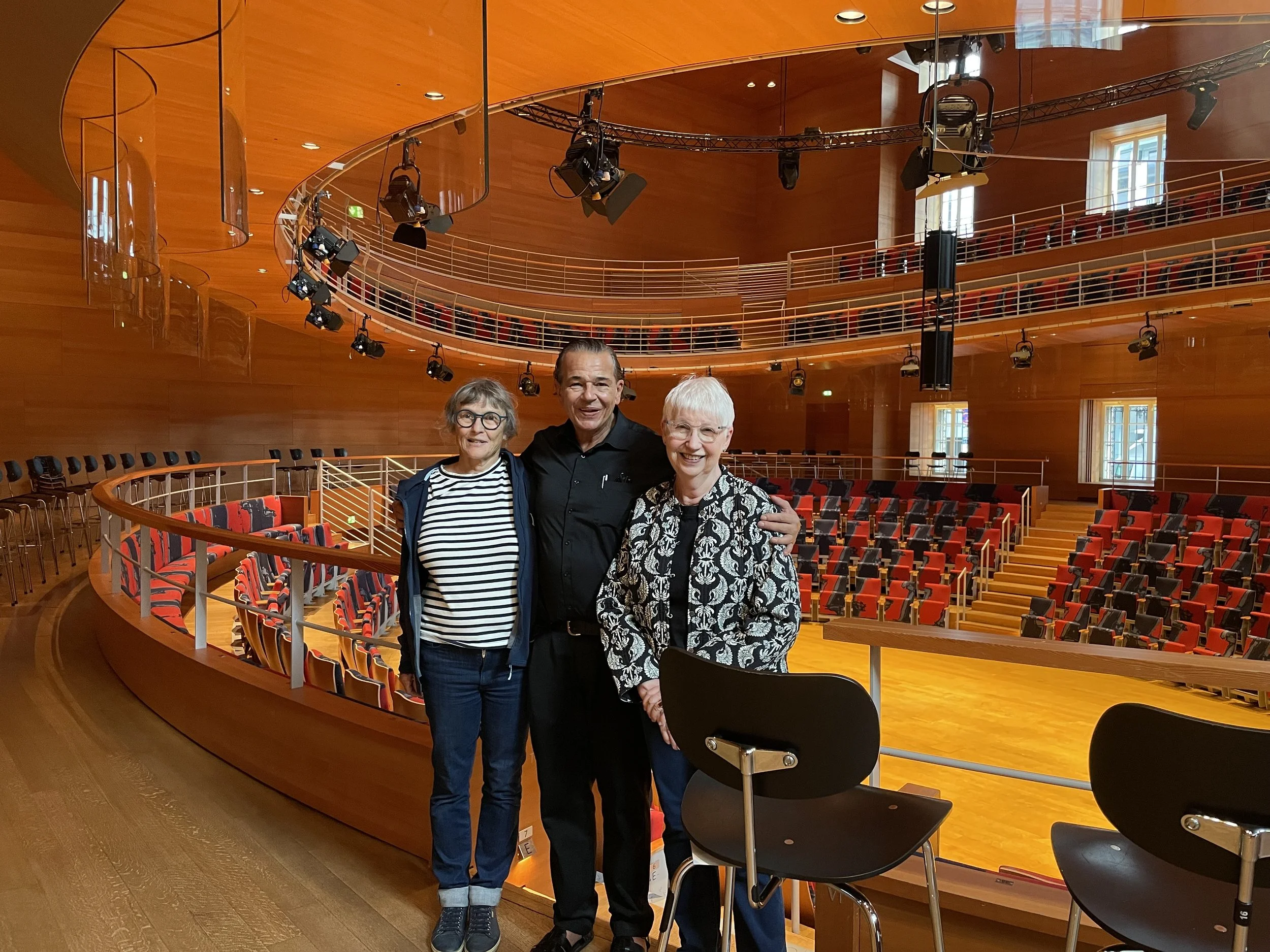
At the Pierre Boulez Saal in Berlin
(from left) Jane Connor, Christian from the Boulez Saal and the author.
There were no concerts in the Pierre Boulez Saal during our week in Berlin (it was their summer break) but I was able to arrange a private visit to the Hall, where the friendly Christian showed us the facilities and back stage area. I’ll be back to experience music there one day.
Art, architecture and opera in Copenhagen
From Berlin we travelled to Copenhagen, a city I’ve never visited, and immersed ourselves in its marvellous galleries of contemporary art, design and architecture. After the dark ambience of Berlin, the Danish capital seemed light, colourful and cheerful.
We visited before the main concert season had begun but had booked for a performance of Puccini’s Tosca at the Copenhagen Opera House (in Danish called Operaen), one of the most modern and well-equipped opera houses in the world. It was built early this century, funded by a private donation from the Foundation associated with the Danish shipping company Mærsk.
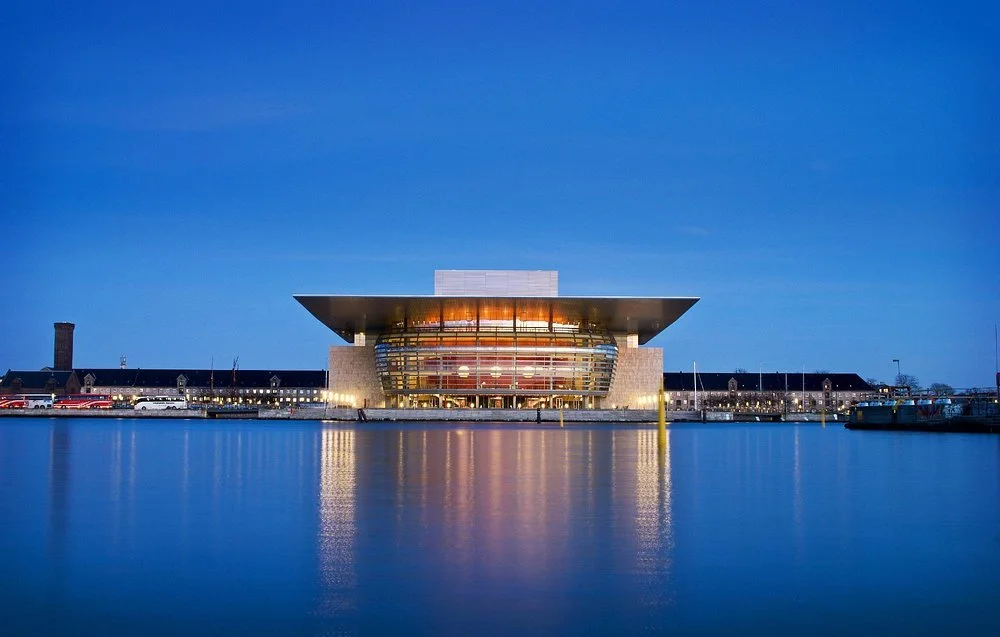
The Copenhagen Opera House
It is a magnificent opera house, situated on the shore of the Inner Harbour, splendid inside and out, with glittering foyer areas. From our seats in the front row of the 2nd circle we looked down into one of the biggest orchestral pits in the world. Everything is spacious, and the church setting for the first Act of Tosca seemed even larger with colossal mirrors along one wall and large hanging paintings.
Cast members soprano Marigona Qerkezi (Tosca), tenor Carlos Cardoso (Cavaradossi) and baritone Johan Reuter (Scarpia) are all possessed of voices a match for the large surroundings. Qerkezi portrayed a strong and strong-willed Tosca, Cardoso a perhaps more idealist than romantic hero, his passion more political than amorous.
Reuter found real menace as Scarpia, and this dark quality was somehow enhanced by his being clad in white, at first in smart uniform. Stripped to a white singlet and braces to oversee Cavaradossi’s torture in Act 2, he became a bull-like male, threatening, cruel and abusive. The upstairs-downstairs set arrangements in this Act showed off the technical capabilities of the house and greatly enhanced the contrast between an elegant performance above and the explicit and bloody interrogation below.
Orchestral work under conductor Daniele Squeo was outstanding throughout, as were the chorus and children’s chorus. Despite the acoustic clarity, however, I didn’t feel deeply touched by the operatic drama, particularly its ending. A single pistol shot replaced the firing squad and Tosca’s final suicide was ambiguous – had she actually jumped to her death? Perhaps the generous size and scale of the production didn’t enhance engagement, making it hard for singers and audience to experience the intimacy this romantic tragedy needs.
George Enescu Music Festival in Bucharest
I last visited Romania in 1973, on the same road trip that took me to East Berlin. The dictator Nicolae Ceauşescu was then both President and general secretary of the Romanian Communist Party and it was not a happy time for Romanians, who queued for day-old bread and lived in what seemed a bleak peasant economy.
Bucharest today is a much more modern city, though many beautiful older buildings and Orthodox churches are cheek-by-jowl with depressing Soviet-style apartment blocks built during the communist era and now in poor condition. Through its unhappy history, however, the country maintained its commitment to classical music and the George Enescu Music Festival began in 1958.
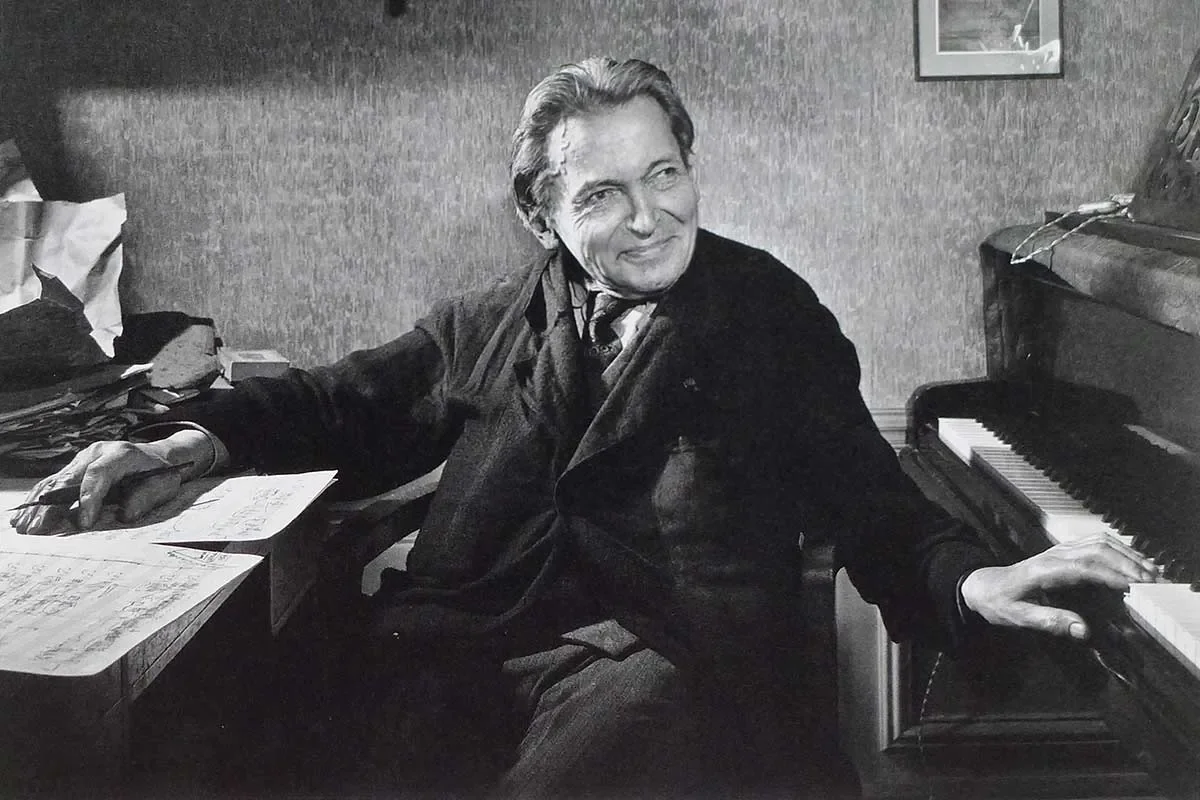
Composer George Enescu
“…venerated in Romania as the nations’ greatest composer.”
Enescu (1881-1955) is venerated in Romania as the nation’s greatest composer, although his music is less often played outside his country of birth. He is also remembered as a great violinist and the teacher and mentor of Yehudi Menuhin, and was apparently a formidable pianist and conductor. In 1946 he chose to leave communist Romania and spent the last nine years of his life in exile, eventually dying in relative poverty in Paris.
Three years after his death, the festival in his honour began in Romania and is now held every two years. It has become one of the biggest classical music festivals in Eastern Europe, bringing the world’s finest orchestras and performers to Bucharest for concerts. The 2025 programme, the 27th edition of the festival and marking the 70th anniversary of Enescu’s death, presented a staggering 95 concerts over four weeks from late August.
Our visit took in the last five days of the festival, allowing us to enjoy eight concerts in two splendid concert halls, the domed Romanian Atheneum and the Sala Palatului or Palace Hall, in programmes featuring some of the finest orchestras and performers of the whole festival.
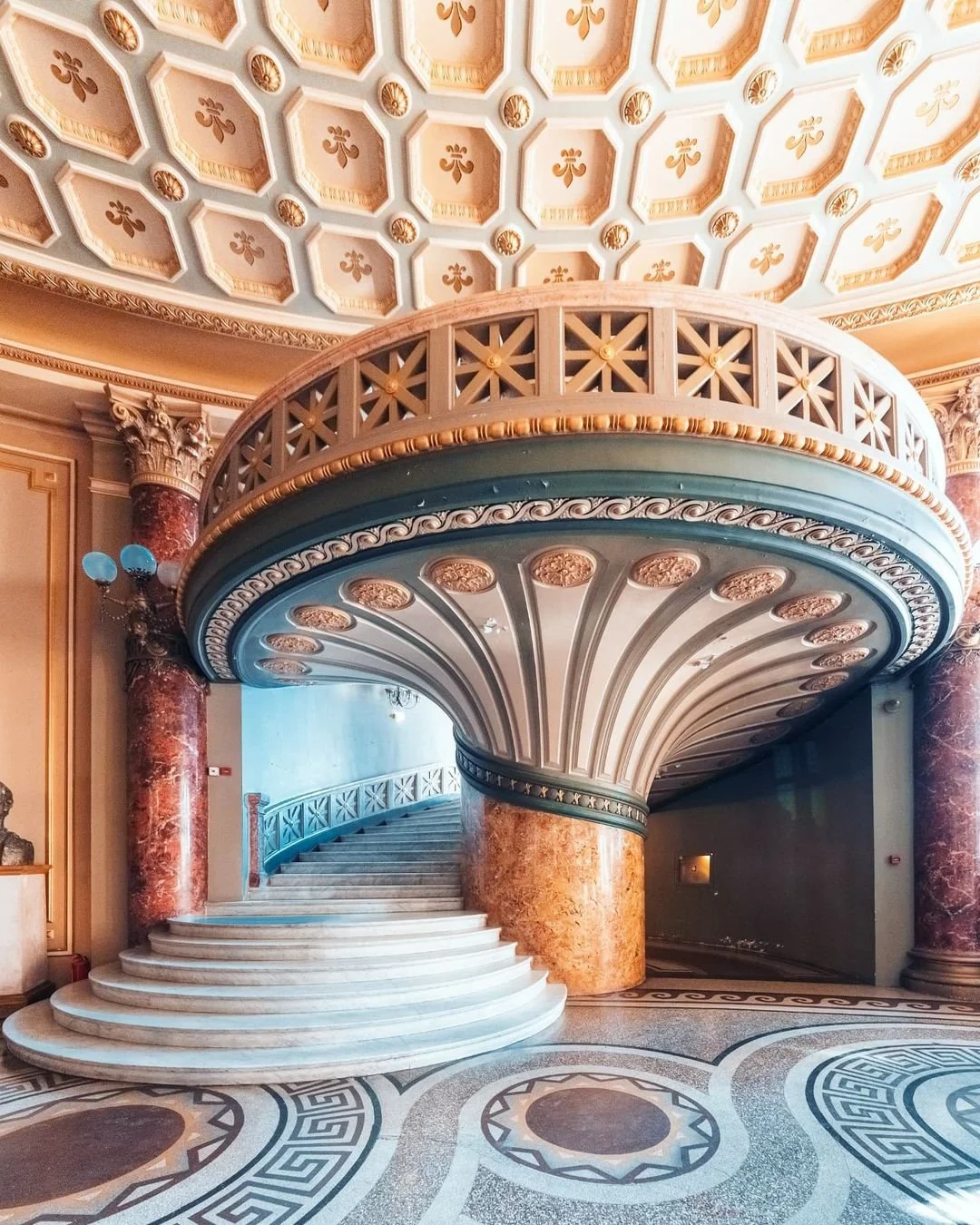
The foyer of the Romanian Atheneum
“…beautiful venue for many concerts in the George Enescu Music Festival.”
Entering the foyer of the Atheneum, the great beauty of the building is immediately striking. Built in the late 19th century and extensively restored in 1992, it is neo-classical in style, with romantic touches. Inside the auditorium, the audience is surrounded by a painted fresco depicting Romanian history on the circular wall, a lavishly decorated domed ceiling above. The stage has a proscenium arch but just behind it a large rectangular box on three sides of the generous stage provides a resonant sound shell that creates the hall’s bright, direct acoustic.
Our first concert there was one of the most memorable of the whole month. Sir András Schiff played two Mozart piano concertos with the Chamber Orchestra of Europe, directing the ensemble from the keyboard while drawing a gorgeous tone from the Bösendorfer piano. The hall is an intimate size, and Schiff’s unfussy but eloquent playing in the opening Concerto No 23 in A K488 drew us in. After a poignant Adagio the third movement was taken at a lively clip, the pianist standing at times to direct the orchestra, and pushing the tempo along from the keyboard.
The two Mozart concerti were separated by two Dvořák Serenades, the accomplished chamber-sized ensemble performing without a conductor, their playing characterful, graceful and beautifully balanced. Then Schiff returned for the highlight of the concert, Mozart’s Piano Concerto No 20 in D minor K 466. He embodied the music, sublimely musical, commanding and lyrical by turns, the dynamic contrasts beautifully handled and piano colours somehow reflected in the orchestra. In the final almost operatic movement, he maintained a splendid balance between soloist and orchestra, his dazzling playing almost improvisatory in its drama. I felt we were truly in the presence of greatness.
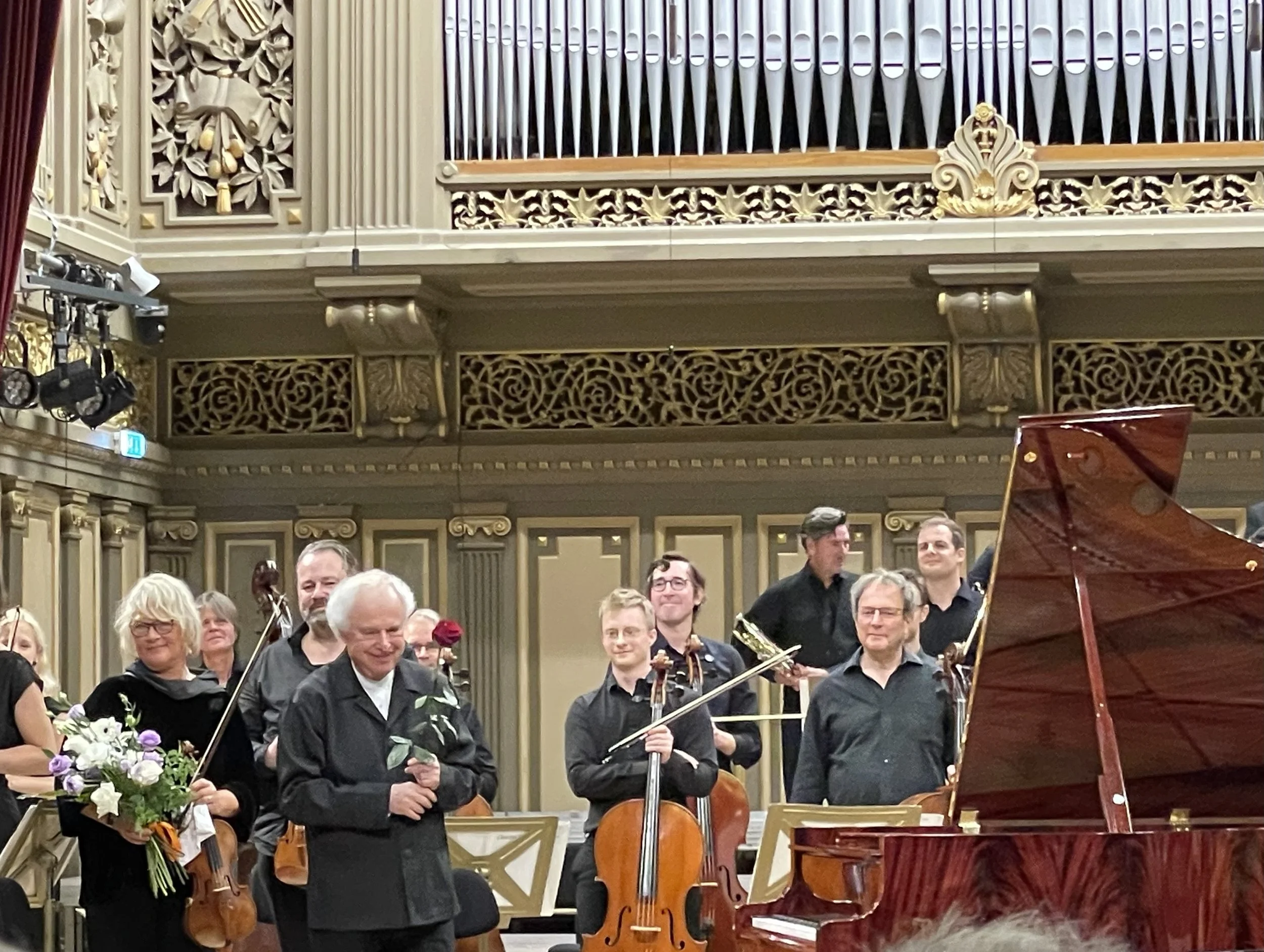
Pianist Sir András Schiff with the Chamber Orchestra of Europe
“…in the presence of greatness.”
Schiff offered a little encore, lovingly played. It was not identified but I suspect it was by Enescu himself, romantic and a little folky and an appropriate gesture towards the composer for whom the festival was named.
In spite of assurances that the two concerts would not overlap, we had to run to the nearby Palace Hall, arriving minutes before our second concert that evening, the distinguished Hungarian conductor Iván Fisher with the Budapest Festival Orchestra in a programme of Bartók’s stage compositions.
Built during the communist era in 1959/60, the Palace Hall is both huge and much plainer in design than the Atheneum. Used as a conference centre as well as a concert hall, the main auditorium accommodates 4,000, so we were relieved to be seated fairly close to the stage for our concerts there.
The Miraculous Mandarin was written by Bartók as a one-act “pantomime” ballet that caused a scandal at its first performance in 1926. For this concert, the brilliant contemporary dancers of the Hungarian Eva Duda Dance Company told the story of the prostitute and her gang of thugs attempting to exploit the mandarin, the compelling new choreography danced on a small stage in the middle of the orchestra.
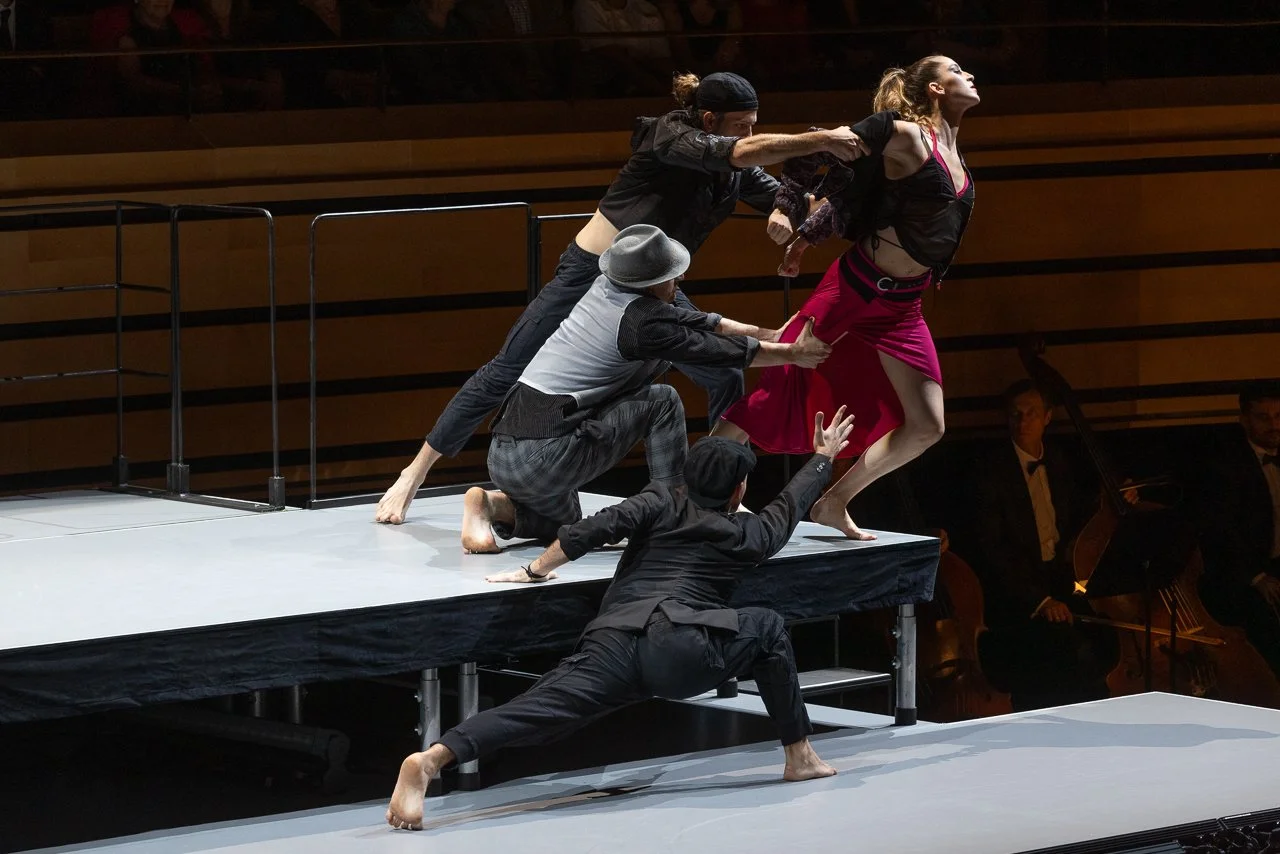
Dancers from the Eva Duda Dance Company
“…compelling new choreography for Bartók’s The Miraculous Mandarin, played by the Budapest Festival Orchestra conducted by Iván Fisher.”
We braved the bar in the massive foyer downstairs for an interval glass of bubbly to sustain us in the absence of dinner. A dazzling concert version of Bartók’s opera Bluebeard’s Castle followed, Fisher intoning the spoken introduction from the podium, while his left hand brought the strings creeping in behind him. Though the production was not staged, composer, conductor and performers showed us that Hungarians are masters of drama. Mezzo Dorottya Lang as Judith and bass Krisztián Cser as Bluebeard were marvellously expressive in Bartók’s chillingly atmospheric music, her face reflecting fear and anguish as the work becomes increasingly unsettled and savage. The orchestra, colourful with harps, woodwind, brass and percussion, also sang chorus parts as the opera moved to its climax. Sung in Hungarian with Romanian surtitles, the performance left us in no doubt about the inevitable progression of the gripping story.
We headed back to the Palace Hall the next evening for a much-anticipated concert featuring star violinist Anne-Sophie Mutter. She performed with the National Orchestra of France, under the baton of Romanian Cristian Mǎcelaru, Artistic Director of the George Enescu Festival.
Mutter, resplendent in cherry pink, was generous to her delighted audience, opening before her concerto with a work recently written for her by Thoman Adès. His Air is short and beautiful, opening with tiny ethereal sounds, and a high tessitura for much of the work, punctuated by deep bass notes in percussion, piano and low strings. Adès describes it as a series of canons in which the violinist’s part is “the freest agent in the mix”. Mutter’s beautiful sound climbs at the end to float in the ether with flute and 2nd violins, before a tonal resolution and a lovely quiet ending.
Her playing of Mozart’s 1st Violin Concerto in Bb major K 207 was a delight. As soloist she was a wonderful character in Mozart’s story, the first movement full of pace, her bowing a little off the string in a display of stylish and forthright virtuosity. Through all three movements her relationship with the very fine orchestra was a great interchange, Mǎcelaru responding to her lyricism in the 2nd movement and the momentum of her cracking pace in the third.
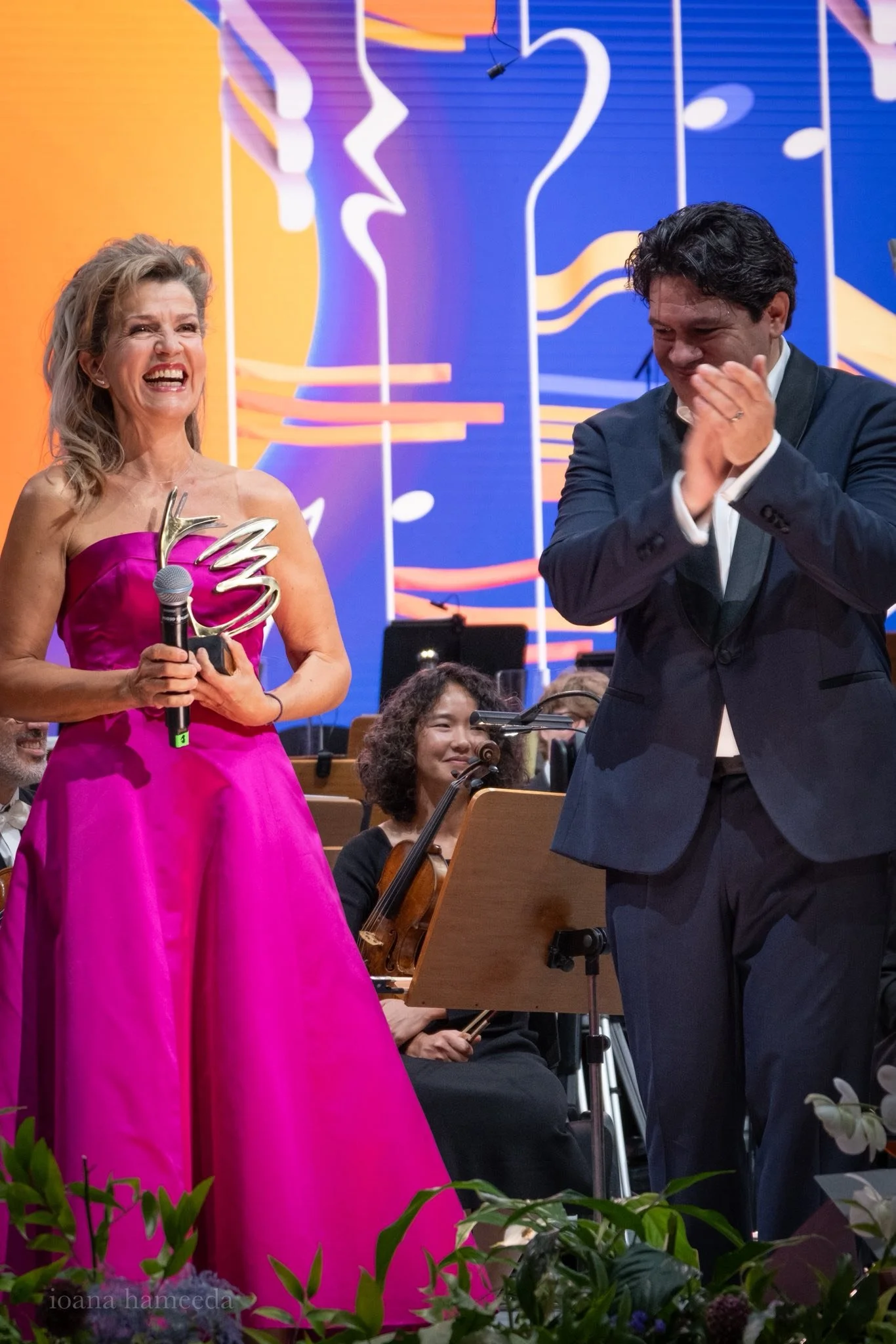
Violinist Anne-Sophie Mutter with Romanian conductor Cristian Mǎcelaru, Artistic Director of the George Enescu Festival
“…after a generous performance of music by Adès, Mozart and Bach, she received a special “excellence” award from the Festival, acknowledging her musicianship and humanity.”
Image credit: Ioanna Hameeda
Her generosity extended to an encore by Bach, after which the Festival presented her with a special ”excellence” award, referring to her humanity; she has apparently contributed to Romania’s orphanages.
The programme ended with Ravel’s Daphnis and Chloe, the French orchestra finding all the sensuous colours, sweep and flow of this lovely music. The video that surrounded the orchestra was, however, completely superfluous, just an unnecessary distraction from a performance by musicians and a conductor who absolutely got the composer’s gorgeous music and aesthetic intentions.
The next day we were back in the beautiful Atheneum in the late afternoon to enjoy the very fine Scottish Chamber Orchestra, their playing under conductor Maxim Emelyanychev as extrovert as the beautifully clear acoustic in selections from Beethoven’s Prometheus. Their somewhat “historically informed” performance included natural horns, trumpets and trombones and the whole ensemble was passionately engaged.
Percussionist Colin Currie joined them for Scottish composer James MacMillan’s concerto Veni, Veni Emmanuel. I confess I often find MacMillan’s music neither inventive nor subtle, relying on “apocalyptic” use of crashing gongs and dark deep instruments, rather than rhythmic or melodic invention. Currie was impressive in his speedy coverage of a huge array of percussion across the stage and he further impressed with a virtuosic solo encore.
The programme ended with as good a performance as I’ve heard of Beethoven’s 5th Symphony, taken at a fast and urgent pace, the orchestra sounding marvellous in the Atheneum in a reading full of momentum and character. Counterpoint was fast but clear, pizzicato sections precise and telling and the whole group exuberant and joyful in demeanour. They then asserted their Scottish character with not only tartan ties but a cheerful foot-tapping encore evoking fiddles and reels, Whisky Mouth, by their composer-in-residence Jay Capperauld.
Somewhat breathless with the excitement of all this musical pleasure, we headed back to the Palace Hall that evening to join Mǎcelaru and the National Orchestra of France for their second concert, this one with the first programmed work we’d heard by Enescu himself, his Romanian Rhapsody No 2 in D major, Opus 11. It’s a work with warm tonality and patriotic fervour expressed through folk melodies, lovingly performed and featuring fine solo work from plaintive cor anglais, soaring trumpet with timpani, viola imitating a folky fiddle and a beautiful flute solo at the end.
The rest of the programme included a sultry, jazz-infused performance of Gershwin’s Piano Concerto in F by Austrian pianist Rudolf Buchbinder, who absolutely captured the work’s flavour. An arrangement of Ravel’s Piano Trio for orchestra left me convinced I prefer the original Trio version, and the concert ended with Ravel’s apparently schmaltzy, lush Valse, a work with a surprisingly expressionist ending, the elegant waltz distorted to evoke, it seems, the death throes of imperialist society. After this, the “Bacchanale” from Saint-Saën’s Samson and Delilah seemed a fitting choice as encore.
What are the Finns getting right for conductors? For our first and last orchestral concerts in Europe Finnish conductors took the podium, Salonen in Berlin and Klaus Mäkelä in Bucharest, and both offered extraordinary, insightful performances. Both have been mentored by the legendary Finnish teacher of conducting, Jorma Panula, which may be one of the clues to answering this question.
Mäkelä is a name to remember. He is not yet 30 but has already held or been appointed to chief conductor or music director roles with the Oslo Philharmonic, the Orchestre de Paris, the Royal Concertgebouw Orchestra and the Chicago Symphony. It was a privilege to hear the work of this astonishing young conducting talent in our final two concerts at the George Enescu Festival, with one of the world’s greatest orchestras, the Royal Concertgebouw, of which he is chief conductor designate.
In the first of these he and the Orchestra delivered a staggering performance of Mahler’s Fifth Symphony, preceded by Berio’s Rendering, a magical re-imagining based on Schubert’s fragmentary score of his uncompleted D major symphony, D 936A. I’ve never heard Rendering live before and was entranced by its beautiful and mysterious colours, laid out gently by Mäkelä with exquisite attention to detail.
Nor do I ever expect to hear a better performance of this marvellous symphony by Mahler. From the opening solo trumpet, setting in motion the funeral march, all was tension and drama, the conductor breathing with the brass, the movement building in savage power. Mäkelä has marvellous control of the interpretation, the strings play as one, the Viennese lyricism and passionate melodies are placed in textures of absolute clarity. The dancing triple rhythms of the third movement were subtle and graceful, horns playing with an edgy timbre, bright, extrovert trumpets soaring above, the tempo held back before an exhilarating drive to the end of the movement.
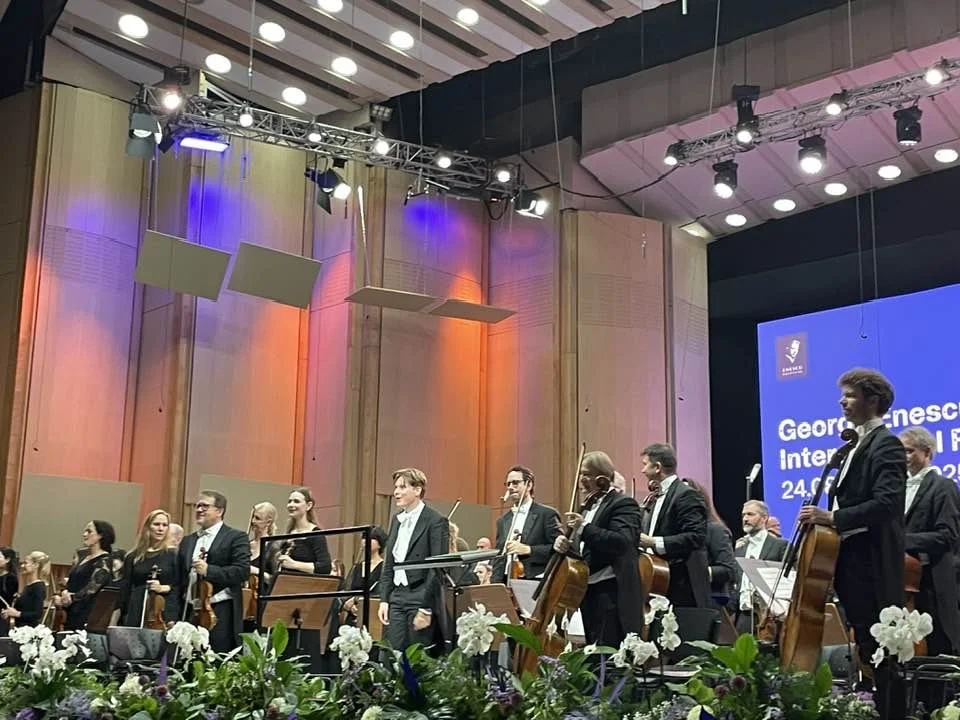
Finnish conductor Klaus Mäkelä with the Royal Concertgebouw Orchestra
“…outstanding performances of Mahler’s Fifth Symphony and Stravinsky’s The Rite of Spring at the George Enescu Festival. “
The famous Adagietto of the romantic fourth movement was slow, almost reverent and rubato-infused, the large audience holding its collective breath. In the happier final movement, the counterpoint bounced joyously, the conductor lowering his baton towards the end of the movement and allowing the brass and winds to play on freely before coming alive to bring in the string sections and build both texture and dynamics to the brilliant ending.
The Concertgebouw’s second concert was on the final day of the George Enescu Festival, and opened appropriately with Enescu’s music, his first orchestral Romanian Rhapsody, from the Opus 11 pair of which we’d heard the second from the National Orchestra of France a couple of days earlier. The many Romanians in the full hall clearly appreciated the fine, almost loving performance from Mäkelä and the Orchestra, the conductor dancing with the graceful music, a rustic stamping dance picking up pace, all sections revelling in Enescu’s fine orchestration. The harmonic language is not adventurous, which may account for the Romanian composer’s lower profile amongst his 20th century European peers, but in the hands of this conductor and orchestra, the music had an invigorating charm and the audience exploded into applause.
The programming of the 2025 George Enescu Festival reflected the historically close ties between Romania and France, based on their Romance languages and many cultural exchanges between the two nations. Bucharest even has an Arc de Triomphe and has been called the “little Paris” of Eastern Europe. French pianist Jean-Yves Thibaudet was soloist for Saint-Saëns ‘Egyptian’ Concerto, bringing a hint of Liberace to the stage in his leather suit, and dazzling with his virtuosic flourishes in a work full of lovely French colours and beguiling lightness. Mäkelä and the Orchestra were flexible and responsive in accompaniment.
The concert and our own Festival experience ended with Stravinsky’s The Rite of Spring. As expected, from the gorgeous wind playing of the opening dawn chorus it was a stunning performance of a work that was a famous cataclysm in musical history. Mäkelä and the Concertgebouw worked in a close musical collaboration, the conductor again stopping occasionally to allow the orchestra to continue in rapid sections. The string sound was huge when needed, the moments of frenzied savagery extraordinary, the telling silences full of drama. Mäkelä exaggerated the dynamics to great effect, pianissimo used with tension and restraint, as if all were on tiptoe. As the music moved towards the final dramatic denouement, every section of the orchestra, violas, pizzicato violins and cellos, a great horn section, the muted trombones, all contributed to an elemental and riveting performance of an iconic work.
And so, our wonderful month of concerts in Europe was over. The remarkable musicians, the conductors, soloists and orchestras we heard are well-known artists readily available on recordings and screen. But my recent travels have convinced me anew that the magic of live performance, the joy and thrill of seeing these world-class artists live in concert, working together to interpret the masterpieces of history and of today in the world’s great concert halls, cannot be replaced.
You’ll find more information about Musikfest Berlin here and the George Enescu Music Festival here.