
NZSO’s Stabat Mater: Victoria Kelly’s profound and moving new work
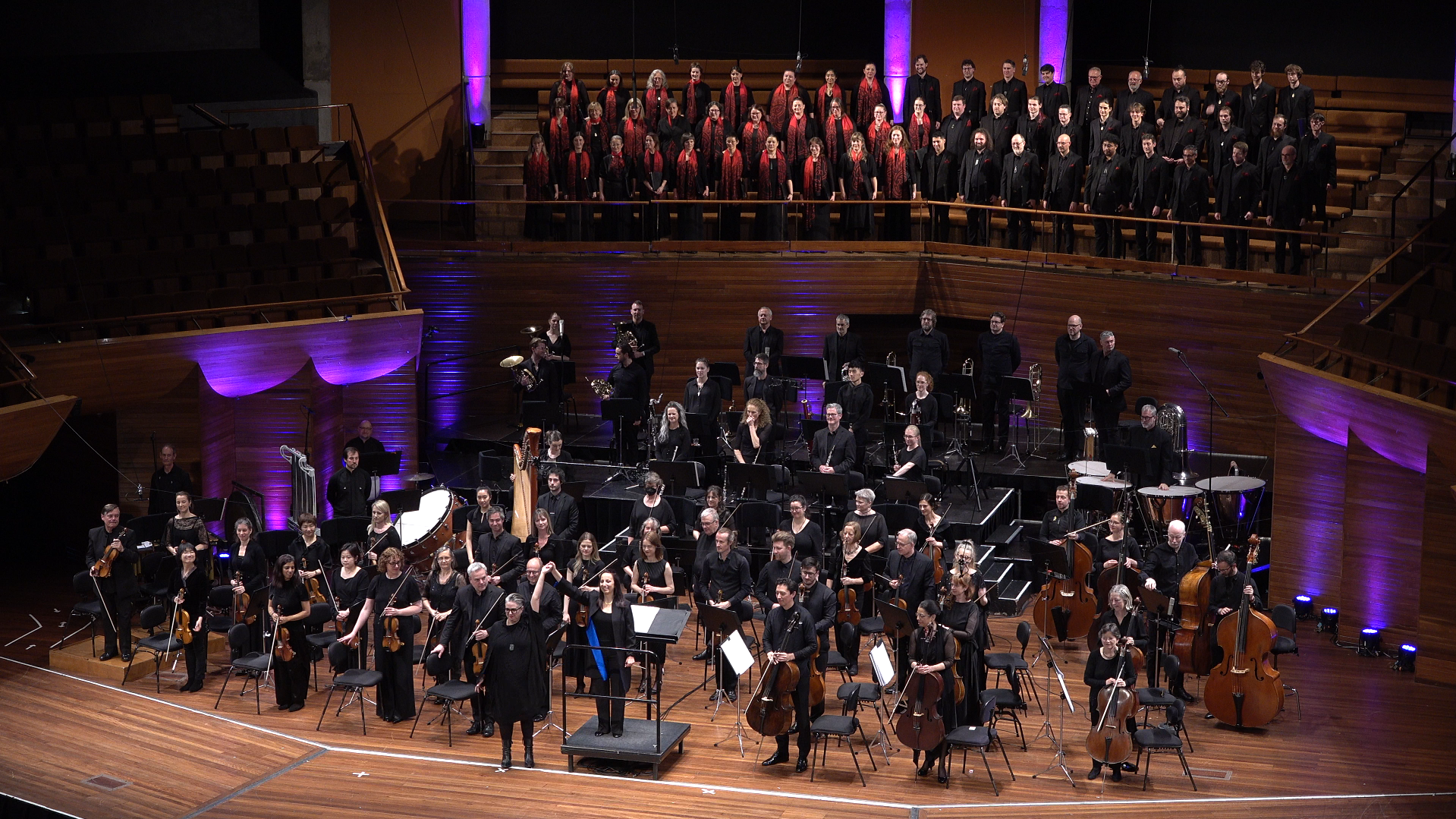
Composer Victoria Kelly and conductor Valentina Peleggi acknowledge applause for the premiere performance of Kelly’s Stabat Mater
Image credit: Chris Watson/SOUNZ
The 13th century text Stabat Mater begins: “Stabat mater dolorosa/juxta crucem lacrimos/dum pendebat Filius”, which can be translated as “The sorrowful mother stood/ weeping by the cross where her Son was hanging.”
Every century since these words were written, composers have set this beautiful and moving text, the very long list including Palestrina, Vivaldi, Pergolesi, Haydn, Schubert, Rossini, Dvořák, Verdi, Avo Pärt and James MacMillan. For its recent concerts in Wellington and Auckland, the NZSO chose Rossini’s version, performed with the Voices New Zealand choir and soloists Madison Nonoa (soprano), Anna Pierard (mezzo), Filipe Manu (tenor) and Australian bass Jeremy Kleeman.
On the podium was Italian conductor Valentina Peleggi, making her New Zealand debut.
To complete the programme, the NZSO had asked New Zealand composer Victoria Kelly to compose a contemporary response to Rossini’s setting, and her commissioned Stabat Mater had its world premiere in the two concerts.
Performed by a classical-sized NZSO, Rossini’s work opened the evening, his melodious orchestral introduction rather like an operatic overture. Throughout the work we were reminded that Rossini was a master of opera, his tuneful writing for choir and soloists beautifully judged. Manu’s Air “Cujus animam gementem” (Her spirit groaning) was sung with beautiful expressivity, answered by the two women soloists in attractive duet, with the orchestra and Peleggi sensitive in accompaniment.
Rossini’s Stabat Mater is not an adventurous setting. It unfolds in an understated manner, the bass soloist taking the story forward in the Air “Pro peccatis suae gentis” (For the sins of his people). Kleeman’s fine voice carried splendidly in the Michael Fowler Centre, his singing glowing through the orchestral textures.
Nonoa brought a lovely lyricism to her duet with Manu, Rossini’s light touch sweetly harmonious, the story told with only a little drama. Mary’s anguish and that of Christ’s followers became more intense in a lovely Cavatina, “Fac ut portem Christi mortem” (Let me bear Christ’s death) sung beautifully by Pierard with solo clarinet and bassoons in tuneful support.
The arc of the work builds towards the Air and Chorus “Inflammatus et accensus” (So fired and consumed with flames). With brass and timpani, the orchestral sound is full of grandeur, the strings darkly foreboding and the choir quite magnificent with a big strong open sound. Nonoa, pleading and distressed, used her big passionate voice to soar over the other forces in a high point of drama.
Rossini’s dramatic instincts take the music back down to a compelling unaccompanied quartet of the four soloists, his sometimes chromatic melodic lines falling sadly downwards as the work approaches its ending. It’s a highly effective moment, although in this performance the four singers were a little uneasy in pitch and blend. Finally, all ends with a contrapuntal Amen from choir and orchestra.
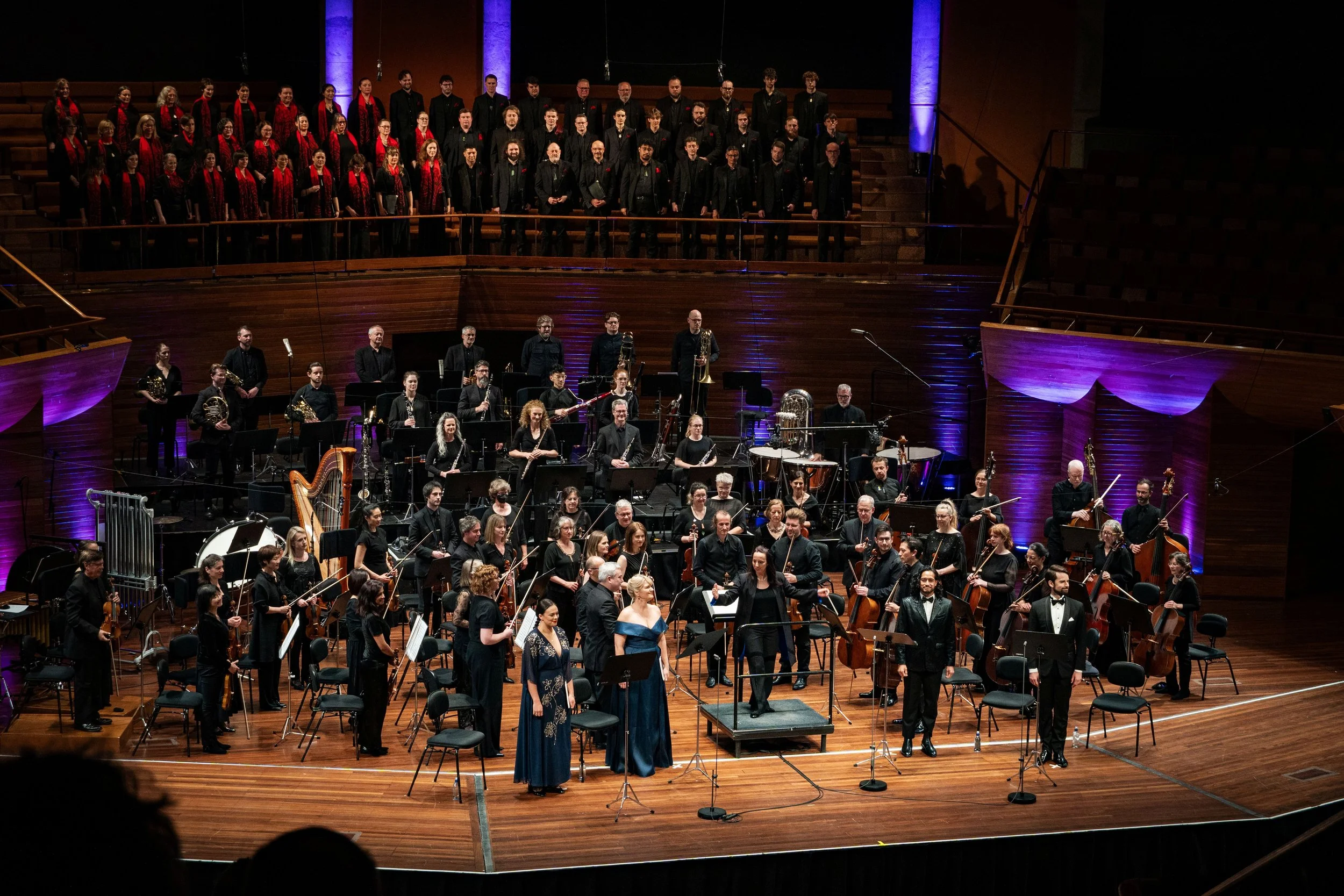
Soloists (from left) Madison Nonoa, Anna Pierard, Filipe Manu and Jeremy Kleeman, with conductor Valentina Peleggi, the NZSO and Voices New Zealand, acknowledge the ovation for Rossini’s Stabat Mater
Photo credit: NZSO/Phoebe Tuxford
I found myself wishing Rossini had been a little less understated in his treatment of a text full of potential emotion and drama. Fortunately Victoria Kelly’s response drew the audience into a much more immediate and raw emotional place.
Kelly has been eloquent in pre-concert conversations about her new work and explicit about her reaction when invited to compose a Stabat Mater. The text, she says “provoked an overwhelming sense of rage and sorrow in me. As a mother of three children, I found Mary’s suffering impossible to conceive and the glorification of it hard to accept.”
Setting aside the Stabat Mater text, Kelly wrote her own. “I realised,” she wrote in her programme note, “that the piece could not be about rage or sorrow. Instead it is about power - Mary’s power, feminine power and maternal power - all of which I have ultimately interpreted as life. I’ve imagined an alternative version of Mary’s story where she doesn’t accept the suffering of her child - she can sense how that sacrifice will be exploited, and how the enduring forgiveness that it offers will be corrupted by people in pursuit of their own interests in the centuries to come. So instead, she saves her son.”
It's a bold approach and one that absolutely succeeds.
Kelly’s composition has the emotional power, dramatic heft and direct communication that I missed in much of Rossini’s tuneful setting. She has drawn, too, on past traditions of word-painting through instrumental timbres in her orchestral writing, enlisting the percussion section to illustrate a new story for Mary.
The work opens with a crystal singing bowl tuned to middle C, the pure white vessel and sound representing the virgin throughout the work. Like Rossini, she plays with contrasts of light and dark, not only using major/minor tonalities, but bending these through the use of microtones in both instruments and voices. The plaintive oboe and microtonal inflections in the flute are poignantly expressive of anguish and pain in the opening section.
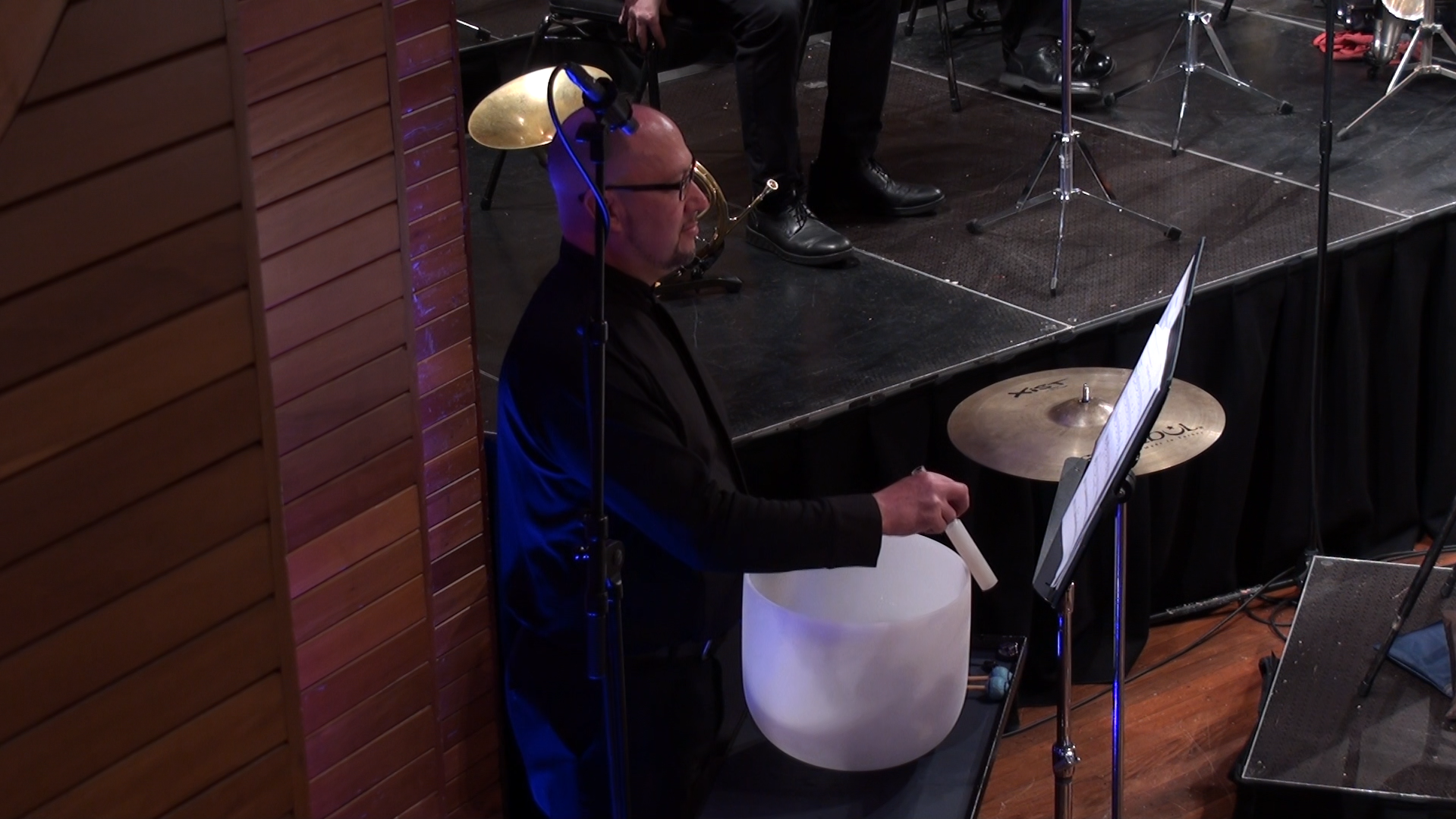
Victoria Kelly’s Stabat Mater opens with a crystal singing bowl
Image credit: Chris Watson/SOUNZ
When the singers of Voices enter with Kelly’s text – “This Mary does not weep” – percussion and harp colours are splendidly communicative, the dramatic orchestral effects almost keening. A lovely contrapuntal chorus repeats the words “she does not weep”, male voices repetitive, the women singing different lines. Bells add to the narrative of the percussion colours.
Kelly has talked about her preference for deep-toned instruments, and trombones and tuba underline a big swell, illustrating Mary’s strength, perhaps? “She wants no choirs castrated…she does not wait.” Silence is also used tellingly.
The singers of Voices are marvellous throughout, the text wonderfully clear, vocal lines skilfully woven together, while tuba and contrabassoon express dramatic foreboding. Conductor Peleggi revealed a real affinity for the new work’s message of female strength. The audience was captivated and involved, the music touching and deeply emotional, the impact sustained with intense, wide-spaced harmonies.
The opening words return at the end – “this Mary does not weep…she does not wait…she does not mourn” – and with brilliant juxtapositions of dark and light instrumental colours, the choral line descends, wordless, the white singing bowl returns to the texture and the work ends with goosebumps and tears throughout the hall.

Composer Victoria Kelly
“…her Stabat Mater further establishes her as one of Aotearoa’s most significant composers”
Image: NZSO/supplied
Two and a half years ago Kelly moved her audience profoundly with her Requiem, a work using the words of New Zealand poets in an extended and deeply felt composition written after the deaths of her parents. It’s good news that Kelly’s Requiem will shortly be performed by Orchestra Wellington; the premiere in the 2023 Auckland Arts Festival made a huge impact. (See my review here.)
With this Stabat Mater, Kelly further establishes her place as one of our most significant composers, one whose music has the capacity to move and engage audiences on a deep and personal level. The performance will be available at some stage on the NZSO’s livestream channel, NZSO+ and on the website of SOUNZ Centre for New Zealand Music.
NZSO Stabat Mater Music by Rossini and Victoria Kelly, conducted by Valentina Peleggi with Madison Nonoa (soprano), Anna Pierard (mezzo soprano), Filipe Manu (tenor), Jeremy Kleeman (bass) and Voices New Zealand Choir. Wellington 2 October, and Auckland 3 October, 2025.
Orchestra Wellington conducted by Marc Taddei will perform Victoria Kelly’s Requiem in the programme The Artist Repents, with Barbara Paterson (soprano), Alexander Lewis (tenor) and the Tudor Consort. Saturday, 22 November 2025. Bookings here.