
NZTrio and friends – and what makes a great concert
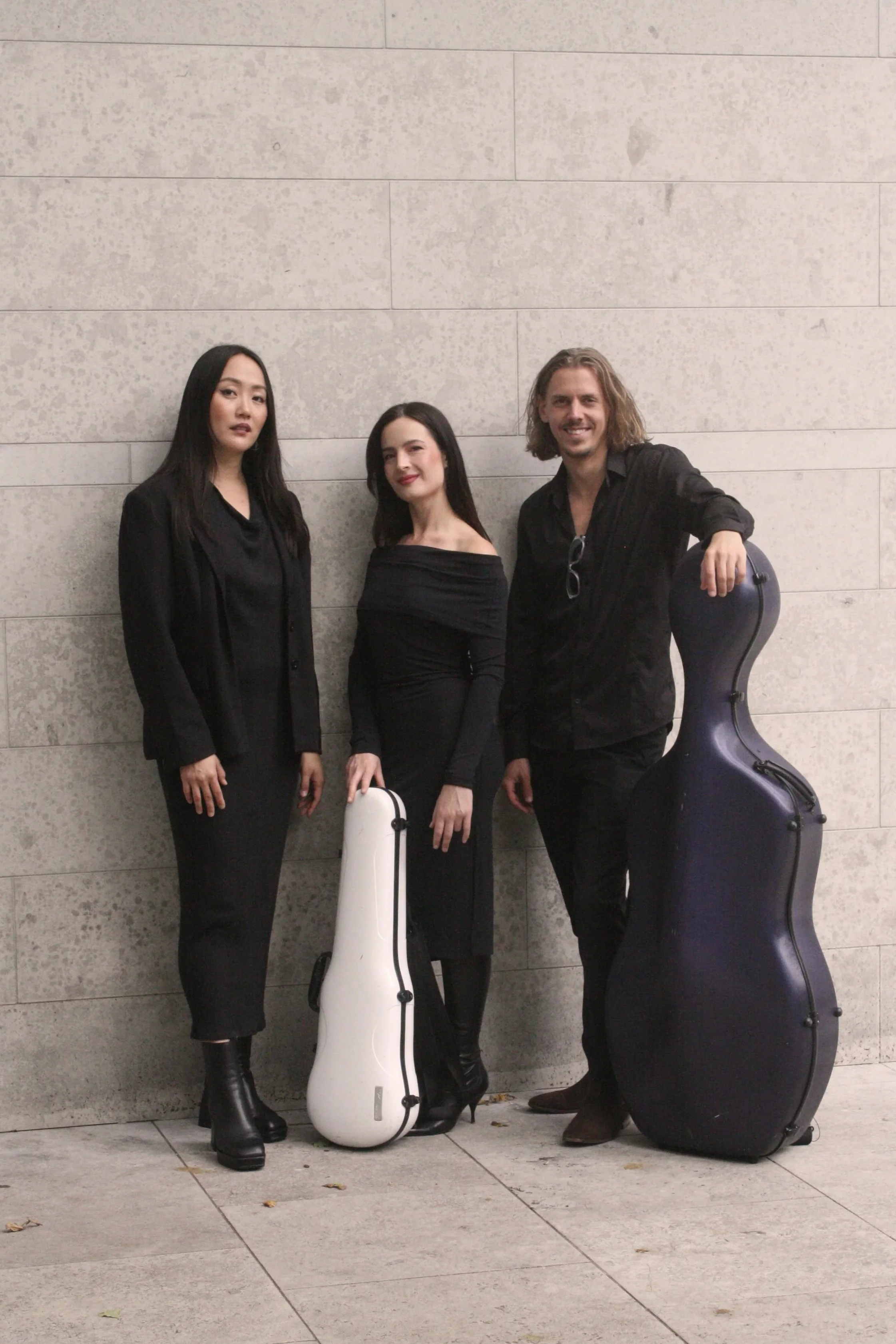
NZTrio on tour (from left) Somi Kim (piano), Amalia Hall (violin), Matthias Balzat (cello).
Image credit: NZTrio
Two recent touring programmes by NZTrio had me thinking about the ingredients of a really great concert. What gives us that buzz of excitement and feeling of satisfaction as we leave the hall? I’ll come back to that question – and some answers – later in this review of the two concerts.
The Trio’s first tour programme, in August, was called, intriguingly, “Space Jump”. Turkish pianist and composer Fazil Say was one of eight million live viewers when Austrian daredevil and skydiver Felix Baumgartner jumped to earth from a helium balloon in the stratosphere in October 2012. He set numerous records with the jump, and was the first human to break the sound barrier with his free fall before he broke open his parachute, eventually landing in New Mexico.
Every phase of the jump is depicted in Say's composition Space Jump for piano trio, a peaceful meditative first movement inspired by the take-off in the capsule attached to balloons, the tension, terror and thrill of the free fall in a fierce 2nd movement and the floating lyricism of the work's conclusion.
NZTrio began with Fay’s work in a concert in the intimate, art-filled setting of Ngā Pou Ruahine, the small performance space on the top floor of Te Matapihi, Wellington's re-opened Central Library. Their playing captured all the sometimes terrifying drama of Space Jump, from liquid meditative piano through frenetic action with lines flung around the ensemble before the profound unison of the final Maestoso.
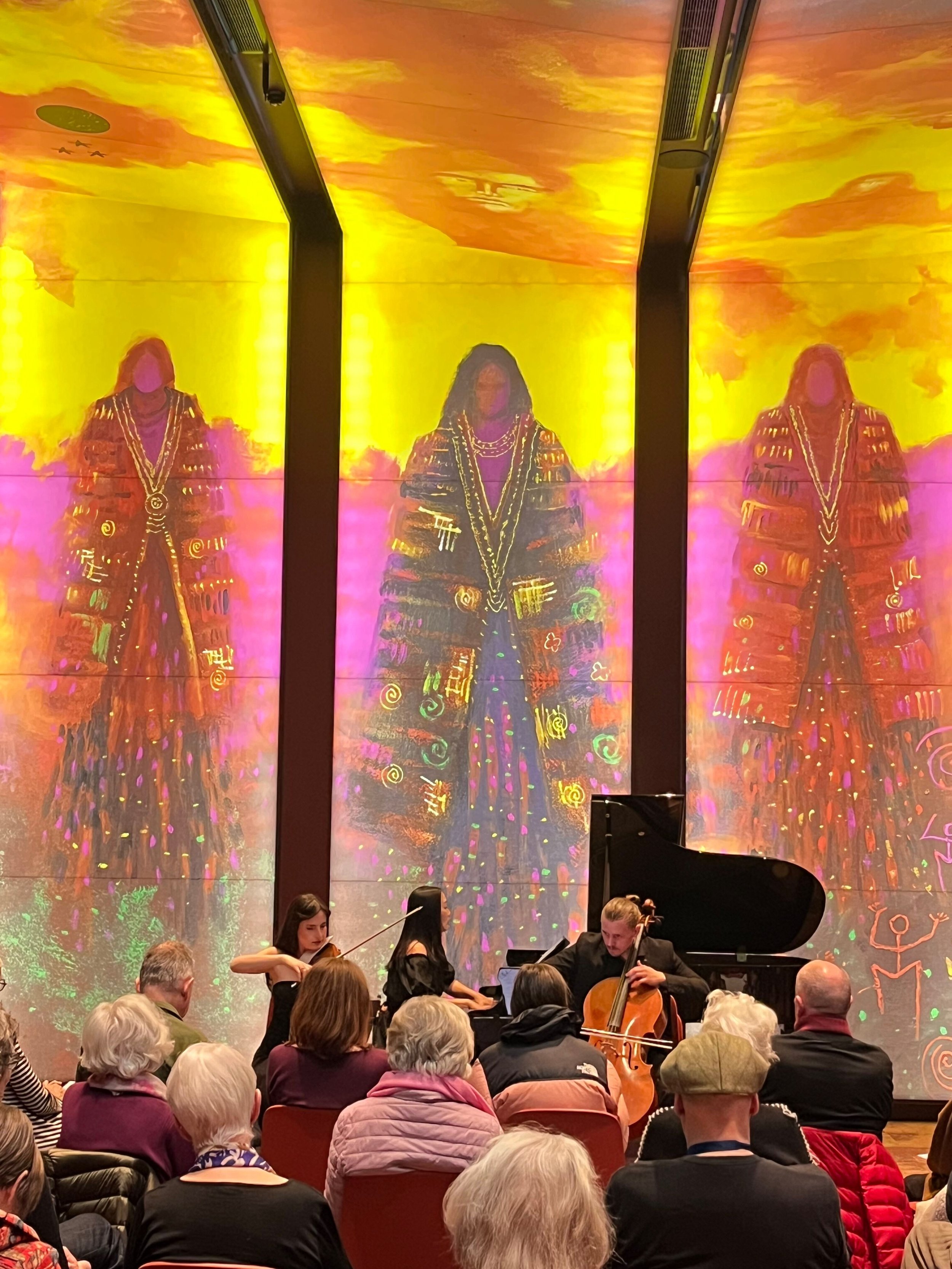
NZTrio in Ngā Pou Ruahine, the small performance space on the top floor of Te Matapihi, Wellington's re-opened Central Library.
“…their performance of Fazil Say’s Space Jump captured all the sometimes terrifying drama of the work.”
Image credit: NZTrio
With this concert, NZTrio was again in its permanent line-up of musicians, with Somi Kim back from maternity leave alongside violinist Amalia Hall and cellist Matthias Balzat, the newest member of the ensemble. Their programme was typically adventurous, with Say’s remarkable work followed by one from Indian-American composer Reena Esmail.
Both works were examples of the Trio’s skill in introducing us to the music of outstanding contemporary composers. Esmail, born in the US in 1983 to Indian immigrant parents, has a growing reputation as one of the most active and interesting composing talents of her generation. Having studied Hindustani music in India in between studies at Juilliard and Yale, her music fuses western music with the pitch material of traditional raga.
Her Piano Trio (2019) offers a lovely wash of colour in the neo-Romantic first movement, a marvellous stillness in the static second, a sprightly playful scherzo-like third and some wailing quartertones in the powerful fourth. This is music about music, without obvious narrative, the materials and the spirit of the raga creating a marvellously interesting and individual work, developed with organic lightness and skilfully unobtrusive architecture. The Trio’s performance was splendid, with lovely tone colours, occasional sliding sitar-like effects, melodious lyricism, violin and cello always in musical accord and Kim steering the direction from the piano with magical subtlety.

Indian-American composer Reena Esmail
“…fusing western music with traditional raga.”
Image credit: Hannah Arista
A new work especially composed for NZTrio followed. Keith Moss is a South African composer now based in Wellington, and his Field Notes in Autumn evokes Wellington as it appears from his home in Ascot Street opposite the Lilburn Residence. It’s a small work, largely tonal, contemplative and gentle, and perhaps a little too soft-edged to make an impact within this programme.
The evening ended with Schumann’s Piano Trio No 2 in F Major. Though NZTrio shines in the lively variety of contemporary works they offer, they are perhaps at their most impressive in this traditional piano trio repertoire. They played Schumann’s joyous work with terrific flair, the three musicians revelling in the emotion-laden melodies, all three absolutely “in tune” with the music and each other. This hyper-romantic Trio, premiered in 1847 with Robert Schumann’s beloved Clara playing the piano, is full of the couple’s passionate love and delight in their relationship.
NZTrio showed in Schumann’s music what accomplished chamber players they are, sensitive to their colleagues as melodies are shared around the ensemble, lines skilfully articulated with well-judged rubato, the final contrapuntal movement played with a nice lightness and expressive control.
Less than a month later, NZTrio were back in Wellington, on tour for Chamber Music NZ. For this programme they were joined by violist Alexander McFarlane and bassist Damien Eckersley. A good-sized audience of hardy Wellingtonians braved some particularly inclement weather to join the Trio+ in the historic timbered interior of Old St Paul’s Cathedral.
It was this occasion that had me mulling over the question with which I opened this review, and finding some answers. The musicians themselves are key of course, and the NZTrio have proven many times that they can deliver the kind of excitement that has an animated audience spilling happily out the door at the end of an evening. The repertoire chosen is also important, and classical music audiences, though choosy about the composers and works they’ll experience, are not as conservative these days as audiences some decades ago. Programme curation matters too, how works are combined and presented, the quality of the programme notes and any spoken introductions.
And then there are important choices to make about the venue, its acoustics, atmosphere, comfort for the audience and whether these will combine to create a sense of occasion that enhances the music.
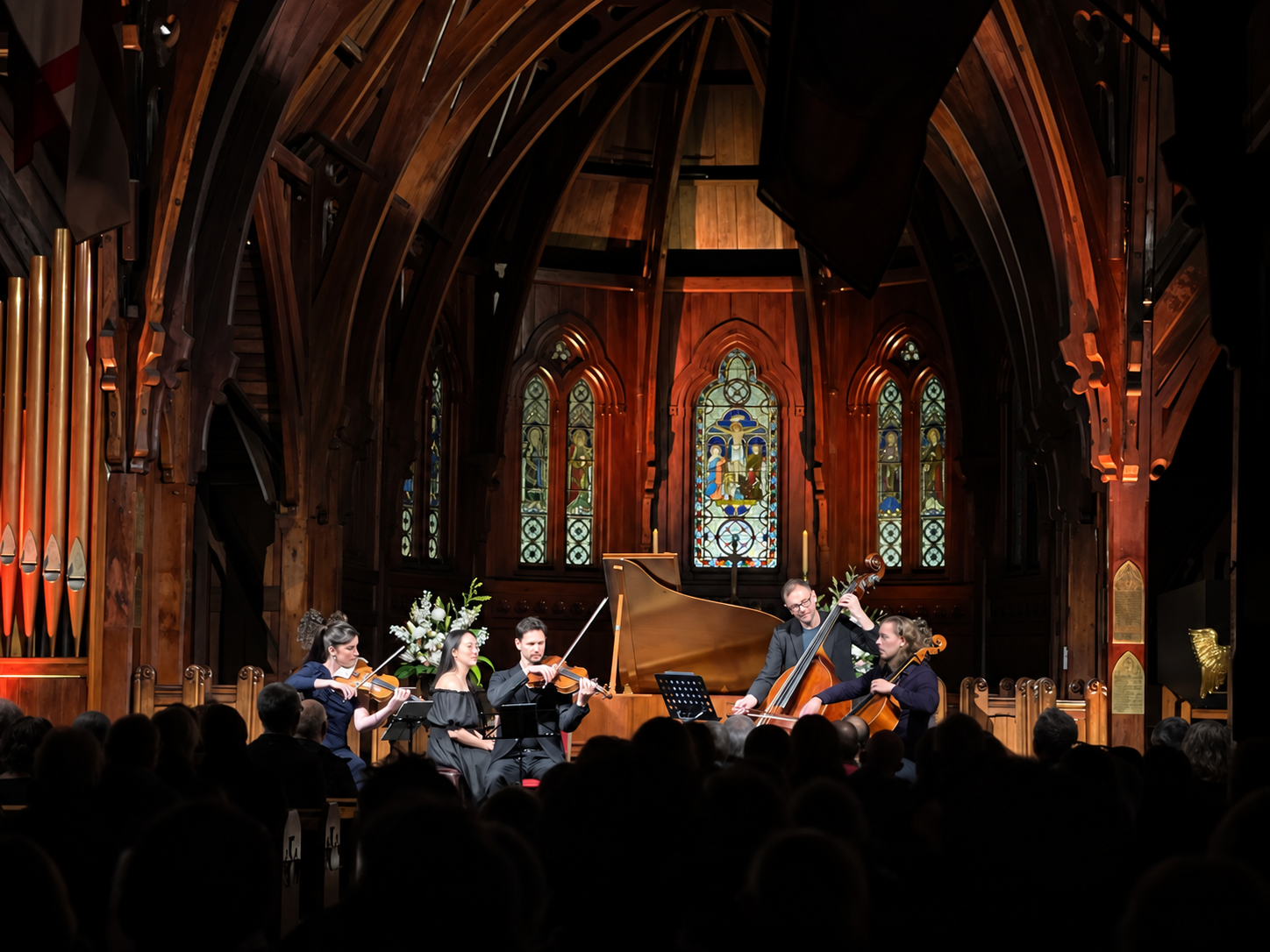
NZTrio and friends performing in Old St Paul’s Cathedral in Wellington
“…an unresponsive acoustic and an unsuitable piano.”
Image credit: Chamber Music New Zealand
Here Chamber Music New Zealand is not distinguishing itself at the moment and some poor choices detracted from this concert. Admittedly there are challenges in Wellington, with a current scarcity of good chamber-sized venues. But anyone with good ears could tell you that Old St Paul’s has a sadly unresponsive acoustic, the hard reflective surfaces are too far away from the musicians to provide any useful reverberation and the sound of string instruments falls into the floor rather than singing forth to the ears of audience. Perhaps only those in the front rows were getting a satisfactory impression of the performance.
Then there is the piano. Somi Kim is an outstanding pianist and I can’t think of anyone who could have made the elderly Steinway at Old St Paul’s sound any better. The treble has a flatness of tone that no coaxing can solve, and the instrument is far too small for the venue in any case. What were CMNZ thinking? Surely a decent instrument could have been moved to the venue for this concert?
The lighting at Old St Paul’s seems to be all-on or all-off, and so the audience was plunged into complete darkness for the performances, another factor that somewhat distanced the ensemble from its audience.
In spite of these limitations, both musicians and audience did their best to create a special occasion of the concert. The programme helped, opening with a lively study in contrasts in Gareth Farr’s four-movement piano trio Ahi. The fire of the title arrives in the second movement, a fast, fierce Scherzo, rhythmic and percussive in a style sometimes typical of the composer. It follows a beguilingly simple opening movement in which the gentle unfolding of the counterpoint showed again the fine ensemble work of the NZTrio that had featured in the Space Jump concert.
Balzat’s lovely cello melody was a romantic and tender opening to the third movement, an interlude leading to a finale described by Farr as “Balinese pop-inspired movement packed with gamelan-like energy and effects.” This was great playing, strings against rippling piano, the music becoming a little jazzy and extrovert, sparkling through to its bold conclusion.

American composer Caroline Shaw
“…her composition Thousandth Orange was a charming and interesting programming choice.”
Of her composition Thousandth Orange, acclaimed American composer Caroline Shaw wrote: “Maybe after the tenth, or the hundredth, or the thousandth time one paints, or looks at, or eats, an orange (or plays a simple cadential figure) it is just as beautiful as the first time.” Violist McFarlane, a fine chamber musician, joined the ensemble and Shaw’s lovely, subtle piece developed as a kind of wonky, fragmented minimalist duet between the three string players and the pianist, as if the piano were somehow in a different rhythmic space. The strings were a tight-knit ensemble, sometimes a kind of rhythmic hymn, Hall directing the group with her eyebrows in one particularly asymmetrical section. It was a charming and interesting programming choice.
After the interval, Eckersley joined the group with his double bass for the work that had attracted many in the audience, Schubert’s Piano Quintet in A Major, popularly called “Trout” because of the appearance of melodies from Schubert’s own song “Die Forelle” (“The Trout”).
It was a lovely and lyrical performance of this deservedly beloved work, one performed less often than one might expect because of its unusual instrumentation. Kim did a splendid job with the brilliant piano part in spite of the instrument’s limitations and the whole ensemble played beautifully together, in subtle accord about the interpretation and uniting with energy and verve in the lively scherzo. Eckersley proved a sensitive chamber musician with a light touch and he and Balzat obviously relished the way Schubert has cello and bass working together.
The dry acoustic did them no favours, making it hard for the strings to sing as beautifully as the work requires. Some dynamic subtleties were lost, Hall’s violin was sometimes hard to hear, and Kim’s lovely trills and tremolos were hampered by the dead treble of the piano. The gorgeous music of the 4th movement theme and variations was nevertheless thrilling, with artistic filigree work in the speedy variations, and the lyrical, Viennese finale was played with musicianly delight by the ensemble, the five musicians dancing together.
Finding an encore for this unusual quintet might have seemed a challenge but we were offered a work by esteemed British composer Judith Weir, her Song of Farewell, written especially for the Schubert Ensemble, that group’s 50th and final commission when they ended their 35-year-old career as a chamber ensemble in 2018.
The audience seemed appreciative of the concert, the last of CMNZ’s short 2026 season, and unfurled their umbrellas to head out cheerfully into the rain. A really great concert? Sadly, not all the ingredients were there. I’m looking forward to hearing NZTrio in the Concert Chamber of the Old Town Hall next year. They deserve a fine venue with a really good piano - well, we all do!
SPACE JUMP NZTrio Music by Fazil Say, Reena Esmail, Keith Moss and Robert Schumann Wellington 23 August 2026
NZTRIO+ Amalia Hall (violin), Matthias Balzat (cello) Somi Kim (piano) Alexander McFarlane (viola) Damien Eckersley (double bass) Music by Gareth Farr, Caroline Shaw and Schubert Wellington 17 September 2026