
The Moth Quartet’s new album Tundra: elevated landscapes
Guest contributor Raf Hosking reviews Tundra, a new album from the Moth Quartet, an ensemble formed by composers Tristan Carter, Salina Fisher, Elliot Vaughan and Nicholas Denton Protsack.
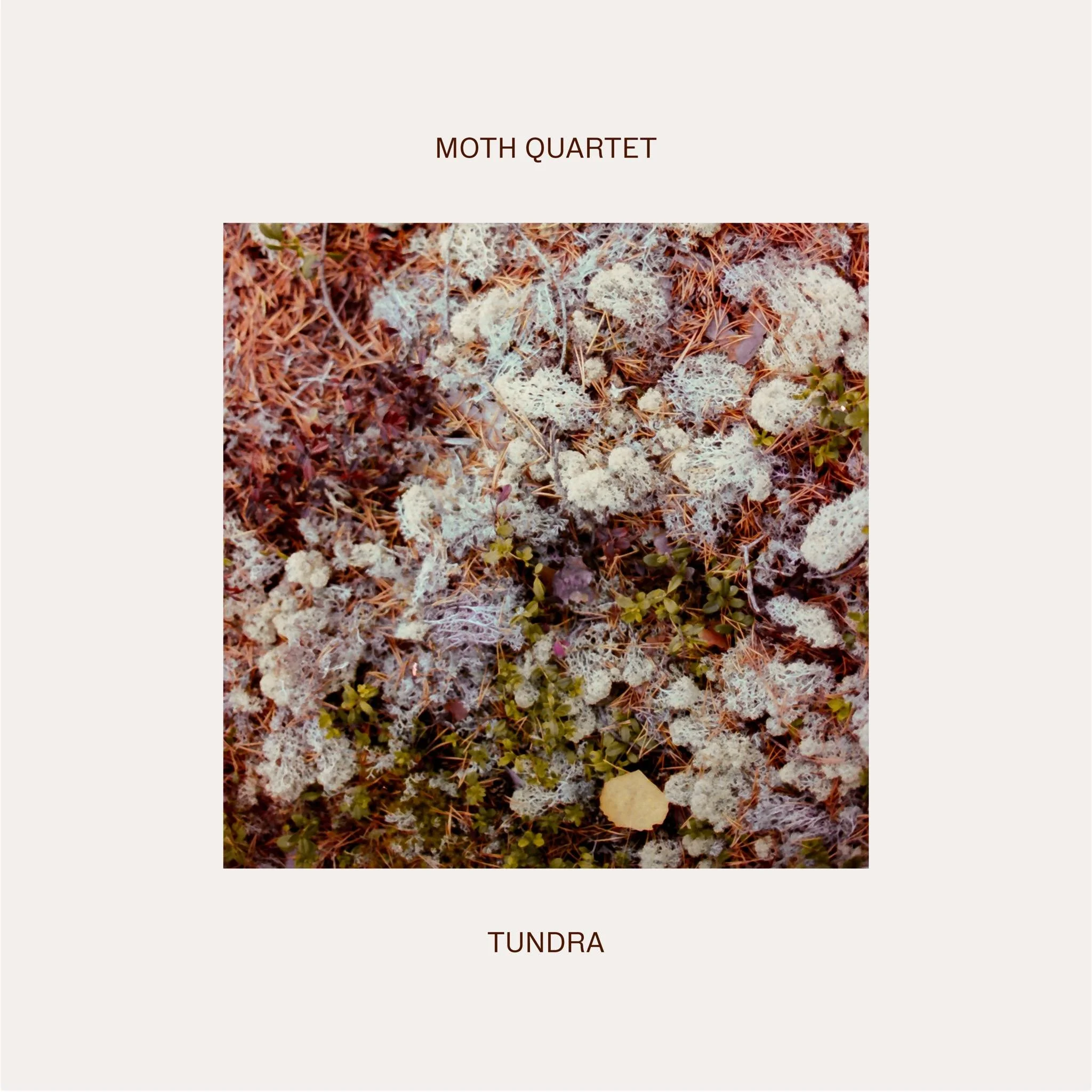
There is a captivating stillness that pervades during the beginning of Tundra, the new album by Pōneke-based composer ensemble Moth Quartet. No individual instrument is discernible from the sustained ethereal chords, yet the precarious quality that accompanies the group’s collaborative improvisation is still tangible. From within this stillness emerges the icy, crystalline landscape of Tundra.
For cellist Nicholas Denton Protsack, this kind of environmental exploration sits at the core of the album. “It’s not so much a question of making something that didn’t exist before, as it is a question of discovering the sort of world around you.”
This reference to a world both tangible and vivid certainly comes across in the album. Its first track, Tundra (Pt 1), patiently develops its sustained texture, often so gradually that these changes are almost imperceptible. One gets the sense of looking up at the vast, slowly shifting sky of some new world, as the quartet navigate this terrain.
Within the world of Tundra, temporality at times seems distorted, at which point the logic of what violinist Tristan Carter calls “Tundra time” takes over. Halfway into the first track I became distinctly aware that I couldn’t tell if I had been listening for minutes or hours, a feeling that became increasingly exhilarating as the album progressed.
Now might be a good time clarify that, like the quartet’s first album, Scree Scrub Mountain Sky, Tundra is entirely improvised. What this makes all the more impressive, then, is the quartet’s cohesion—nothing is out of place, no one oversteps or creates an unwanted distraction that might break the spell.
It takes an immense amount of trust and mutual understanding to successfully perform like this. Together now for just over three years, violist Elliot Vaughan points out that the group has a great deal of clarity “between [them] and what the sound is. At any given point there’ll be a set of sounds we can go to that blend.”
This is where having an ensemble made up of musician-composers is a huge strength. As Vaughan explains, “composition, if it’s notated, there’s a very slow conversation that happens where you finish a whole piece and maybe other composers hear it… In Moth, you can talk at the same time and cover a great deal of ground.”
Towards the end of Tundra (Pt 2) we hear this dialogue in full flow. A sustained, lush violin melody emerges from amidst the swirling texture of the quartet. The simple phrase—hardly a melody at all, really—is imbued with emotion only possible because it emanates straight from the composer. The other players step back, allowing these drawn-out notes room to soar, before this voice melts back into Tundra’s homogeneous landscape.
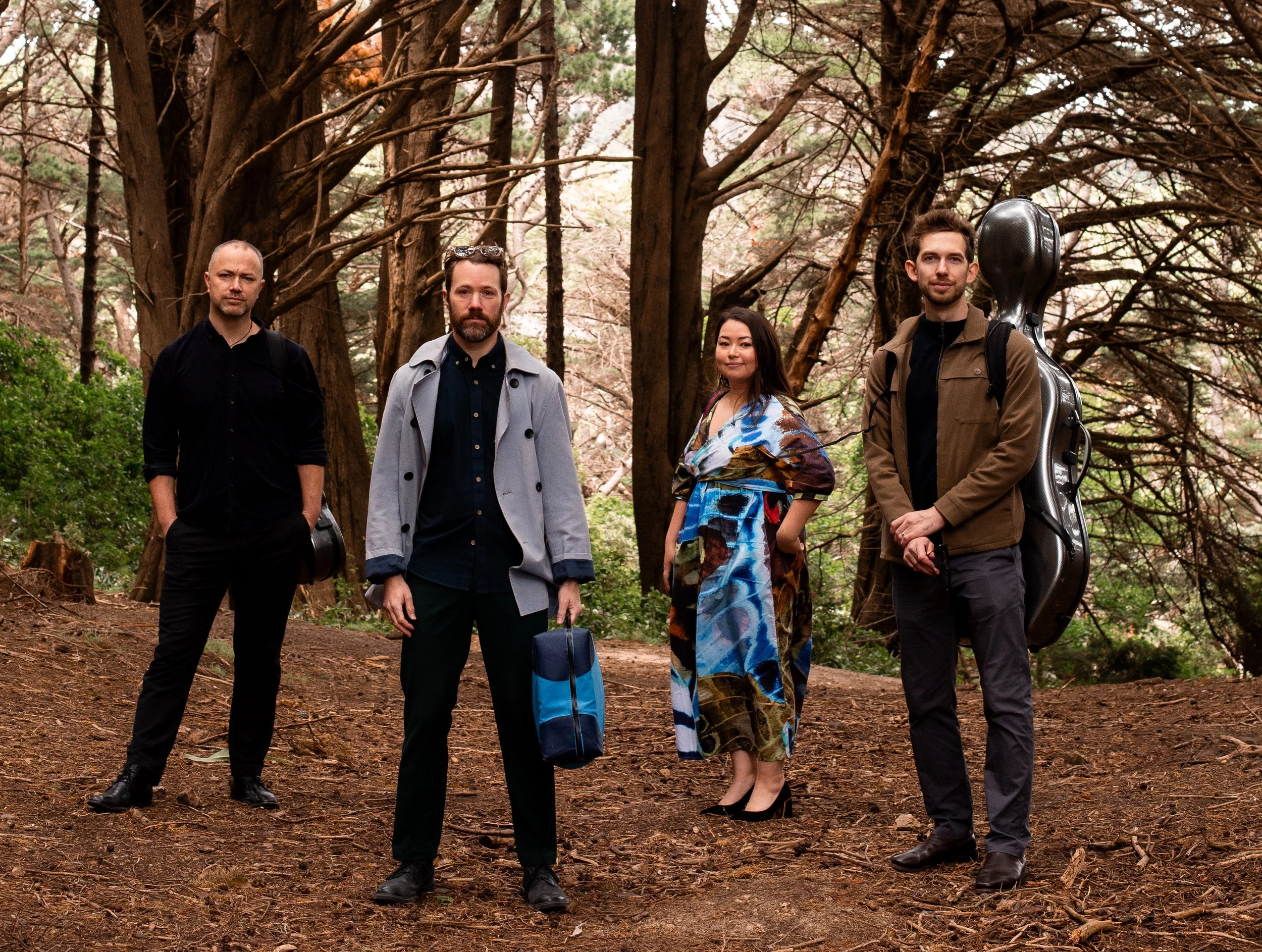
The Moth Quartet, (from left) Tristan Carter, Elliot Vaughan, Salina Fisher and Nicholas Denton Protsack
“…an ensemble comprised of four of Aotearoa’s most innovative and forward-thinking composer-performers.”
Photo credit: Hannah Mackintosh
The album’s fourth track, Tundra (Pt 3), is perhaps its most challenging but, in many ways, its most rewarding. Here, the quartet’s gliding and shifting harmonies are both unsettling and hypnotically beautiful; in the background, an undulating glissando traces some unseen alpine topography.
There is no doubt that this approach to string quartet playing is quite unlike any other ensemble, and this is expressly Moth Quartet’s intention. Protsack comments, “we tried very much to avoid anything that sounded like other kinds of music.”
However, the group still feels very much connected to the canon of string quartet writing, now contributing a fresh approach to perhaps chamber music’s most popular ensemble. “I think of us very much as a string quartet,” Vaughan explains. “I like that we are in conversation with that tradition and all of what that brings.”
Indeed, the vast body of string quartet works throughout history definitely adds to the significance of what Moth Quartet is contributing to contemporary music. Violinist Salina Fisher remarks that “because of how much tradition is associated with string quartets, the way we are experimenting feels like a bigger contrast than if it were a different collection of instruments.”
Tundra finishes with the twenty-minute Tundra (Pt 4), followed by a brief epilogue entitled Campfire Music. During the former, we witness ideas develop and grow over great lengths of time, sometimes playing out during almost imperceptible timescales.
Arriving at Campfire Music, one gets the sense that things have changed — a transformation has taken place. However, this difference is not with the landscape itself — the tundra is very much the same. Instead, having navigated this terrain for almost an hour, it is the quartet’s view of it that is different, as well as my own understanding of this space held open by the music.
It seems logical that an ensemble comprised of four of Aotearoa’s most innovative and forward-thinking composer-performers have produced one of the most exciting works for string quartet in recent memory. However, in a world in which the arts feel increasingly uncertain, Tundra’s existence feels both reassuring and extremely exciting.
Tundra will be available to stream and purchase from Bandcamp from 12 of December, the first single of which is available now from the link below.
For those based in Wellington, come along to Moth Quartet’s album release at 8 pm on 12 December at a mystery location (RVSP at this link for the address).
The Moth Quartet Tundra (Bandcamp) Available here