
International Chopin Piano Competition: a New Zealand pianist reports from Warsaw
For three weeks in October this year, young New Zealand pianist Otis Prescott-Mason attended, observed and wrote about one of the most prestigious piano competitions in the world. The 2025 quinquennial International Chopin Piano Competition, in Warsaw, is the contest’s 19th edition. This review article for Five Lines summarises some of Otis’s impressions of the remarkable competition and its outcome.

Pianist Eric Lu accepts applause during the 2025 International Chopin Piano Competition
Photo credit: Fryderyk Chopin Institute
In the small hours of the 21st of October, with hundreds of people gathered in the foyer of the Warsaw Philharmonic, the 11 finalists of the 19th International Chopin Piano Competition descended the stairs before the crowd, followed closely by the 17-member jury who would deliver what would be, for some, a life-changing verdict. The tension in the air was palpable and the excitement infectious. As the director of the competition stepped up to the microphone to read the results, no one dared to breathe.
Dubbed as the ‘Olympics of piano’ this competition lives up to the comparison both in terms of the immense challenges demanded of all those taking part and in terms of the incomparable glory and opportunity that is awarded to the winner, and other high prize winners, alongside their medals.
With all eyes on Warsaw throughout October (the competition saw a total viewership exceeding 40 million on YouTube alone) the musical world waited excitedly for another torch-bearer of Chopin’s music to be found.
Though many aspects of this competition are unique, not least its dedication to the music of a single composer, possibly the most significant aspect is the choice of pianos available to the competitors. Five were available for selection this time: Bechstein, Fazioli, Kawai, Steinway, and Yamaha.

Five different pianos were available to competitors
Photo credit: Fryderyk Chopin Institute
To my ears each piano sounded unique in many ways, though most important was the level of brightness in the sound. Two distinct groups formed. Fazioli, Kawai, and Yamaha were very bright, their sound bigger, and projecting to the back of the hall. The Steinway and Bechstein, on the other hand, had a different sound, more intimate but at the same time less powerful.
A record 642 applicants had been whittled back to 162 for a preliminary round. During the first main stage round, each of the 84 competing pianists presented a programme of approximately 25 minutes in length, comprising four pieces by Chopin. The four included an étude to show technical mastery, a nocturne to reveal the capacity for lyricism and tenderness, a waltz to ensure everybody’s fingers could dance in step and a ballade or similar work to demonstrate the ability to tell a longer story in a more substantial piece.
With each of the four categories offering limited choice (the jury allowed only selected pieces from each genre), those of us in the audience (and the judges) heard many pieces several times throughout the five days of round one performances. One waltz in particular, Op.42 in A flat major, was chosen by 32 pianists! In the subjective world of music this strict choice of repertoire was clearly an attempt to make each pianist clear the musical equivalent of the high-jumper’s uniform height.
By 11:00pm on the final day of stage one the jury delivered their decision to admit 40 pianists to stage two. Though consensus is unusual in the subjective world of piano competitions, I thought that their decisions largely made good sense and were based, alongside countless others, on the factors mentioned above.
The repertoire in stage two was both substantially longer and more given to free choice. 40-50 minutes being the compulsory time, a polonaise and 6 preludes from Op.28 were the only set pieces, leaving most competitors approximately 30 minutes to play with. A few pianists chose to play the big and serious Bb minor Sonata in this round, trying to ‘get their word in first’, so to speak, as a sonata was compulsory in stage three.
One daredevil, in the form of part-human and part-machine Kevin Chen, opted to play the entire set of Chopin’s Op.10 etudes. He did so with such dazzling control and scintillating energy that the audience and jury alike sat in a stunned stupor for the entire duration.
Roughly one quarter of the pianists in stage two elected to play the entire set of 24 Preludes, Op.28. This decision, taking up 35-40 minutes, left enough time for the polonaise and perhaps one other short piece.
The complete set of Preludes is a great musical and storytelling challenge. How does one unite 24 wildly different miniatures, each itself a universe, into a cohesive whole? The results were mixed. Some pianists presented a powerful and moving display, showing a beautiful synthesis of their style and Chopin’s that seemed both completely consistent and yet endlessly varied. Two such performances were given by Gao Yang and David Khrikuli.
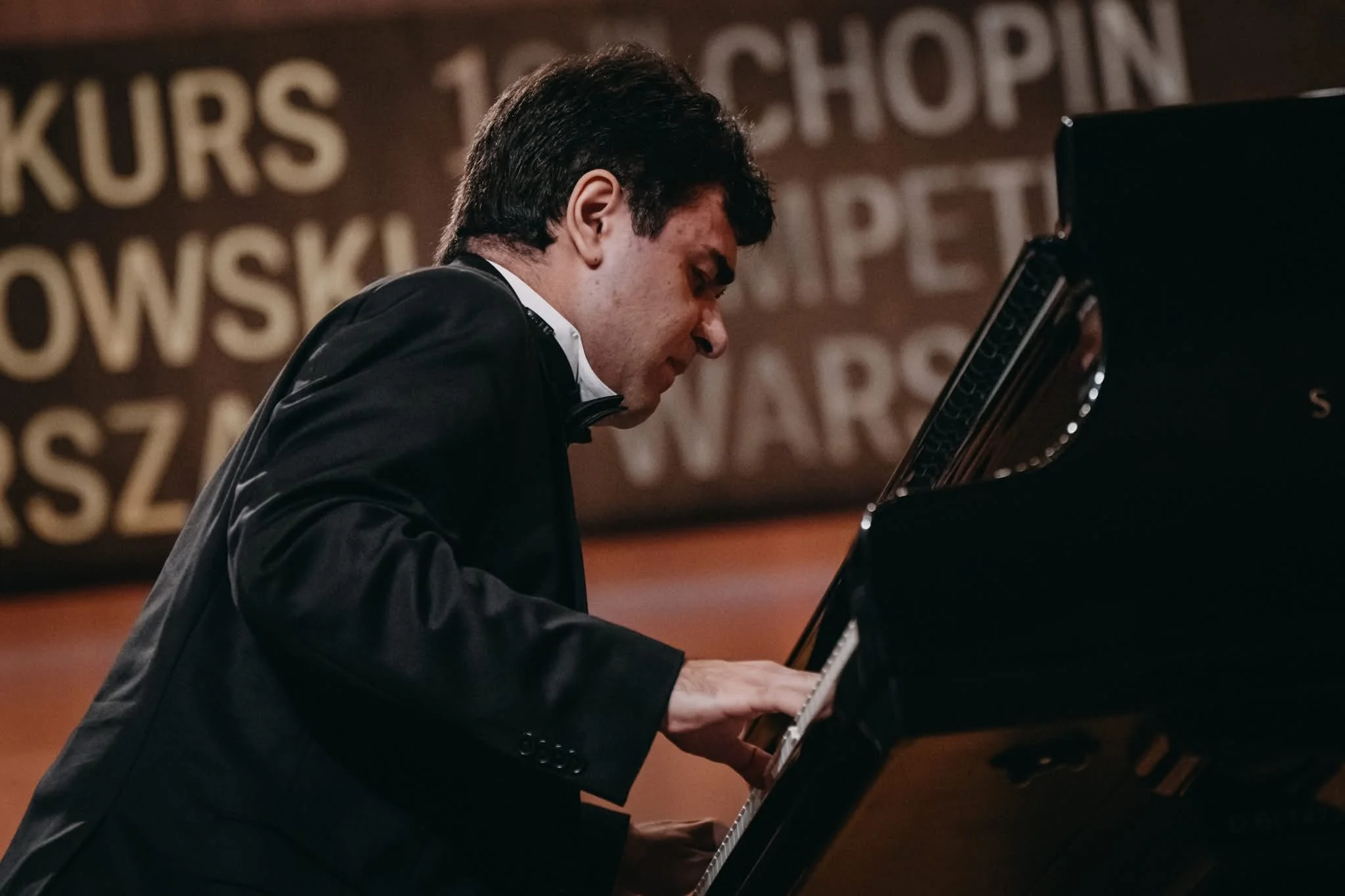
Georgian pianist David Khrikuli
“…one of the pianists whose performance showed a beautiful synthesis of his style and Chopin’s music.”
Photo credit: Fryderyk Chopin Institute
After 40 performances, each lasting nearly 50 minutes, the jury again retired for deliberations. This time it was nearer midnight when the jury chair descended the stairs and broke the news: 20 pianists had qualified for stage three, including both Gao Yang and David Khrikuli.
The progression from stage two to stage three has always been, in my opinion, where the wheat is separated from the chaff. With a 45–55-minute programme to show themselves again, including at least one sonata and one set of mazurkas, each of those 20 pianists showed themselves to have genuine artistic capabilities. Rather than falling into the categories of ‘weak’ and ‘strong’, they sorted themselves into ‘strong’, ‘stronger, and ‘strongest’.
With too many highlights to mention, I can share only my very favourite performance of this stage. Eric Lu’s performance of the B minor Sonata, Op.58, was so sincere and deeply felt that by the end of his third movement a large portion of the audience was in tears, something that did not happen in any other performance during the entire competition. That evening we did not hear a competitor - we were treated to a recital by a great artist. The jury joined the audience, and all were transported together to better places by his music.
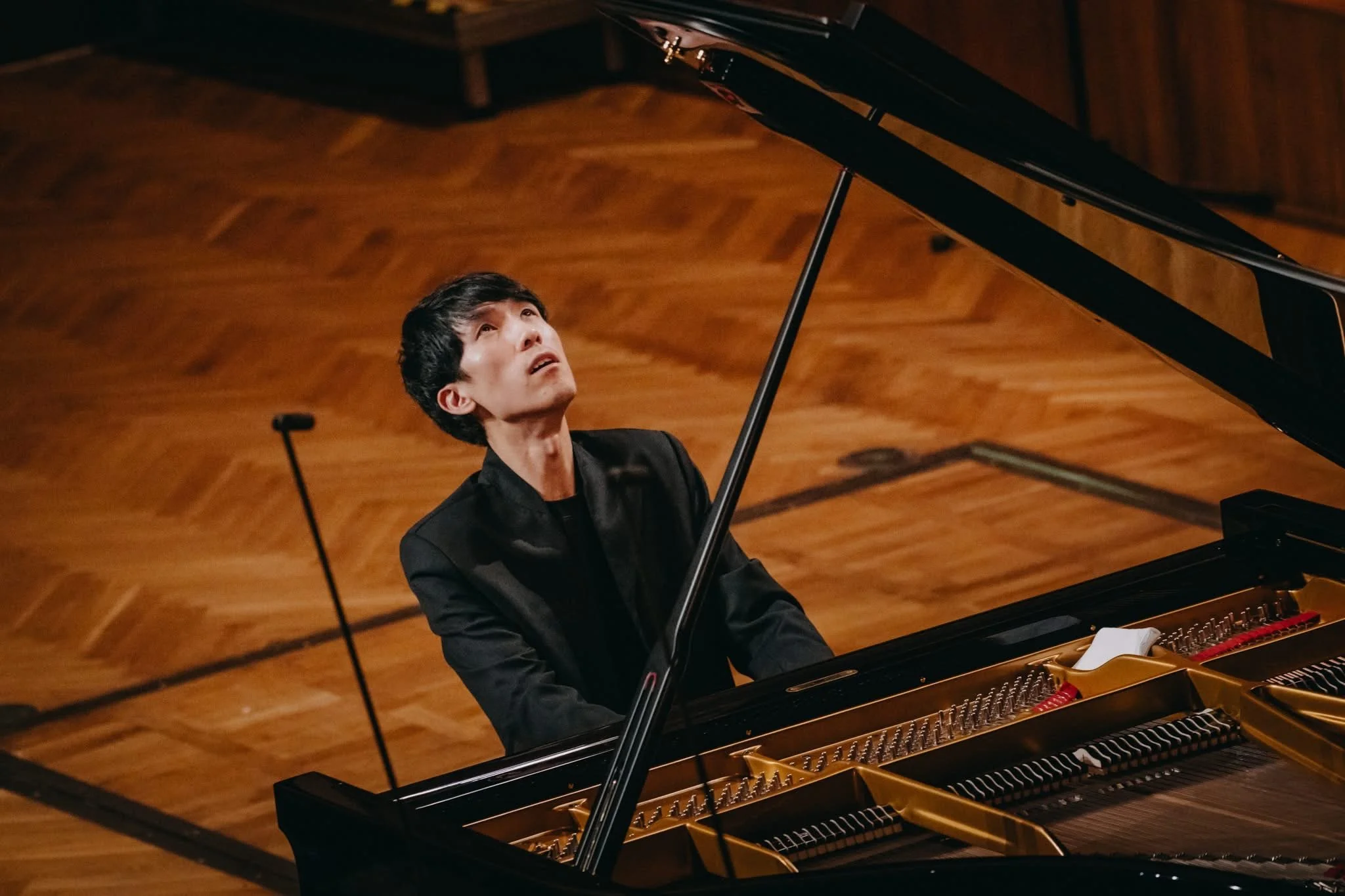
American pianist Eric Lu
“…moved the audience to tears with his deeply felt performance of Chopin’s B minor Sonata Opus 58.”
Photo credit: Fryderyk Chopin Institute
The jury, after two hours of toiling, and we, after two hours of stewing, were bursting to find out who would be selected for the final stage. The eleven finalists chosen were Piotr Alexewicz (Poland), Kevin Chen (Canada), David Khrikuli (Georgia), Shiori Kuwahara (Japan), Tianyou Li (China), Eric Lu (United States,) Tianoyao Lyu (China), Vincent Ong (Malaysia), Miyu Shindo (Japan), Zitong Wang (China) and William Yang (United States).
The final round, held over three nights, demanded one of Chopin’s two piano concertos and something never before required in the final round, a solo work. The jury had chosen this piece, the composer’s Polonaise-Fantasie, Op.61. There are many good reasons to juxtapose this piece with a concerto in the context of a competition. The best, perhaps, is that the concertos, both written by the time Chopin left Poland aged just 20, are youthful works with a certain emotional and musical simplicity and naïveté. The Polonaise-Fantasie, on the other hand, was written only a few years before Chopin’s death at the age of 39. It is a mature and enigmatic piece with a complex emotional landscape and a fragmented structure, lending itself better to subjective interpretation than objective analysis. Far reaching harmonies, a strange and drawn-out introduction, subtle blending between the rhythmically firm polonaise dance and more rhapsodic fantasia style are just a few of the challenges of the piece.
The eleven finalists took the stage and wore their hearts on their sleeves for one last time. Each pianist gave a finals-worthy performance, showing brilliance and artistry.
Kevin Chen, however, seemed unable to drastically alter his approach to the Polonaise-Fantasie, compared to his approach to the Op.10 Études of stage two. His performance in the final lacked a certain substance and gravity. His fingers sure flew, but perhaps right past the opportunities for depth and profundity.
Tianyao Lyu’s sheer joy at being on stage was a delight to witness. The massive technical demands of Chopin’s First Concerto, made all the greater by their need to sound undemanding, rolled off her fingers with ease. Not an ounce of tension was visible in her shoulders or arms, and the result was a performance so fluid, effortless, and light that it seemed, for her, no more difficult than drinking a glass of water.
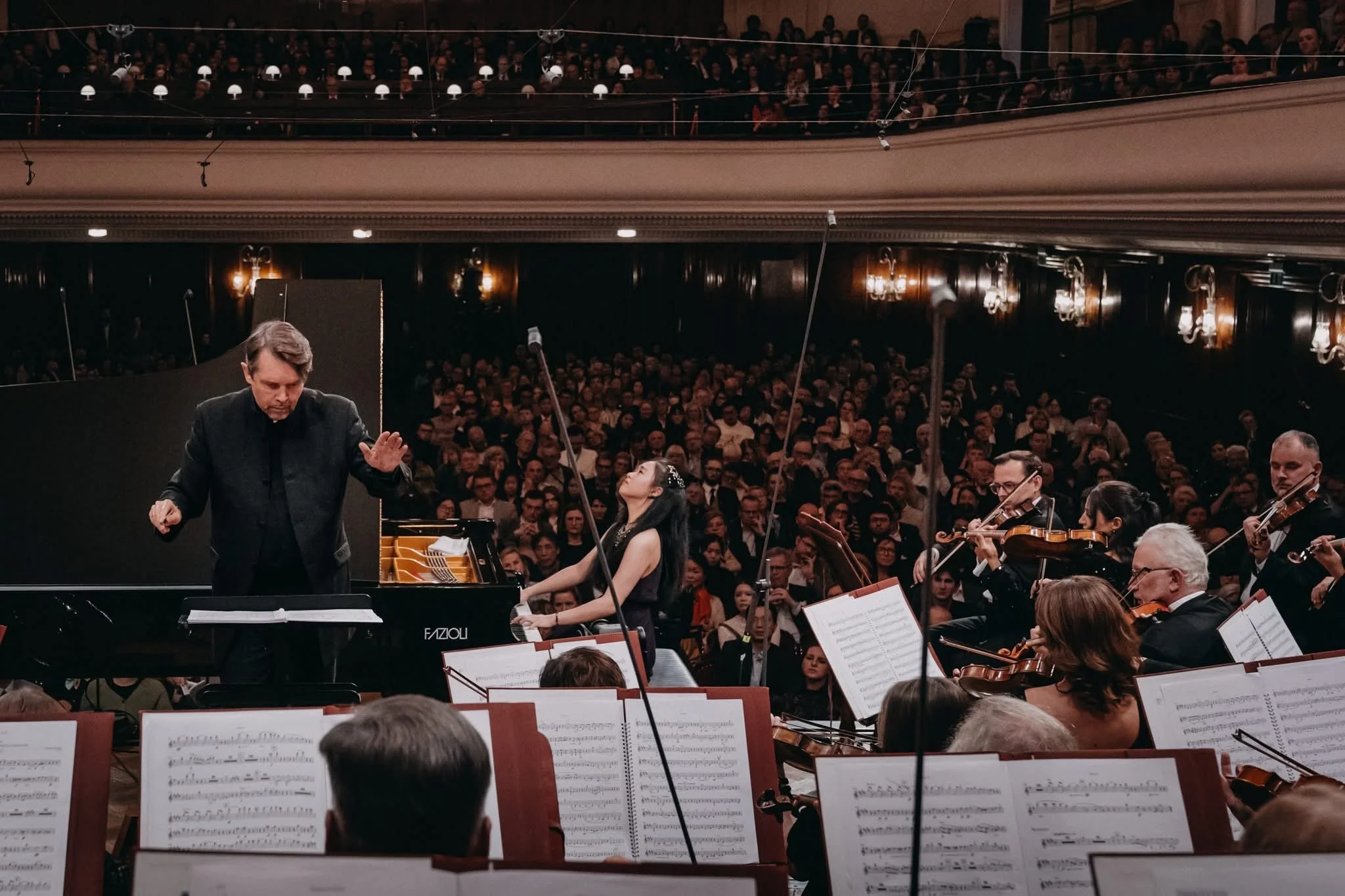
Chinese pianist Tianyao Lyu performing Chopin’s First Piano Concerto with the Warsaw Philharmonic Orchestra conducted by Andrzej Boreyko
“…her fluid, effortless and light performance was a delight.”
Photo credit: Fryderyk Chopin Institute
David Khrikuli’s range of sound was captivating, showing both tenderness and ferocity. At times, however, his sound did not project sufficiently, and this dampened the drama of his performance.
Eric Lu performed what I felt to be the most mature Polonaise-Fantasie. The general shape held together amazingly while allowing him the freedom to ‘sniff the flowers’ whenever, seemingly, he felt like it.
As the last note faded from the hall it was time for the jury to give their own final performance. The ultimate deliberations have always taken a long time. What goes on behind those doors? To be a fly on the wall during the discussions…. All that anyone could do, who wanted to hear the announcement live, was to stay in the Philharmonic and vainly attempt to find something else to think about.
For me this was a most wonderful time as, for several hours, I had the chance to speak casually with the finalists and get to know them, albeit slightly, as people. We stewed in solidarity for five hours before hearing the first whispers, at 2:30am, that a verdict had been reached. The finalists were whisked away to make their own separate entrance into the historic foyer of the hall.
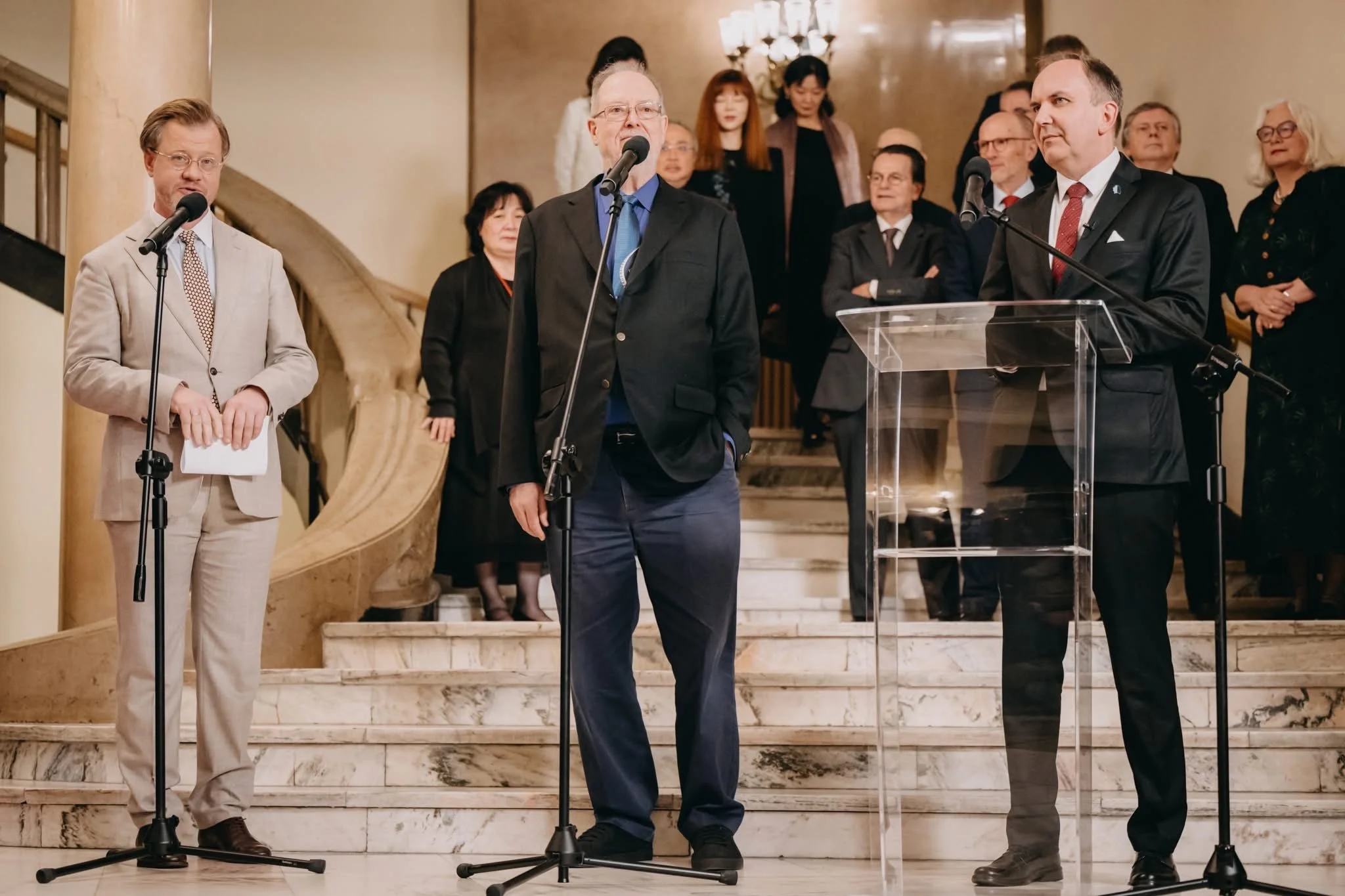
The Competition Jury announce the results
(from left) Aleksander Laszkowski, Garrick Ohlsson (jury chair), Artur Szklener
Photo credit: Fryderyk Chopin Institute
Prizes were announced, for maximum suspense, from those with the smallest stakes to those with the greatest, beginning with the special prizes awarded for performances of individual pieces throughout the competition (“best sonata”, “best concerto”, etc.). Then began the main prizes, starting with the 6th prize. Prizes for 5th and 4th were shared. 3rd prize went to Zitong Wang of China. Canada’s Kevin Chen took the 2nd prize.
The life-changing first prize and gold medal were awarded to Eric Lu from the United States. It was not surprising to me that the jury members were taken by his imaginative range of colours, depth of sound, and maturity in being able to simultaneously play fully in the present moment but also with an eye on the long arc of a piece, or an entire programme. Eric’s mesmerising and enchanting final round can be viewed below.
Main Prizes:
1st Prize and Gold Medal - Eric Lu - United States of America
2nd Prize and Silver Medal - Kevin Chen - Canada
3rd Prize and Bronze Medal - Zitong Wang - China
4th Prize (ex-aequo) - Shiori Kuwahara - Japan
4th Prize (ex-aequo) - Tianyao Lyu - China
5th Prize (ex-aequo) - Piotr Alexewicz - Poland
5th Prize (ex-aequo) - Vincent Ong - Malaysia
6th Prize - William Yang - United States of America
Special prizes, for which all competitors were eligible:
Best Performance of a Sonata - Zitong Wang - China
Best Performance of a Ballade - Adam Kałdunski - Poland
Best Performance of a Concerto - Tianyao Lyu - China
Best Performance of a Mazurka - Adam Prokopowicz - Poland
Best Performance of a Polonaise - Tianyou Li - China
Audience Choice Award - Piotr Alexewicz - Poland