
Music at the Festival: do venue acoustics matter?
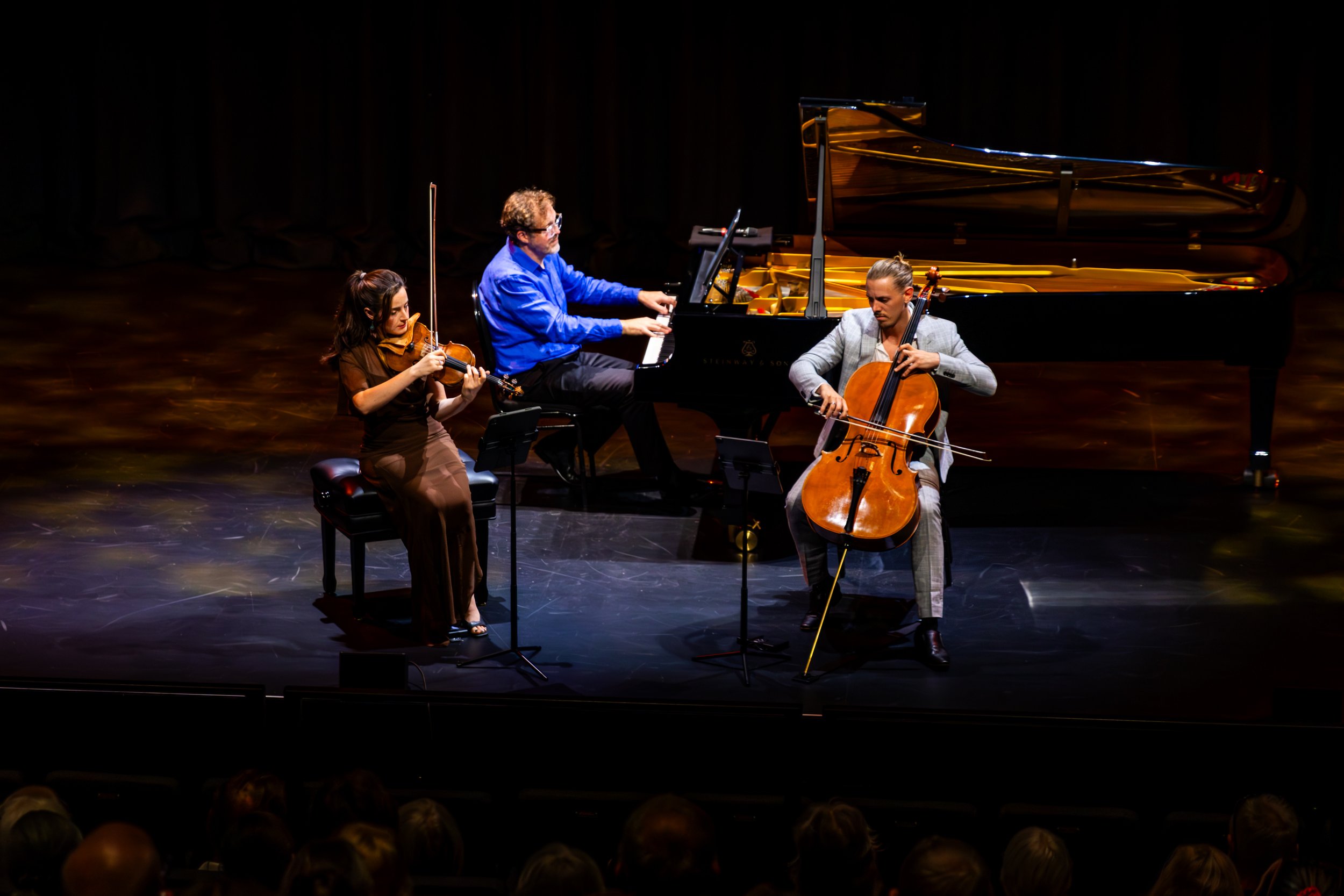
NZTrio performing the programme Groove Café at Te Raukura ki Kāpiti Performing Arts Centre
Photo credit: Josiah Wood
I was confronted by acoustic issues at my first event in the recent Aotearoa NZ Festival of the Arts. The concert, enticingly called “Groove Café”, was presented by the NZTrio at Te Raukura ki Kāpiti Performing Arts Centre. Pleased to have a programme by one of our favourite ensembles at a local venue, we joined a medium-sized audience for the early evening event.
NZTrio opened their light and lively programme with Three Island Songs by New Zealand composer John Psathas, a work influenced by the dances of his Greek heritage. The first song features the composer’s signature repetitive ostinato, with driving rhythms and asymmetrical emphases. The gentler and more thoughtful second, inspired by the slow zeibekiko dance, had Matthias Balzat strumming his cello against meandering melodies, while the third, in the style of the fast and furious sirto dance, featured violinist Amalia Hall whirling in energetic folk style.
Next came a dramatic and appealing modernist work by Italian composer Eliodoro Sollima, called simply Tre Movimenti. It showed off the Trio’s fine ensemble work throughout, and the strong playing of guest pianist Stephen de Pledge, who bounced through the angular lines with edgy, spiky pianism.
Vivian Fung’s Ominous Machine is fast and dramatic, many moving parts combining in what was indeed, as Hall told us, “a thrilling ride.” The musical roller-coaster included some “alternative” playing techniques, de Pledge muting strings with a hand inside the piano, the violin and cello finding new timbral effects and the whole work building to a climactic flourish complete with a final weighty forearm cluster and glissando sign-off on piano.
The “groove” of the programme’s title arrived fully with Ukrainian/Russian jazz musician-composer Nikolai Kapustin’s Divertissement in 4 movements. His music is not improvised but was played by NZTrio with flexible jazzy freedom. Balzat clearly enjoyed the “walking bass” of his pizzicato cello line, the whole ensemble grooving together in the dreamy bluesy harmonies of the slow 2nd movement, and the flashy endings that Kapustin favours nicely managed throughout. De Pledge played with both impressive facility and a very relaxed jazz style. Hall seemed, of the three, the least at home in this idiom; she’s one of this country’s most outstanding violinists but didn’t always toss this music off with the casual ease it needs.
The audience seemed to enjoy the concert well enough and was pleased with the encore of a William Bolcom rag. And yet…
As we walked out into the golden evening sunshine, we weren’t feeling the exhilaration concerts by the brilliant NZTrio usually provide. It all seemed, ultimately, a little underwhelming and flat. Why was this? I believe it was all down to the auditorium acoustics.
Te Raukura, which opened in February 2020, was designed as a “multi-purpose” facility, which means the acoustic, apparently intended for theatre or amplified music, is too dry or “flat” for this ensemble, musical sound disappearing up into the fly tower, little resonance or bloom added to the string tone. This resulted in an out-of-kilter balance between strings and piano, the latter often too loud. The performance space has good sight-lines but deprived the audience of the full impact and thrill of the sound of the live performance. Sadly, many there may have been having their first encounter with NZTrio, and may not have understood why their evening didn’t really spark.
Why acoustics matter
Do venue acoustics really matter that much? Yes, they do – I believe they contribute hugely to the audience experience, though audiences may not identify them as the reason for the absence of buzz.
What are the factors that produce an optimal acoustic for live, unamplified musical performance? I asked this question of AI, which confirmed that what is needed is “a careful balance of sound reflection, diffusion, and absorption, typically favouring hard, reflective surfaces to maintain sound energy, while using geometry to prevent echoes. Ideal spaces are intimate enough to allow for clear articulation but large enough to provide warmth and resonance.”
Reflective surfaces are certainly key – they’re the reason you enjoy singing in the shower – but size and geometry of the hall are also important and some echo or reverb is actually necessary, how much depending on the musical texture.
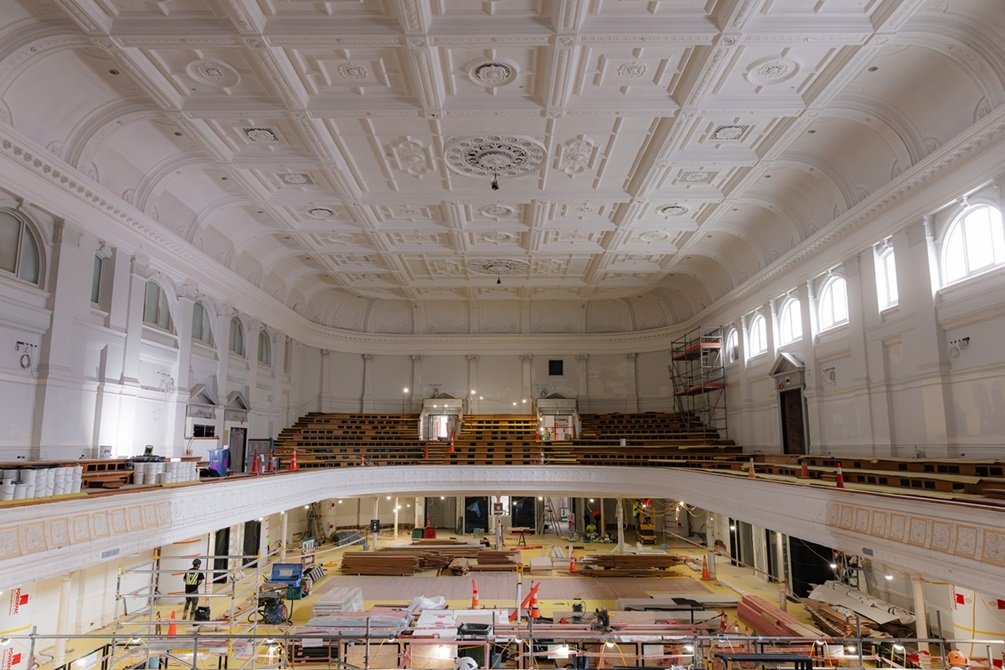
The Adam Auditorium in the Old Wellington Town Hall
“…scheduled for re-opening in 2027.”
Photo: Wellington City Council
Received wisdom has long asserted that the traditional shoe-box shaped auditorium, a long, rectangular, narrow, high-ceilinged room with those “hard, reflective surfaces”, works well for music. This certainly applies to the older town halls in Auckland, Wellington and Dunedin and the splendid Nelson School of Music auditorium, all of which have plenty of warmth and resonance. Smaller venues with plenty of reflective surfaces and reasonably high ceilings are similarly responsive to chamber-sized ensembles, while supplying the intimacy the artform requires.
It's no secret that Wellington's performing arts organisations have been challenged over recent years to present their work in venues with sympathetic acoustics. But new venues have been created or found, some of them working better than others.
Music venues for the Aotearoa NZ Festival of the Arts 2026
As the Aotearoa NZ Festival comes to an end, I've been thinking about the Festival’s 'classical' music programme, and in particular, about where that programme was presented. I attended quite a few concerts and other events with live music in half-a-dozen of the capital's venues, large and small.
Probably the most successful acoustic marriage of venue and performance was found at “SOUNDCATHEDRAL”, designed specifically by composer Michael Norris for its ultra-resonant Cathedral setting (and reviewed here.) But the large Wellington Cathedral has a reverberation time much too long to be ideal for most kinds of music; the flowing lines of 16th century vocal counterpoint are best for such spaces, as Renaissance composers knew well.
The live music from the pit by NZSO players and Voices New Zealand for the moving performance of Douglas Wright’s Gloria at the St James Theatre worked pretty well, although – a different issue – the recorded music for the other two works in that triple bill was unpleasantly overloud.
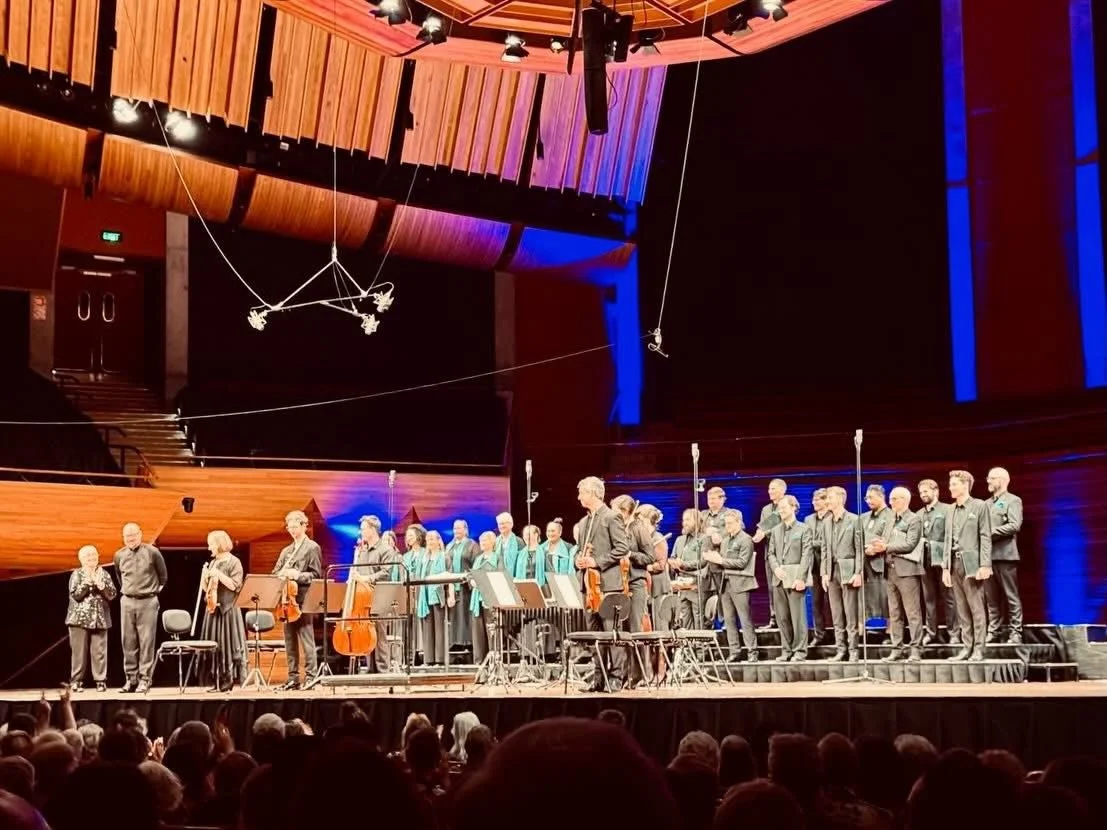
Applause for Voices NZ, NZSO musicians and conductor Karen Grylls at Ara Hura
“…the Michael Fowler Centre acoustic did not enhance the performance.”
Photo supplied
Sadly, the Voices NZ special farewell concert Ara Hura for their retiring conductor Karen Grylls was not enhanced by the over-dry and challenging acoustic of the Michael Fowler Centre. There are hard surfaces there, but the curves of the MFC’s circular shape and other aspects of the geometry mean singers (and probably instrumentalists) can’t hear each other well, vocal and string sounds are not warmly enhanced and the acoustic adjustments (those suspended wooden structures in the ceiling) can produce idiosyncratic outcomes. I first heard the choir’s featured work, Robert Wiremu’s marvellous Reimagining Mozart: Erebus, two years ago in the more resonant (and somewhat shoe-box shaped) St Mary of the Angels, where the Voices choral sound was much more vivid and impressive.
The 13-year closure of the old Wellington Town Hall has deprived the arts sector and its audiences of not only a great auditorium for orchestral and other music but of the associated Concert Chamber for smaller and more intimate events. The re-opening of that much-loved Town Hall, scheduled for February 2027, will be a thrill for many of us and will provide more venue choices for the Aotearoa NZ Festival in 2028.
New Wellington venues
Amongst newer venues on the Wellington scene is the handsomely refurbished Public Trust Hall. It looks elegant, but the sound is very disappointing; the website refers to “perfect acoustics for chamber music”, but sadly the reality is far from this. The absorbent screen behind the stage is unlikely to help. No concerts were held there during the Festival.
I was unable to attend A mua, presented by Chamber Music New Zealand, a collaboration between multi-instrumentalist, composer and sound artist, Riki Gooch and author Tina Makereti. It was staged at the new Festival venue, the Tāwhiri Warehouse, created as a bold response to venue challenges by the organisation that presents the Festival. It’s large, high-ceilinged, with hard surfaces – I’m looking forward to checking out unamplified music there sometime soon.
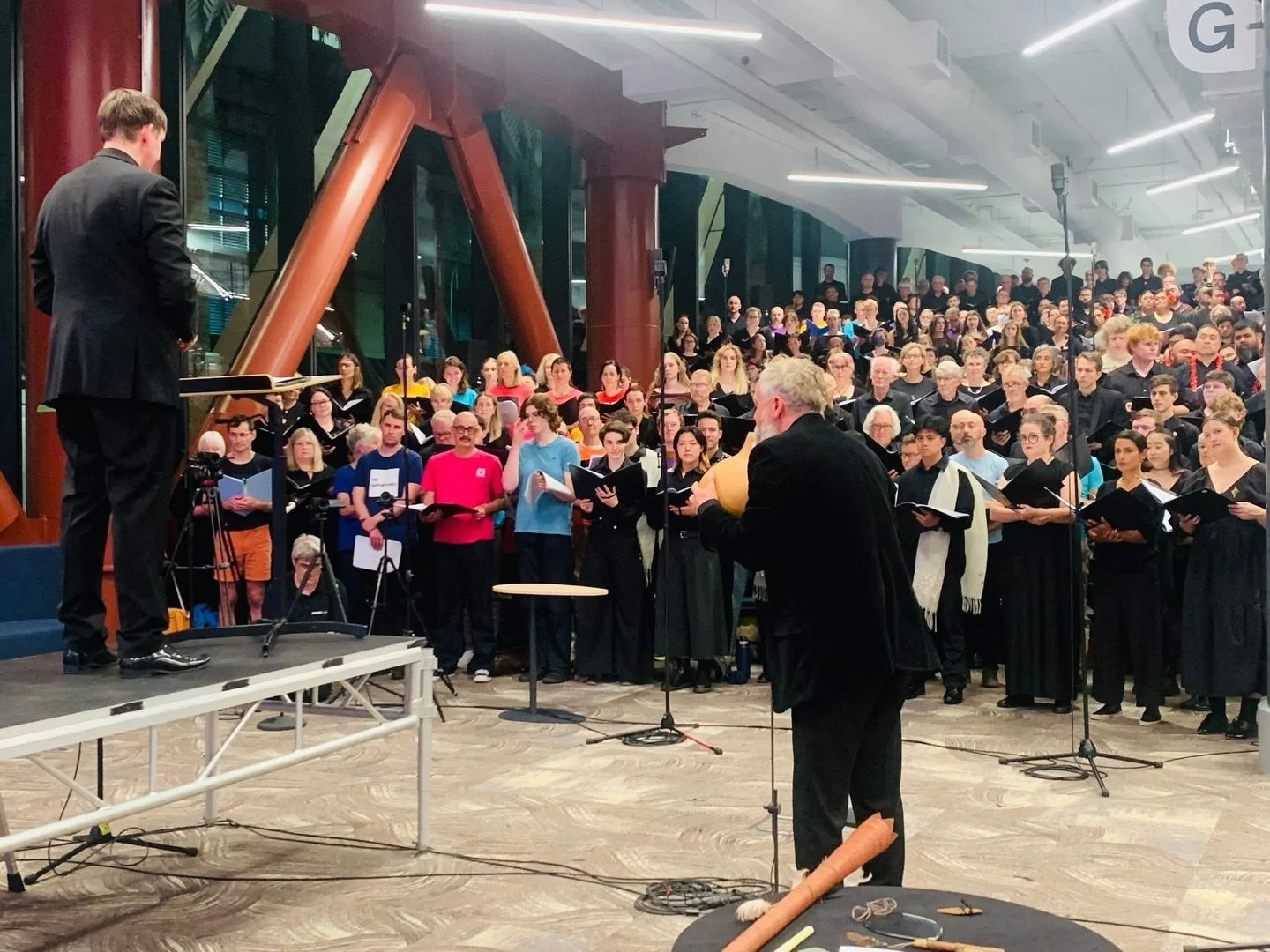
Massed choirs for the commissioned work, Te Matapihi, by Briar Prastiti, with conductor Brent Stewart and taonga pūoro musician Alistair Fraser, at the re-opening of Te Matapihi ki te Ao Nui, Wellington’s Library.
Photo supplied
The re-opening ceremony during the Festival of Te Matapihi ki te Ao Nui (The Window to the Wider World), Wellington’s Central Library, included an appealing and approachable work for eight choirs, some 300 singers with taonga pūoro, spread around the building with several conductors. Composer Briar Prastiti had composed her work Te Matapihi especially for the occasion, and it proved the interior of the building is resonant and reflective and ideal for a special celebration, though unlikely to be useful for regular concert presentation. Perhaps more exciting for the longer term is the small performance space on the top floor of Te Matapihi, Ngā Pou Ruahine, which may provide a intimate, art-filled setting for small ensemble concerts.
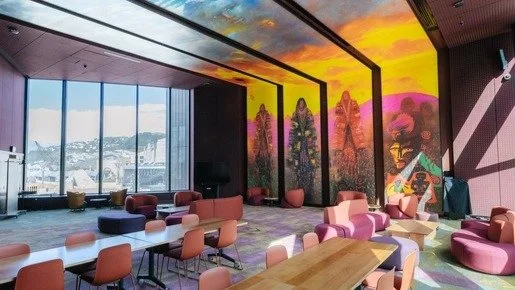
Ngā Pou Ruahine in Te Matapini
“…may provide an intimate, art-filled setting for small ensemble concerts.”
Photo supplied
New Zealand String Quartet in Prefab Hall
And finally, let’s return to Festival 2026, and one of my last concerts, “Last Leaf, Wandering East”, by the New Zealand String Quartet. For the programme the ensemble performed in the Prefab Hall, a space used successfully for their Shostakovich: Unpacked series last year. Located behind Prefab Café, it’s a small venue, seating just 150, but the NZSQ performed their Festival programme twice on the same day, and the session I attended was packed, as they say, to the gunwales.
Music groups often take the opportunity offered by the Festival to spread their wings in terms of repertoire choices. This programme had a folky feel, beginning with the “Last Leaf “ collection of quartet arrangements of traditional Nordic folk music, borrowed from the Danish String Quartet. These appealing short works date from the 13th to the 21th centuries; in fact, a few of the 14 pieces were written by the Danish musicians themselves, though you’d be hard put to work out which.
For New Zealand ears, there are clearly links with Celtic music, and the rapid fiddling, drones, pizzicato accompaniments, modal harmonies, acidic dissonance, skirling solos and bouncing rhythms had the audience tapping its toes or sighing in sympathy.
Musically it was all pretty light, but the whole performance was characterful and beautifully judged, with fine ensemble work. The set ended peacefully in a solemn minor mode.
After a short introduction by the composer, the Quartet travelled eastwards for Ross Harris’s Klezmer Tunes, arrangements of his original compositions in klezmer style for the Wellington group, The Kugels. The Quartet musicians ripped into this spirited music, which, while still folky and toe-tapping, has a very different energy from the Last Leaf Nordic collection.
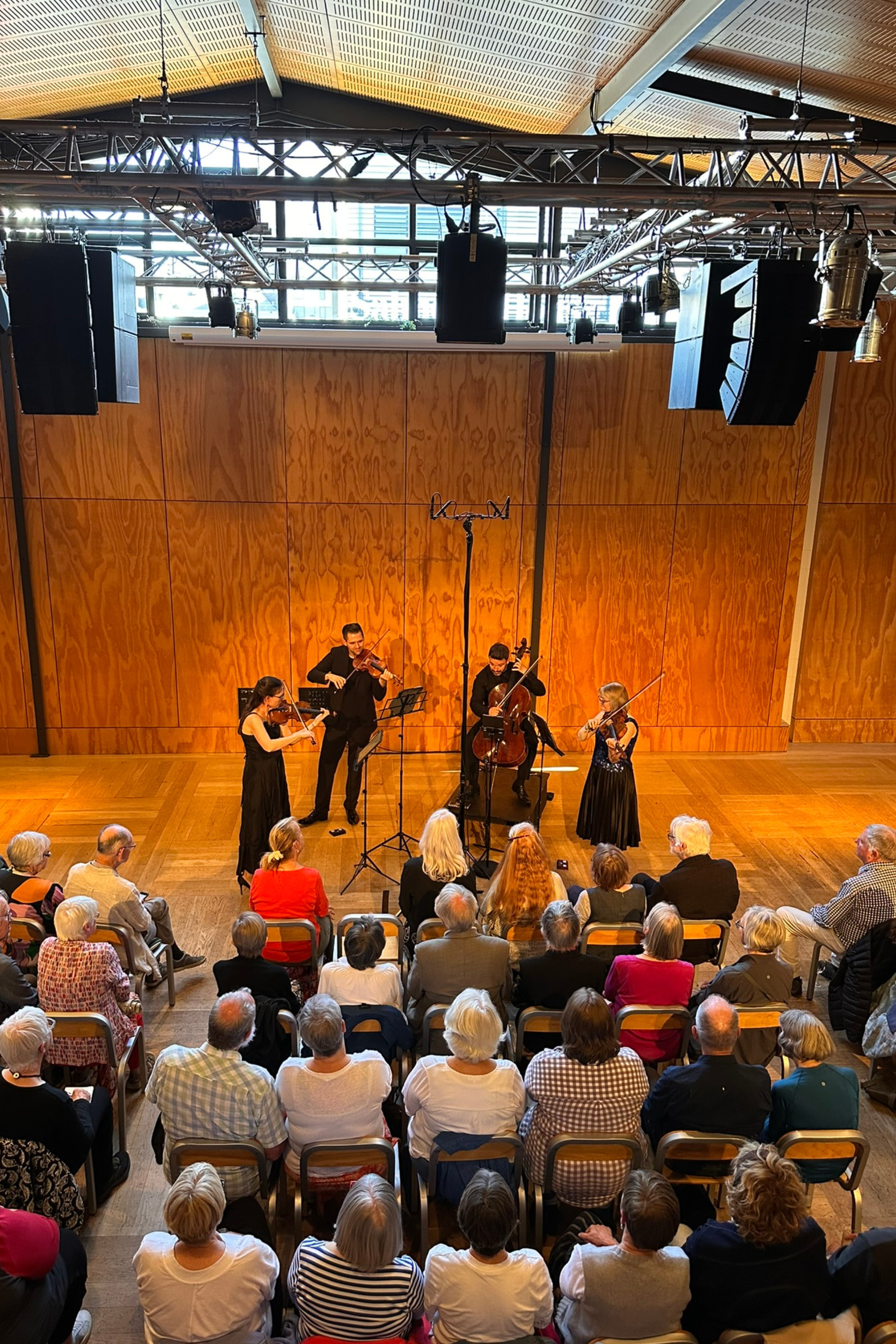
The New Zealand String Quartet performing Klezmer Tunes by Ross Harris at Prefab Hall
“…smaller venues with plenty of reflective surfaces and high ceilings are responsive to chamber ensembles.”
Photo credit: New Zealand String Quartet
Klezmer, the music of the shtetls, the small Jewish villages of Eastern Europe, is melodically-based dance music, often played by a band at weddings and ceremonies and traditionally including virtuosic improvisation for violin and clarinet. It’s high energy, with a distinctive humour, and these compositions by Harris capture its wry and sometimes biting wit, with abrupt changes of mood or rhythm and bittersweet emotions.
The NZ String Quartet delighted the audience with their performance, guest violinist Manu Berkeljon leading the ensemble and proving, as she had from the 2nd desk in the Last Leaf works, a great violin partner to Peter Clark.
I realised afterwards, with pleasure, that I didn’t need to think much about the acoustics in this programme. The high-ceilinged Prefab Hall has a great combination of intimacy and bright reflection for string instruments and showed the music and musicians off splendidly. Surely this is the ideal – a venue that enhances the music without calling attention to itself.
Aotearoa NZ Festival of the Arts February 24 – March 15, 2026
Groove Café NZ Trio Te Raukura ki Kāpiti Performing Arts Centre, February 28, 2026
Last Leaf, Wandering East New Zealand String Quartet, Prefab Hall, March 14, 2026