
NZSO and María Dueñas: casting a spell with Beethoven
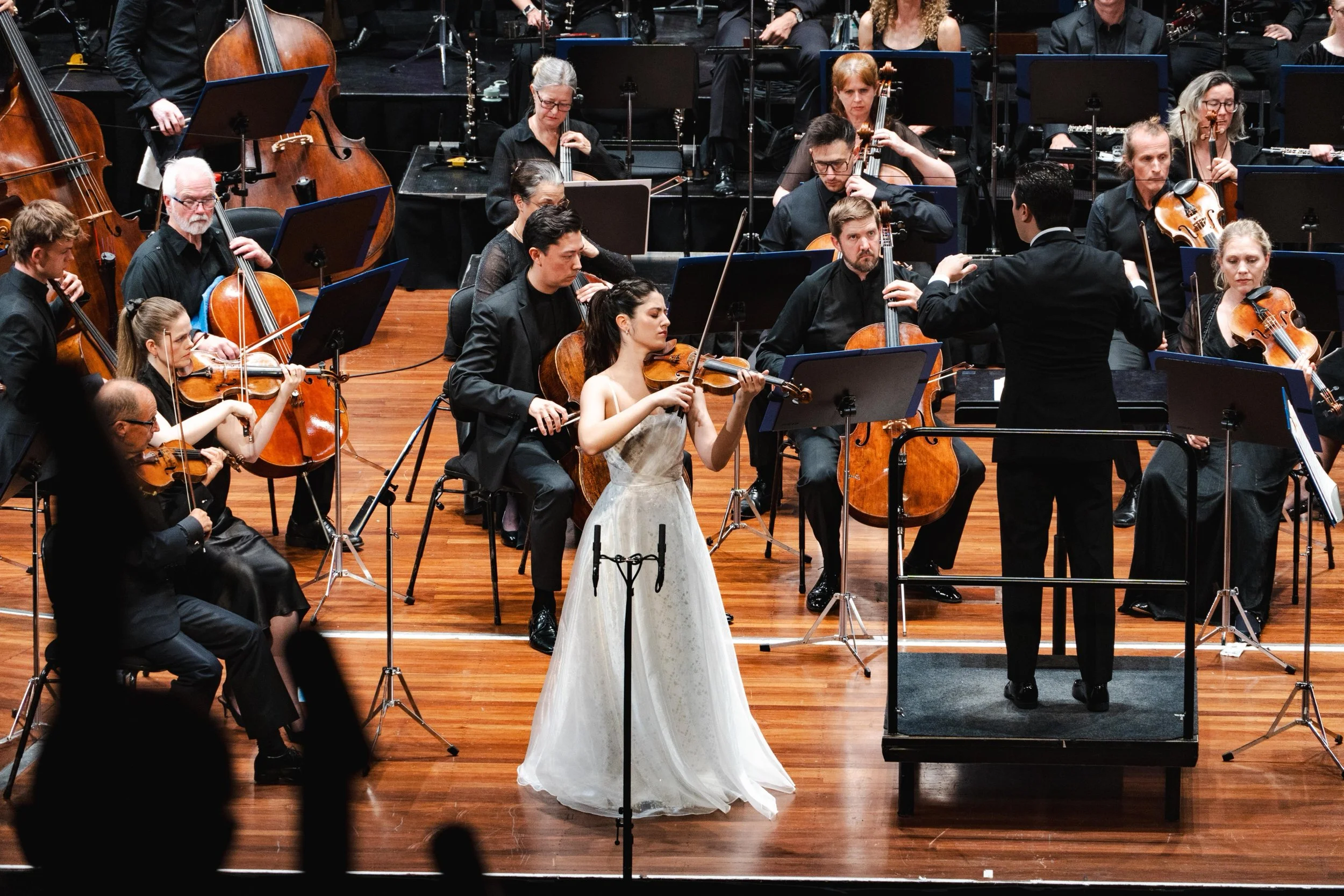
Violinist María Dueñas playing Beethoven’s Violin Concerto with the NZSO
Photo credit: Phoebe Cassidy/NZSO
The first concert of the New Zealand Symphony Orchestra’s 2026 season attracted a full house, foyers abuzz beforehand and a sense of excited anticipation in the Michael Fowler Centre’s packed auditorium.
The programme opened with a very short work by Eve de Castro-Robinson, currently composer-in-residence at the New Zealand School of Music and living in the Lilburn House in Wellington. Her Aurora, originally commissioned by the Auckland Philharmonia, is a witty and extrovert dawn chorus, opening with clarinet birdsong and imaginative percussion effects.
The AP commissioned a series of short fanfare-like works including Aurora from local composers to open its concerts in 1990, a nice project, and it’s good to see at least one of them returning to the platform. Suiting the fanfare intention, de Castro-Robinson’s playful work has splendid brassy effects alongside inventive woodwind chirping and tweeting. The composer stood from the audience to receive applause.
The main attraction for the audience was undoubtedly young Spanish violinist María Dueñas, playing Beethoven’s Violin Concerto, the work with which she launched her recording career with Deutsche Gramophon in 2022. Aged just 23, her rise has been described as “meteoric” and when she took the stage in a sparkling white gown, the audience was hushed for the five timpani strokes that usher in Beethoven’s orchestral introduction. As she began to play with her beautiful, singing sound, it was clear she was bringing her own interpretation to the concerto, one with effortless breadth of tempo and a sense of taking time to delight in the music.
On the podium was young Venezuelan conductor Rodolfo Barráez, now based in Berlin, and working internationally while maintaining links to the renowned music education programme El Sistema, which had a nurturing role in his own early education as a violinist. He was marvellously sensitive to Dueñas’s approach and timing, leading an NZSO clearly in good shape to open its season. The strings were sounding particularly warm and rich, the 1st and 2nd violins facing each other across the front of the stage.
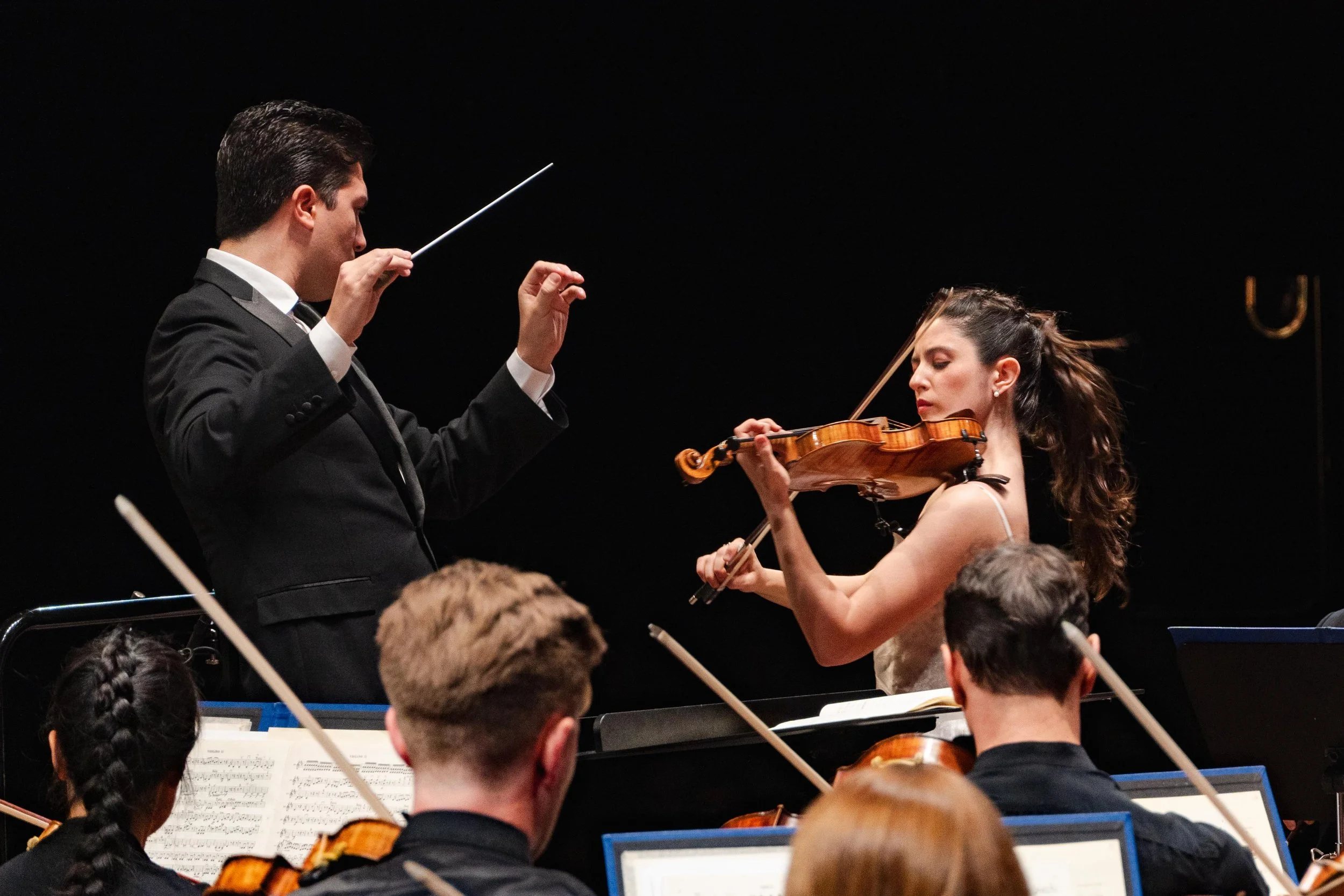
Conductor Rodolfo Barráez with violinist María Dueñas
“…marvellously sensitive to the soloist’s approach and timing.”
Photo credit: Phoebe Cassidy/NZSO
Dueñas maintained a subtle flexibility throughout the concerto. Passion and tension built, with some magically soft playing that had the audience holding its breath. In the 1st movement cadenza, she began strongly, with a slowish tempo and relaxed double stopping. Riffing on Beethoven’s themes with harmonic explorations, she showed her big range, sometimes fierce and emphatic, then silences creating drama, cascades of arpeggios and little questing figures, the whole cadenza ending quietly as pizzicato strings joined her. This gentle, dreamy playing revealed a new side of Beethoven before she released the tension for a strong ending to the movement.
Her thoughtful approach continued in the tuneful 2nd movement, Larghetto, her conception here a romantic exchange with the orchestra, horn and bassoon melodies nicely placed and soloist spinning a long, unhurried and lovely line. Having cast a spell with this exquisite playing, Dueñas followed the growing strength of the orchestral part with a big flourish, taking the symphony straight into the Rondo of the 3rd movement.
Technical demands seem no problem to this young star, who has virtuosity to spare, and Beethoven’s light, bouncing music here has both classical restraint and opportunities to dazzle. Dueñas creates her own cadenzas, and after the short one in the third movement she offered some virtuosic double-stopped counterpoint before the concerto ended brilliantly to a great ovation. Her encore was not announced, but maintained her expressive, deeply felt playing in a lovely, Spanish-inflected solo
When the NZSO’s Chief Executive Marc Feldman delivered his usual – and perhaps superfluous – pre-concert message from the stage, he reminded us that the NZSO will celebrate its 80th birthday next year. He also mentioned that the upcoming performance of Dvořák’s Symphony No 9“From the New World” was the 118th time the NZSO had played the work over the orchestra’s lifetime.
Several decades ago, Professor Frederick Page wrote the NZ Listener’s weekly ‘Concert’ column. Often, in his curmudgeonly old-man-critic persona, he asked of the NZSO’s repertoire choices “why could we not have had…?”. His querulous question was followed, inevitably, by suggestions of music by avant garde 20th century composers whose music would probably have challenged the audience more than management could tolerate.
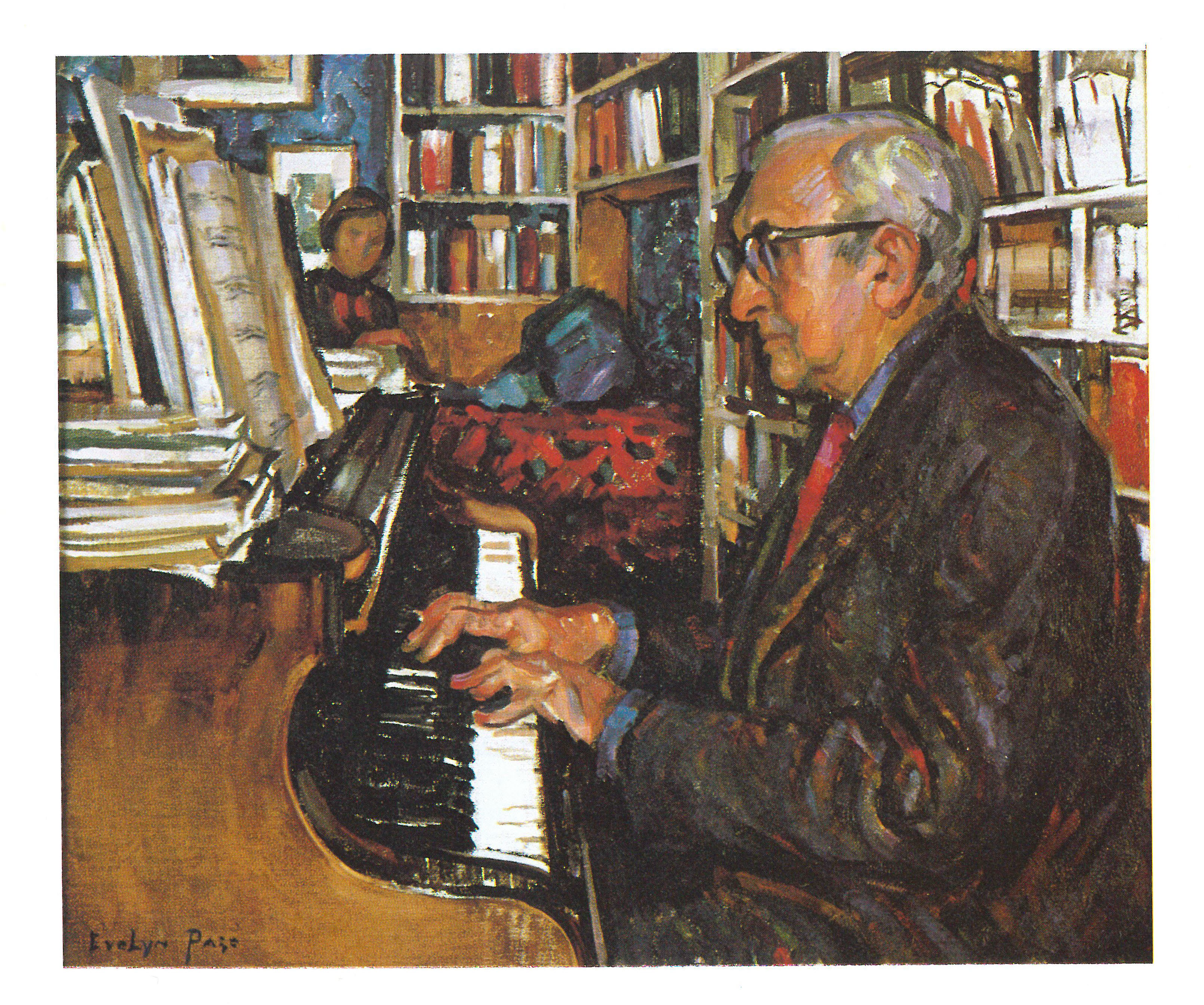
Music critic Frederick Page
“…frequently questioned the NZSO’s repertoire choices.”
Painting by Evelyn Page
I confess, in listening to yet another fine NZSO performance of Dvořák’s ever-popular 9th Symphony, I drifted into Fred’s “why could we not have had…?” mindset more than once.
Yes, I’m sure there were many in the large audience who love the work, perhaps some who had not heard it before. I think Maestro Barráez probably loves it too. From a bracing and assertive opening, he conducted without a score, showing the strengths of our very fine orchestra, with crisp string playing, splendid brass work and lovely, finely judged solos from horns and woodwinds. In the second movement, there was some distracting on-stage drama with a broken cello string, but the grand hymn-like section was moving and the famous “Goin’ Home” theme for cor anglais beautifully played by Vivienne Brooke.
But did we really need to hear this work again? The western canon of symphonic music is huge, and composers are still adding to it. I know orchestral programming must balance many factors; for instance, Beethoven’s Violin Concerto is on the long side, so a shorter symphony was needed. The “New World” is under 40 minutes long. But so is Amy Beach’s “Gaelic” Symphony, written just a couple of years later and an appealing, romantic work that also uses folk material. Is there some rule that only one woman composer can be featured per concert?
Alternatively, are two New Zealand composers on one programme beyond the pale? The NZSO’s 2026 subscription series is almost shamefully skimpy in its representation of our own creative talents, and, since Douglas Lilburn’s 1st Symphony in 1949, our composers have written many fine and well-received orchestral works of symphonic length.
Well, box office matters, of course, and the house was full. But I suspect Beethoven’s beloved music and an exciting young soloist were largely responsible, and some more adventurous, even “risky” programming could have been possible (and I could have been saved from a 24-hour ear-worm of “Goin’ Home”).
Maybe for its 80th birthday celebrations next year the NZSO might push the programming boat out little further?
NZSO “From the New World”: music by Eve de Castro-Robinson, Beethoven and Dvořák. Rodolfo Barráez (conductor), María Dueñas (violin) Wellington, 26 March, 2026.