
NZ Opera’s “Figaro”: glorious music, fast-moving farce and the dark side of power
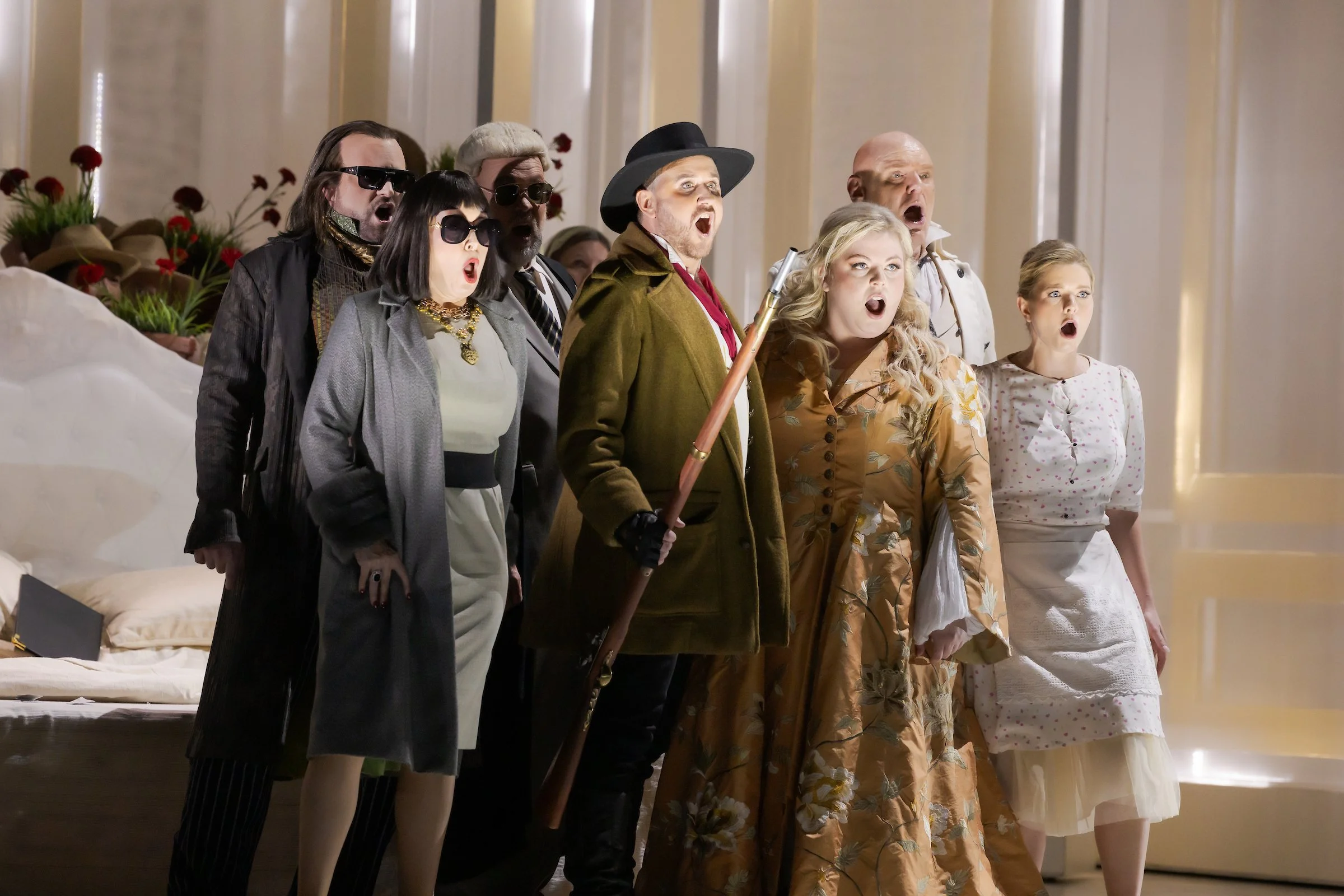
The principals of Mozart’s The Marriage of Figaro
Photo credit: Stephen A’Court
As we take our seats for New Zealand Opera’s The Marriage of Figaro in Wellington’s grand St James Theatre, a tableau of characters is fluttering on stage behind a gauzy curtain. It’s the chorus, dressed in creamy white, and busily preparing for – what? A wedding, of course. Colourful flowers spill from baskets and are sewn on costumes in a happy flurry of anticipation.
The lights go down and Maestro James Judd arrives in the pit, Mozart’s glorious overture buzzes into speedy life and the chorus packs up and leaves. When the gauze curtain rises on a brightly lit stage, they return, eyes turned to the back of the stage where another curtain rises, revealing large rectangular lightbox pillars which chorus members quickly position on stage.
It’s a stylish and effective opening for one of the most popular works in the operatic canon. This masterpiece was created by Mozart and his librettist Lorenzo Da Ponte as a “comic” opera, but one with deep social and political themes alongside its farcical humour. This brilliant NZ Opera production, directed by Australian Lindy Hume, entertains with seamless action at breakneck speed while cleverly revealing the work’s profound explorations of power dynamics.
It all takes place on a single day, beginning at dawn with Figaro and his bride-to-be on stage, the lightbox set now suggesting a bedroom. In their opening duet, Figaro (baritone James Clayton) is measuring for the bridal bed, pitches rising as measurements increase. He’s valet to Count Almaviva, while Susanna (soprano Sophie Sparrow) is the Countess’s maid, and they’re preparing for their wedding. All seems light and cheerful, but a dark undertone lurks.
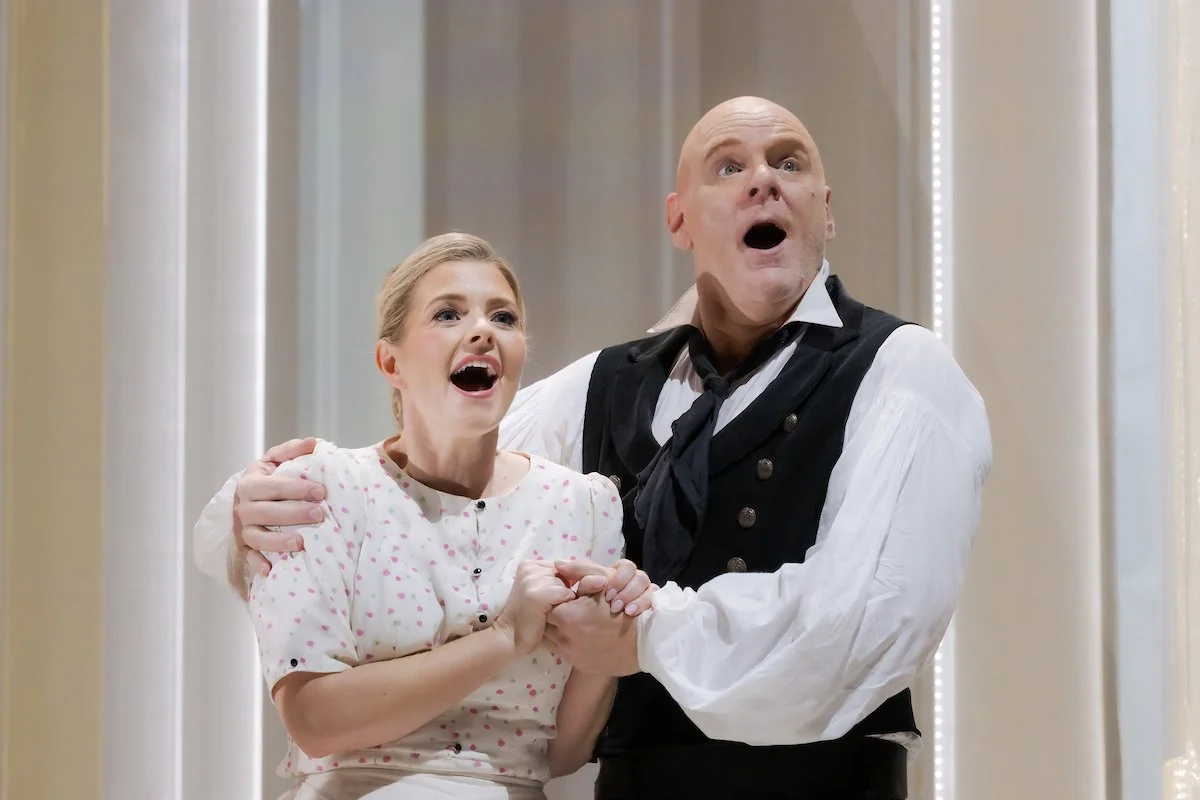
Susanna (Sophie Sparrow) and Figaro (James Clayton)
“…preparing for their wedding in Mozart’s The Marriage of Figaro.”
Photo credit: Stephen A’Court
Total power in the household belongs to the wealthy, entitled Count. He claims to have renounced the practice of droit du seigneur, his right to bed Susanna on her wedding night, but she doubts his sincerity and fears his lust. The opera thus lays out in its opening act the consequences of the social hierarchy. It’s a work of its time - it premiered in Vienna in 1786, when revolution was in the air – but contemporary parallels are not far away.
Clayton sings Figaro’s cavatina, “Se vuol ballare, Signor Contino” with menacing sarcasm in his rich baritone. “If you want to dance, little Count, you may, but I’ll call the tune.” The music begins in triple time, an ironic courtly dance. Then Mozart shifts to furious speed and duple time, for a lower class contredanse, Figaro spitting his defiance -"tutte le macchine rovescerò" (I will overturn all your schemes) - before resorting to an even more mocking aristocratic style in a return to the waltz. It’s one of many examples of Mozart’s subtle musical underlining of the drama on and off stage.
The well-matched cast of this production offers wonderful singing throughout. Sparrow’s agile soprano has a lovely clear tone and her characterisation is deliciously flexible. At first she occasionally struggles to be heard over the orchestra, which may be her position on stage, since for most of the opera her voice has plenty of power. Clayton’s singing is consistently fine, though his demeanour may be a little too threatening for Figaro, often played as a more genial fellow.
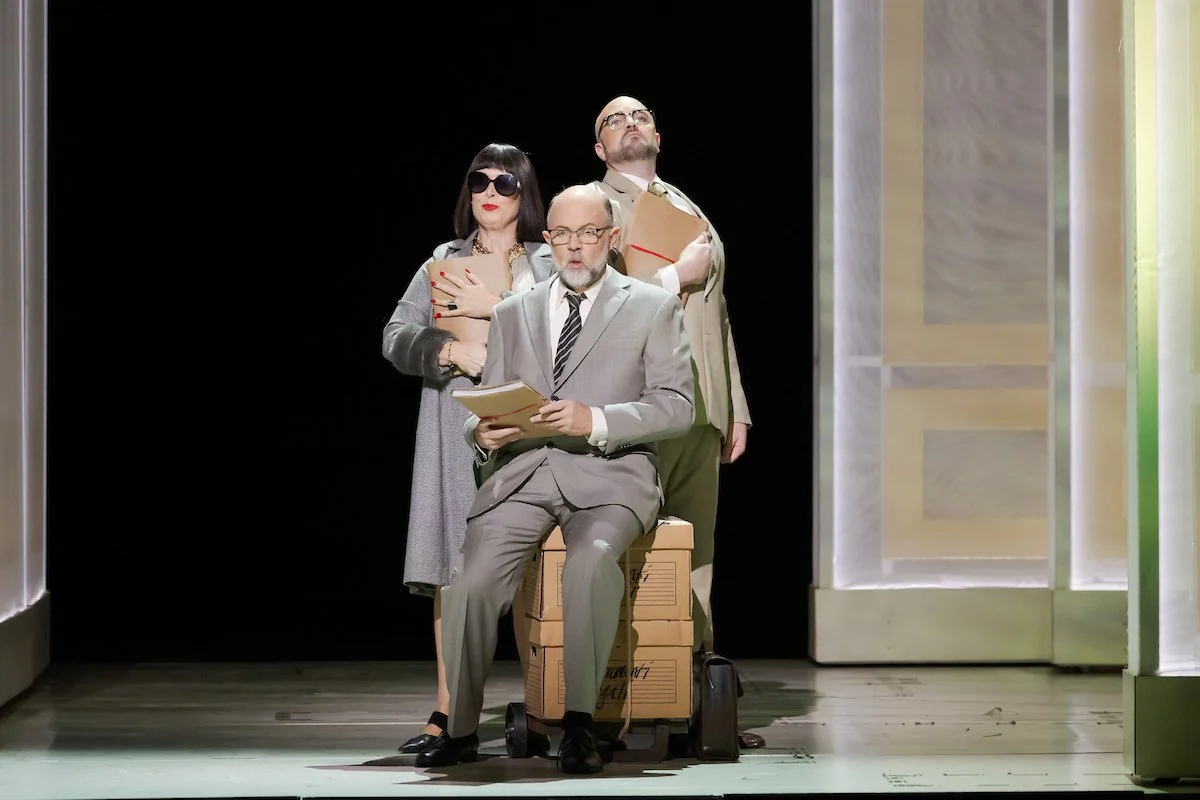
Marcellina (Kristin Darragh) with Doctor Bartolo (Andrew Collis) and Don Curzio (Andrew Grenon)
“…resembling a government audit team.”
Photo credit: Stephen A’Court
Mozart uses Act 1 to set up the story and introduce the cast. Next on the scene are a suited and bespectacled trio in dove-grey modern dress, resembling, perhaps, a government audit team. It’s Doctor Bartolo (bass-baritone Andrew Collis) with his housekeeper Marcellina (Kristin Darragh) and his lawyer Don Curzio (Andrew Grenon, who returns later, bewigged, as a splendid Don Basilio). Bartolo has some old scores to settle with Figaro and sings the rancorous aria “La vendetta”, the rapid-fire words occasionally a little hard to hear. Marcellina, meanwhile, has designs on Figaro and her duet with her rival Susanna is clever and spiteful from both women.
The complexity of male-female relationships is a major theme. There’s a lot of unresolved desire about, and its attendant rivalries and yearning. The pace quickens further with the entry of Cherubino, a wonderful “trouser” role played by mezzo soprano Cecilia Zhang. Cherubino is young, innocent and libidinous, fancying women right and left, and particularly infatuated by the Countess. In his famous aria “Non so più, cosa son, cosa faccio” (I do not know anymore what I am, what I do) he explains to Susanna his obsession with love – “every woman makes me tremble” – showing Zhang’s lovely voice and sparkly lightness of approach.
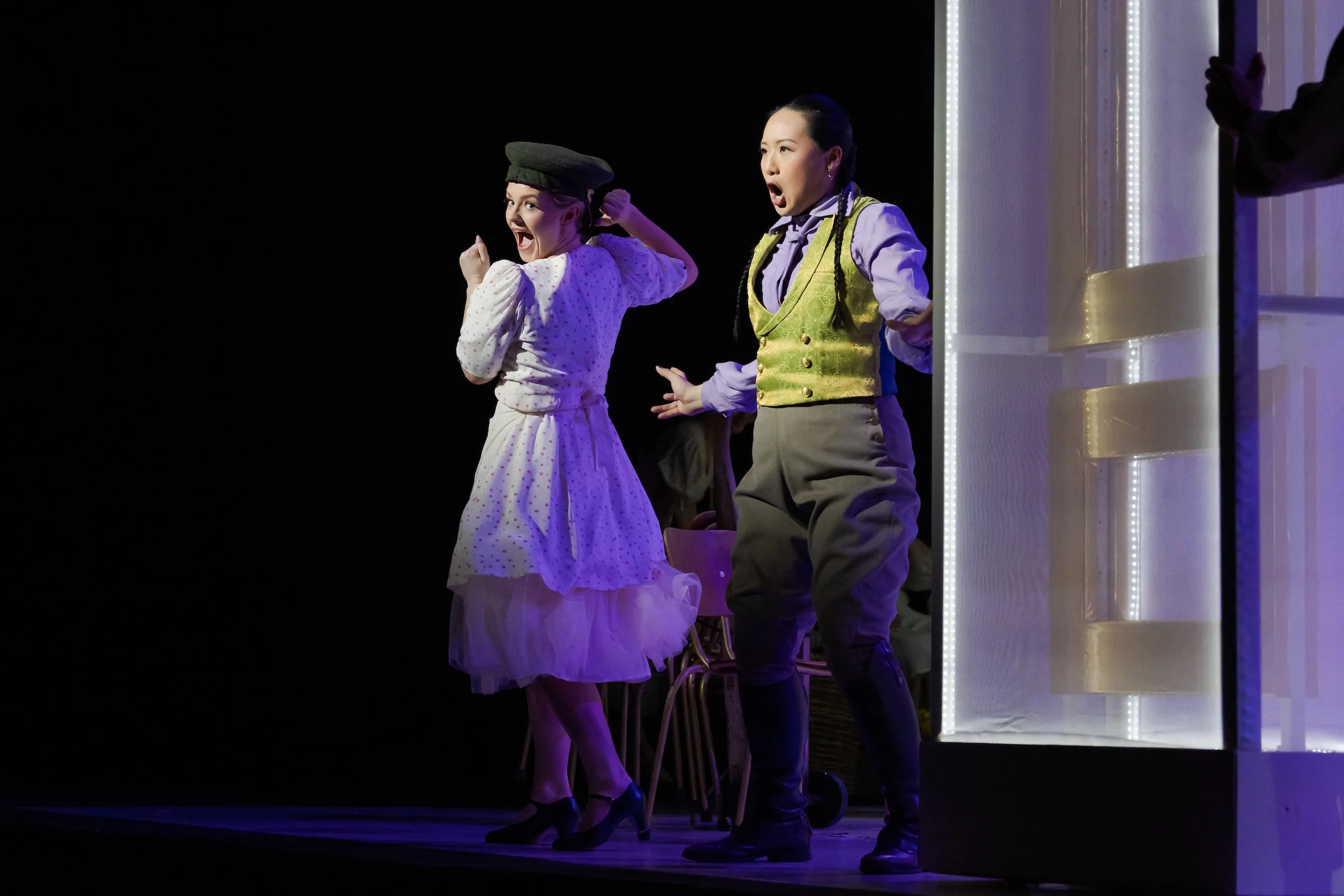
Susanna (Sophie Sparrow) (left) and Cherubino (Cecilia Zhang)
“…many brilliantly choreographed scenes of farcical dissembling.”
Photo credit: Stephen A’Court
Cherubino is the source of much of the fast-moving chaos in the opera, the androgynous nature of the trouser role seeing him more often in cahoots with the women than the men, his disguises as a pretty girl adding to the gender ambiguity. When the Count arrives, Susanna quickly hides him, in the first of many brilliantly choreographed scenes of farcical dissembling.
Count Almaviva is played by baritone Julien Van Mellaerts with marvellous presence and movement, his fine voice commanding attention. He’s definitely the bad guy. Act 1 ends with some terrific ensemble work, everyone confused about who is hiding where and from whom, the action funny and slick, the singing splendid, the tables turned and turned again. Figaro ushers in the chorus as a distraction to cheer everyone up. After Figaro’s admonishing aria to the childish Cherubino, the versatile lightboxes move again to take us seamlessly into Act 2.
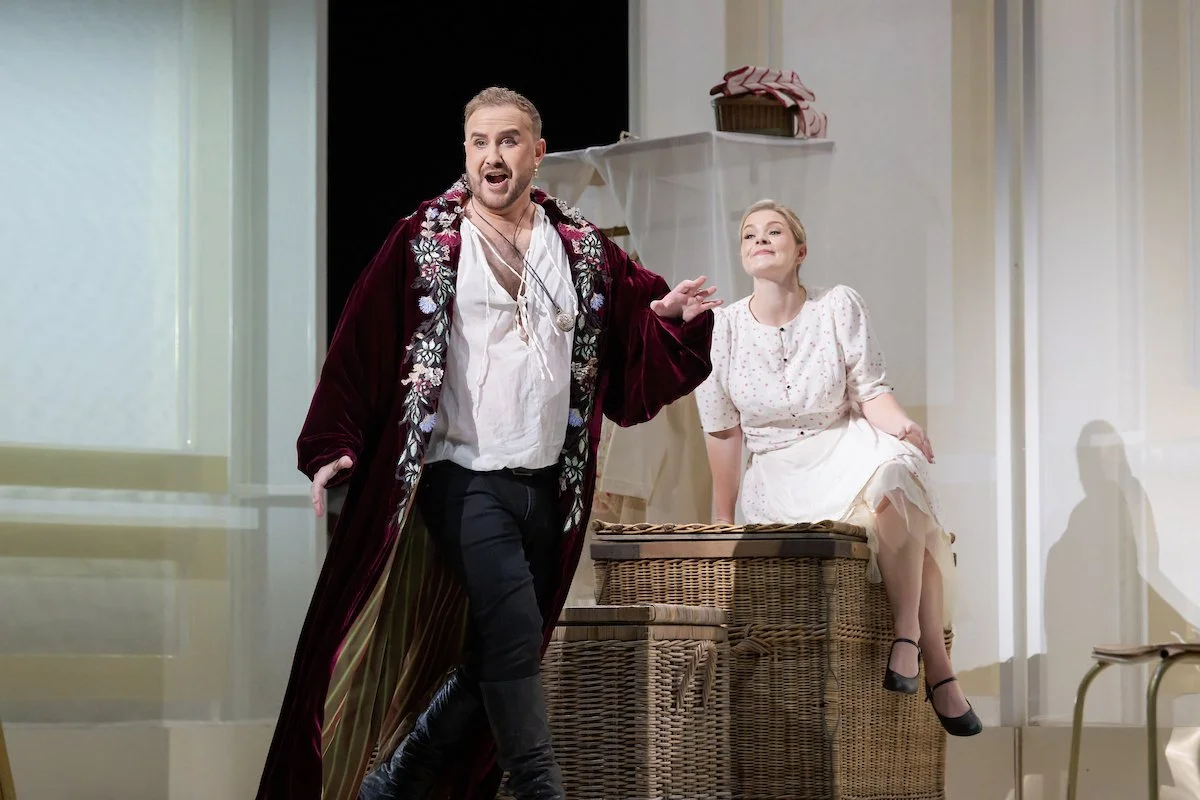
Count Almaviva (Julien Mellaerts) with Susanna
“…marvellous presence and movement - he’s definitely the bad guy.”
Perhaps underlining a democratic impulse, in Figaro Mozart has written an opera full of ensembles – duets, trios and bigger groups. Felicity Tomkins as the Countess Almaviva, however, holds the stage alone at the beginning of Act 2, singing of her distress about her husband’s philandering in the lovely cavatina Porgi d’amor. Tomkins has a big and beautiful voice and her aria is finely judged, moving but artistically restrained.
Of course, much of the action is advanced by recitatives, rapid exchanges amongst characters agitated by lust, anxiety or anger and almost always on the move. These are splendidly accompanied by continuo, including very fine work from David Kelly on fortepiano, a nice period touch.
Opera is an artform of passion and in Act 2 many emotions simmer behind the action – Cherubino’s genuine distress, the Count’s abusive manner to his wife and apparent contrition, the Countess’s growing and empowering anger, Susanna’s and Figaro’s attempts to smooth over the issues. Within the playful and fast-moving choreography of Taiaroa Royal, this brilliant act doesn’t hide the dark side of this story.
By the end of the act, the plot develops into a double double cross with everyone on stage. Clever design uses colour to subtly distinguish the groups, the servant class, Figaro, Susanna and the chorus, in white, the Countess magnificent in gold, Marcellina and her associates and the Count in darker colours. Almaviva marches about indignantly brandishing a rifle while Marcellina triumphantly waves a contract. Cherubino, as usual, is characterised as chief trouble-maker. The Act ends with magnificent ensemble work, lightboxes flashing and maximum drama and confusion.
The twists and turns continue in the second half of this four act opera. Designer Tracy Grant Lord has employed the papers, secret letters and unexpected contracts that feature so often in the plot as a witty design feature. Documents are often ripped into confetti that floats down, reminding us this is all about a wedding. Or is it?
Act 3, which begins with Van Mellaerts in brilliantly nasty form in a scene where the Count abuses his servants, moves to comic relief by revealing Marcellina as the mother of Figaro. Mozart’s hilarious extended treatment of this, particularly Figaro’s explanation to a jealous Susanna – “Sua madre? Sua madre! Tua madre?” – is one of the wittiest comedic moments in the whole opera, splendidly handled here, the final sextet a triumph. The Count, thwarted, sits disconsolate with a blanket over his head. Figaro’s marriage is now to be a double wedding.
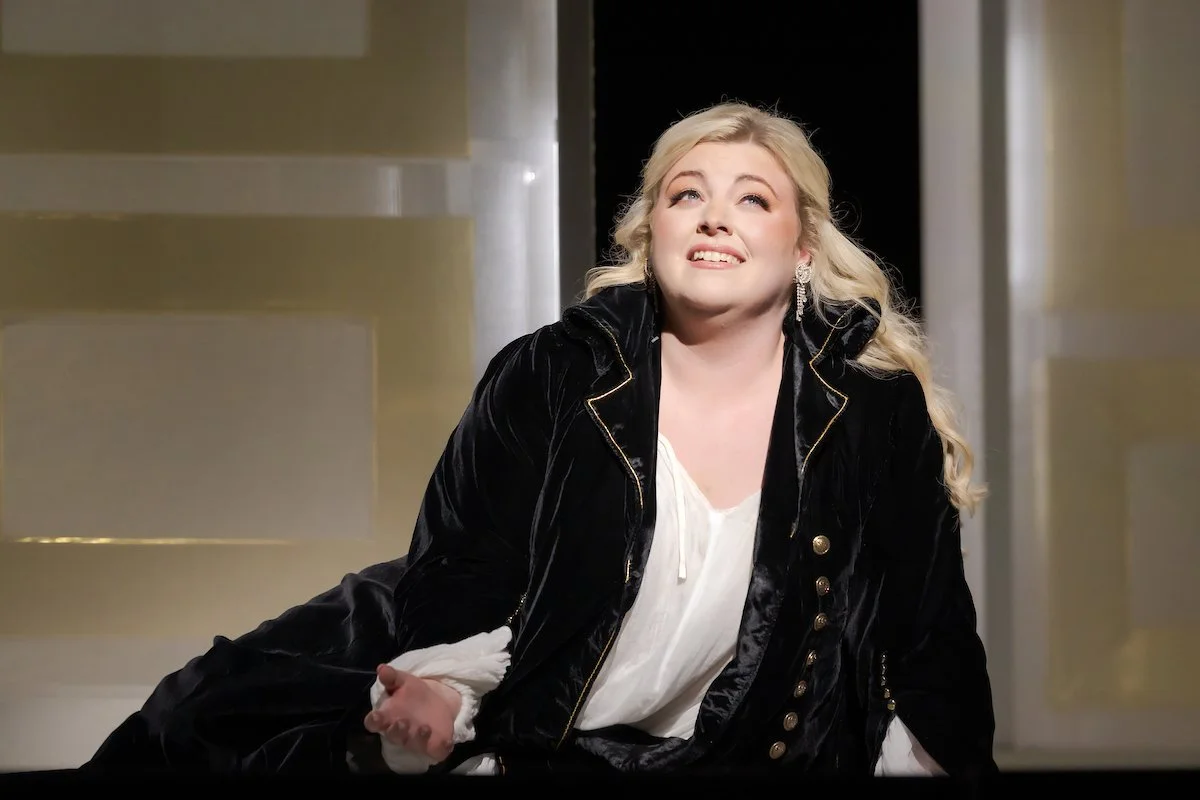
Countess Almaviva (Felicity Tomkins)
“…a big, beautiful voice, and her singing moving, with artistic restraint.”
Photo credit: Stephen A’Court
While all this plays out, the Countess is left alone, and Tomkins thrills the audience with her emotional aria “Dove sono i bei momenti?” (“Where are the beautiful moments?”), remembering her past happiness with the Count and regretting she is reduced to manipulating him with the help of her servants. Indeed, the plot shows how tricks and deceptions are the only power available to women in this environment.
The colour palette changes again in this Act, the Countess in deep red with floral touches, the chorus multi-coloured in festive wedding garb. As the Almaviva household servants, the chorus doesn’t have a big singing role in The Marriage of Figaro, but vocally they’re fine, well-balanced and expressive, and director Hume has them involved in almost every scene, observing, listening and making it all work with set changes and other household management.
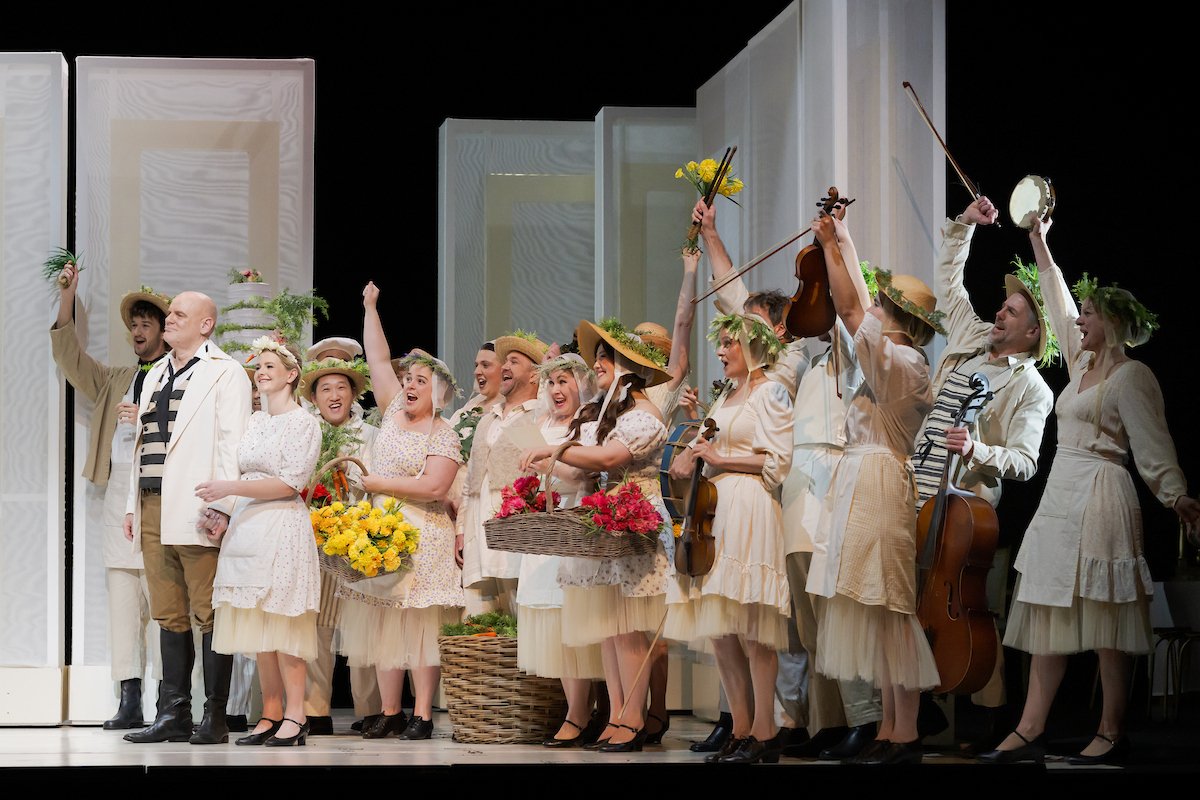
The chorus with Figaro and Susanna
“…involved in almost every scene.”
Photo credit: Stephen A’Court
In Act 4 the lightboxes transform into the trees and ominous shadows of a dark nocturnal scene. The imaginative lighting work of Matthew Marshall complements Mozart’s brilliant harmonic conjuring of atmosphere, the music shifting to a minor key as the young Barbarina (beautifully sung by Sarah Mileham) sings sadly of losing of a pin and failing her task in the deception. As Figaro reminds us later in the Act, “the night joins the conspiracy”.
Orchestra Wellington and Judd are splendid throughout the performance, matching both the opera’s breathless pace and its emotional depth. In this final Act, their accompaniment of an expressive and compelling aria from Clayton, "Aprite un po' quegl'occhi", marvellously underlines Figaro’s lament on women’s duplicity, a pair of French horns commenting wryly on his disillusionment.
Luckily, Susannah, the Countess and Cherubino have pulled off their plans to foil the Count’s lecherous intentions, using yet another letter and costume switch. Again the farcical trickeries are cleverly handled by director and choreographer, the Countess forgiving the Count and everyone’s relationships sorted for a celebratory ending. Sheets of paper floating from above suggest incriminating love letters, pre-nuptial contracts and other fun-suppressing documents will be put aside in the interests of conjugal happiness. Love rules over cynicism, at least for now.
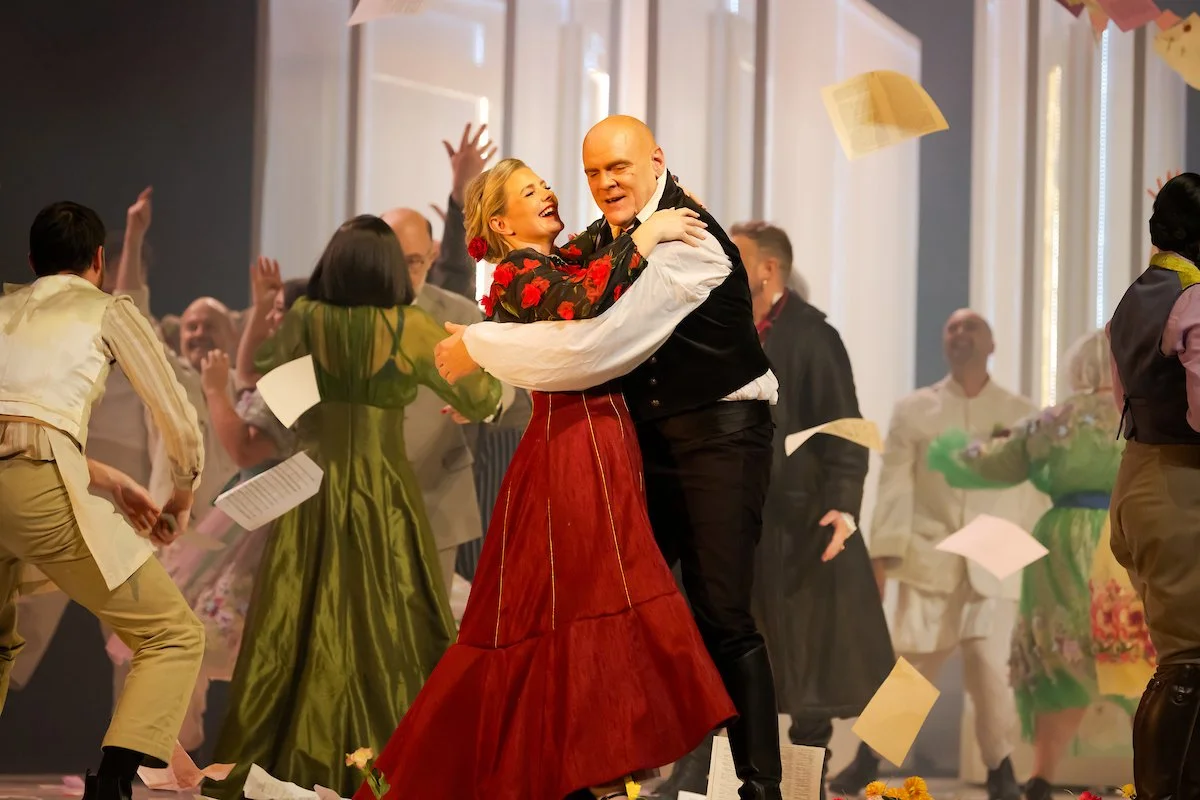
The celebratory final scene of The Marriage of Figaro
“…everyone’s relationships sorted…”
Photo credit: Stephen A’Court
This gorgeous production was scheduled for Wellington in 2021 and cancelled when the city moved to Level 2 Covid restrictions. Thank you, NZ Opera, for bringing it to the capital at last – for the delighted audience, it was clearly worth the wait.
New Zealand Opera The Marriage of Figaro by Mozart and Da Ponte. Wellington, June 17-21, 2026.
Creative team: James Judd (conductor), Lindy Hume (director), Tracy Grant Lord (designer) Matthew Marshall (lighting designer), Taiaroa Royal (choreographer).
Cast: Julien Van Mellaerts (Count Almaviva), Sophie Sparrow (Susanna), Felicity Tomkins (Countess Almaviva), James Clayton (Figaro), Cecilia Zhang (Cherubino), Kristin Darragh (Marcellina), Andrew Collis (Doctor Bartolo), Andrew Grenon (Don Basilio/Don Curzio), Sarah Mileham (Barbarina), Joel Amosa (Antonio), with Orchestra Wellington and the Freemasons Foundation New Zealand Opera Chorus.
Related Five Lines articles:
Soprano Felicity Tomkins: sharing the joy of opera
When the curtain suddenly falls