
Phoebe Russell: double bass virtuoso and ‘kind of a big deal’
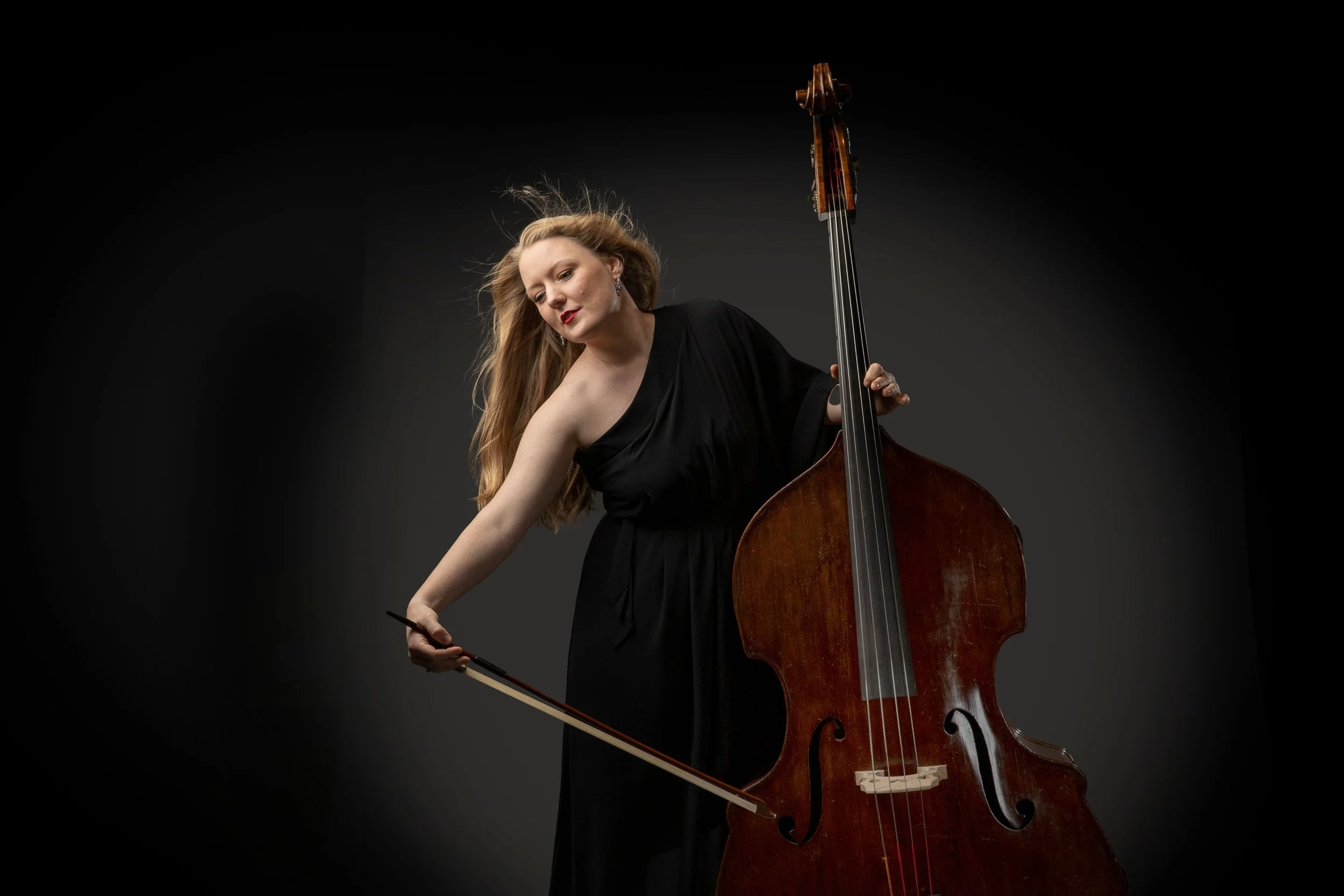
Double bass player Phoebe Russell, who is performing at the Adam Festival of Chamber Music in February 2026
Photo credit: Sarah Marshall
Australian double bass virtuoso Phoebe Russell is about to pack her bags and cross the Tasman. Her reputation suggests she’ll delight audiences at the upcoming Adam Chamber Music Festival in Nelson.
Russell was eight years old when she won the opportunity to play the double bass by successfully arm-wrestling two boys, one after another. "They both wanted to play the only bass available. I only wanted to play it because I'd been promised it was similar to the harp, which was what I really wanted to play."
Russell had been playing the piano since the age of three and played bass in her primary school's string orchestra - "to be honest the only things I remember are the snacks the teacher brought" - but her strongest memories date from a few years later when she began working with “excellent” bass teacher Jill Griffiths.
"She made me realise that playing bass was something I'd like to continue," Russell recalls. Confidence came when she won a full scholarship on double bass to senior school "and from there, my love for the bass only grew."
An early career watershed was attending Karr Kamp in Victoria, British Columbia when she was just 15. Legendary US bassist Gary Karr, regarded as one of the greatest bass players of all time, ran the biennial summer camp for bass players, described by attendees as “transformative”. Karr was already a bass hero of Russell’s when her mother persuaded him to allow the passionate Phoebe to attend in 2009, though the lower age limit was usually 18. He agreed if her mother attended with her.
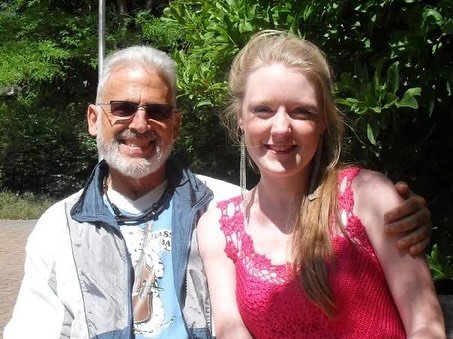
Phoebe Russell with double bass legend Gary Karr
“…her time at his transformational Karr Kamp in Canada was life-changing.”
Photo supplied.
It was “just incredible”, Russell says now. “I got to play for him every single day, at least 3-4 lessons with him a week, opportunities to play alongside him, chamber music with other bass players.” She was so inspired she went back to the next Karr Kamp two years later.
When Karr died last year, Russell wrote in an Instagram tribute “You didn’t just change the double bass world and the music world for the better—you also changed my life. I feel so lucky to have met you…”
At that first Kamp Russell made her first musical connection with New Zealand, meeting bassist Vicki Jones. “She had pink hair,” she remembers. “She said one day she’d dye a streak of my hair pink, but it hasn’t happened yet. Maybe this is the trip for it.”
In 2011, after her second Karr Kamp, the 17-year-old Russell, then early in her studies at the Australian National Academy of Music (ANAM) in Melbourne, travelled to Berlin to audition for the Karajan Academy of the Berlin Philharmonic. Founded in the 1970’s by famed conductor Herbert von Karajan during his 40 year reign as the Berlin Philharmonic’s principal conductor, the Academy offers two-year scholarships to talented young musicians worldwide, providing individual lessons by members of the Philharmonic and regular opportunities to rehearse and perform with the orchestra.
For a teenage double bass player from Australia, it seemed an ambitious undertaking, but Russell was clearly ready. Immediately after her audition, the Philharmonic invited her to play with them two weeks later as a casual player. “ I was really taken aback and excited,” she recalls. “I went home and thought ‘did this really happen?’. I didn’t get any confirmation, not even an email. No music was sent to me from the orchestra’s library, nor any correspondence till the day I was supposed to go in and play – I was in denial that it was really happening.”
She was hugely relieved when she arrived at the rehearsal and found her name. “I hadn’t dreamed the whole thing. And that first rehearsal was incredible. I was sitting next to Edicson Ruiz.”
Venezuelan musician Ruiz came from a poor area of Caracas and began his musical studies aged 11 in the El Sistema network of youth orchestras. He gained his place in the Berlin Philharmonic aged 17, then the youngest player ever in the orchestra. For Russell, he was, after Karr, her “second bass hero”.
“Edicson is a really amazing musician,” she says. “I was a little bit star-struck”.
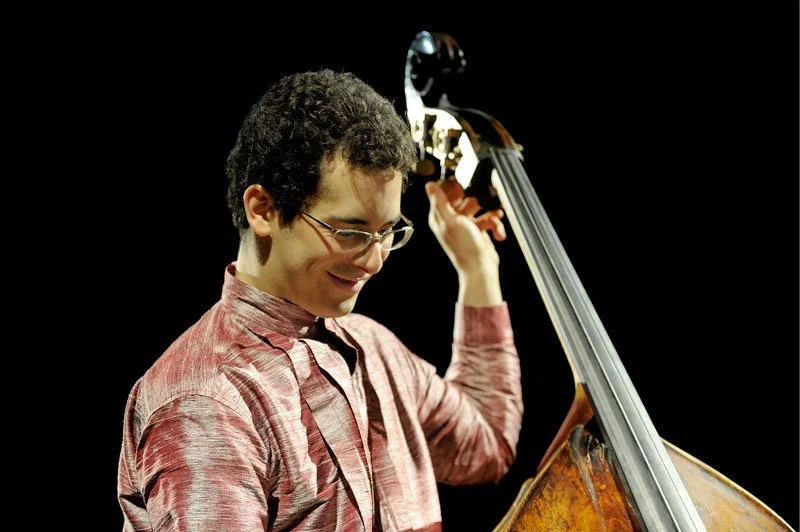
Berlin Philharmonic double bass player Edicson Ruiz
“…after Karr, he was Russell’s ‘second’ bass hero”.
She was also confused when Ruiz turned to her at that first rehearsal and suggested ‘let’s do all the exact opposite bowings to the principal today.” Fortunately, it became clear that he was just teasing her, “pulling my leg.”
Although she had reached the finals of the Academy’s audition process and been invited to play with the orchestra as a “casual”, only one place at the Karajan Academy was immediately available and it went to someone else. But fortune was on her side. Another academist finished early and she was appointed to that position for two years.
There was a lot for a young musician to learn, some of it unexpected. “I had to get used to playing with an orchestra that doesn’t follow the conductor; they don’t go with the conductor’s beat at all. They have a way of playing harmoniously like one organism, but not in a way that a newcomer would see as following the beat. The conductor’s role for that orchestra is to shape the phrasing and give their musical input. At first, I didn’t look at the conductor at all,” she admits, laughing, “because there was a downbeat and then, it felt like a matter of seconds later, the orchestra played”.
So, who did she follow? “As a student I was following the section leader,” says Russell, “but I also learned to be aware of everything that was going on in the orchestra. I studied the scores, so I knew who was playing the important parts, rather than relying on the conductor.”
Were technical changes needed? Double bass players use either a “German” or a “French” bow, the former, with an underhand grip, often favoured by European orchestras for the rich resonant tone it can produce, using greater weight with less physical effort. Russell already played with a German bow, so no change was required there. But she was keen to address the technique around another bowing issue. “My main focus technically,” she says, “was creating a ‘spiccato’ bowing that was strong and resonant, not just scratching the surface of the string.”
After graduating from the Academy, Russell free-lanced in Europe, playing on a casual basis with the Berlin Philharmonic and other ensembles. But after six musically inspiring years in Berlin, a city full of cultural riches but with dark, long winters, the Australian sunshine beckoned Russell and her Columbian-born double bass-playing husband Bernardo Alviz, who played with the Staatskapelle Berlin, the resident orchestra of the Berlin State Opera. She applied, auditioned and secured the role of principal double bass at the Queensland Symphony Orchestra (QSO), a role she has now held for almost nine years.
“I love it!” she says. “I enjoy the regional touring, where you can really make a big difference in people’s lives. And we do everything; we play for Opera Australia and Opera Queensland – I’m a huge opera fan – and we also do ballet and the full symphonic repertoire.” She’s also a member of Ensemble Q, a crack Brisbane-based chamber ensemble comprising string and wind quintets, piano and percussion that tours a wide range of repertoire, including new music by Australian and international composers.
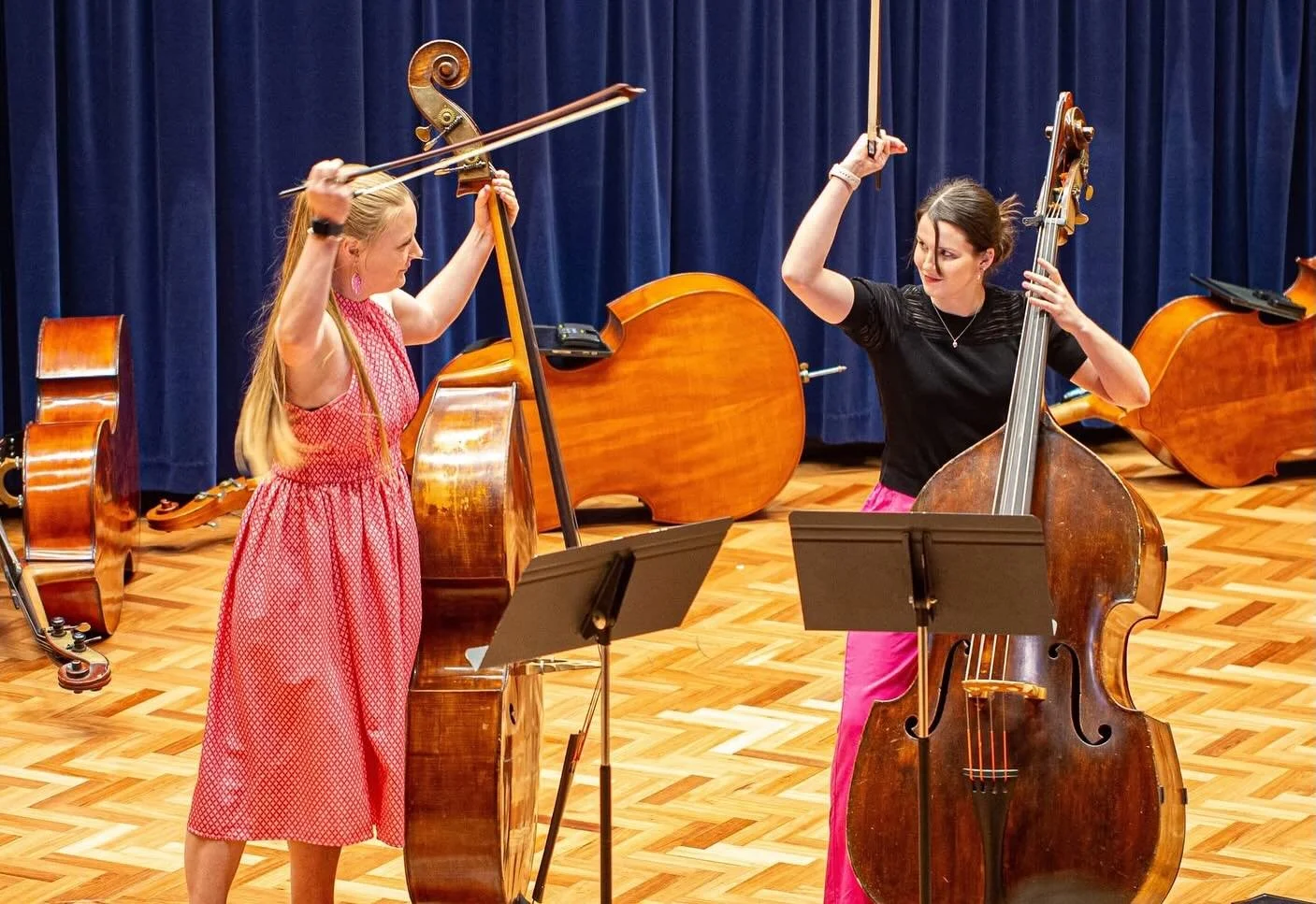
Phoebe Russell (left) with a student at the Queensland Conservatorium Griffith University
“…have a rigorous practice routine, learn all the repertoire - but it's also so important that you love it!
Photo supplied
Russell's own approach to the bass is reflected in her advice to her students at Queensland Conservatorium, where she has been teaching since her return to Australia. "Obviously, you have to focus, work on your technique constantly, have a rigorous practice routine, learn all the repertoire – but it's also so important that you love it! We have to play things we love purely for enjoyment, play music with friends, purely for the sake of sharing the experience. Those things stick with you later, after you graduate, and ensure the longevity of your career – and that you enjoy your life."
On the technical side, she comments that strength in the left hand is important. "It takes a lot of finger strength to push down the strings of the bass, and the higher you go, the harder it is to push down the strings. On all instruments, of course, you need basic, foundational technique but on bass you also need sheer physical weight."
When Russell performs, her playing seems effortless, with a lovely, resonant, singing sound. How does she achieve this? "I've got to be honest, "she says, smiling. "I've practised a lot. My aim is for it to seem effortless; you don't want to look as if it's really hard."
This month Russell is bringing her chamber music skills to Aotearoa to perform at the 2026 Adam Chamber Music Festival (January 29 – February 7). She’ll join other Festival artists in performances of Beethoven’s Septet and Schubert’s Octet, both works she plays regularly. She’s also looking forward to playing Rossini’s playful Duet in D major with cellist Martin Smith, recently appointed to the New Zealand String Quartet. She and Smith knew each other in Berlin, though the pair haven’t met for over a decade.
With New Zealand violinist Arna Morton she’ll play a new duet by her husband, Elegia y brillo para dos. Alviz, following an injury, had to stop playing the bass for a time and began composing, completing a doctorate in composition. “We’ve always had a relationship based on our being double bass players, heavily invested in our careers on the instrument,” she says, “but now that he’s composing, he can also write music for me to play, which is pretty cool.”
Footnote: a musical portrait of Phoebe
In November last year ABC Classic released an EP of Australian composer Paul Dean’s Concerto for Double Bass and Orchestra, played by Russell and the QSO. Dean, co-director of Ensemble Q, is a friend and colleague of Russell’s, having known her since she was 16, first as her mentor at ANAM.
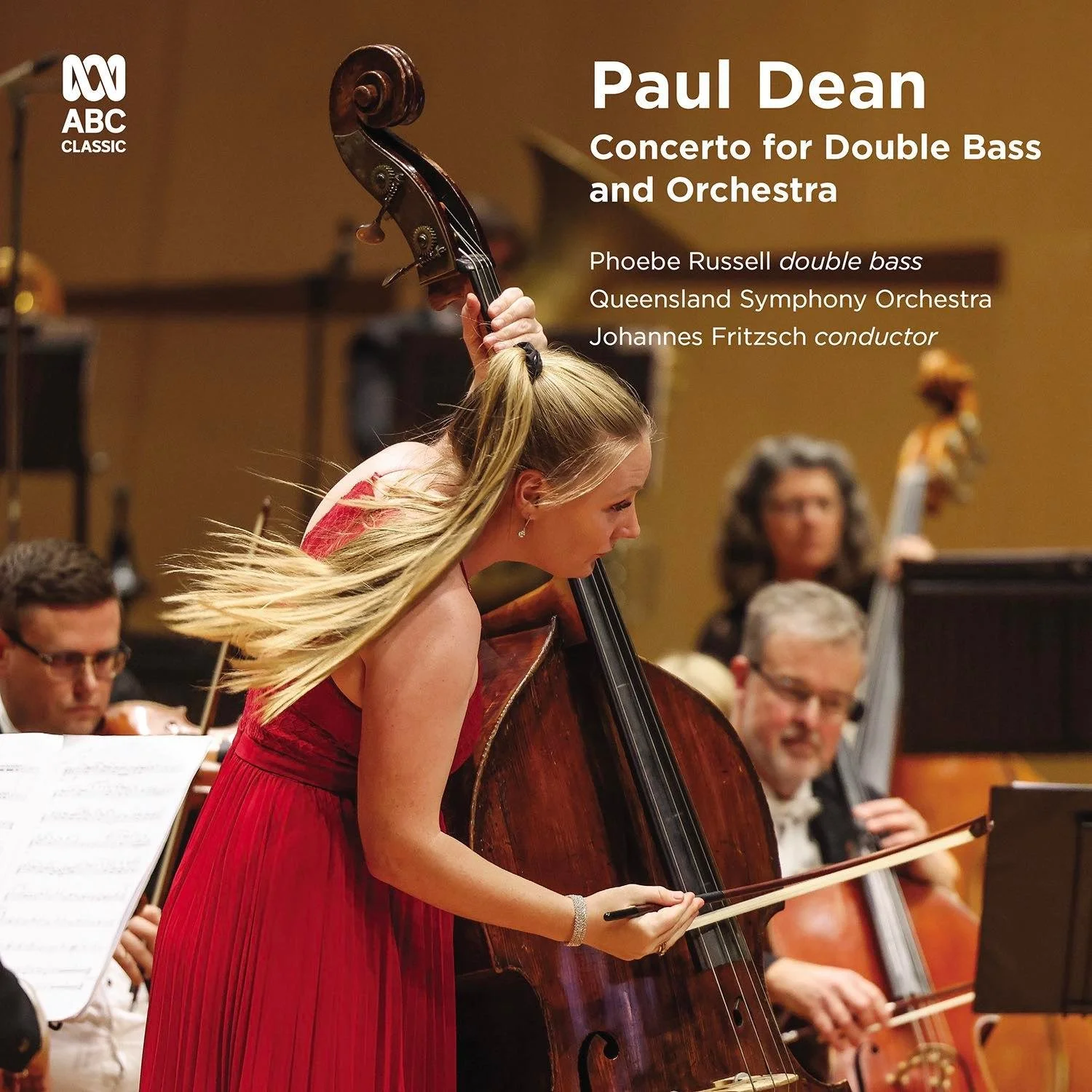
Paul Dean’s Concerto for Double Bass and Orchestra was released in November 2025
“…the composer describes it as ‘a Concerto for Phoebe’”
It’s really, he has said, a ‘Concerto for Phoebe.’ “I have a good handle on her personality, quirks, sense of humour and her more serious side,” Dean explains. “I tried to imbue the piece and indeed every note, with her spirit.”
His Concerto paints a portrait of a warm, humorous and dazzlingly virtuosic musician. The movement titles reflect their relationship: the ‘Queen of Tarragindi’ is Dean’s nickname for Russell, who lives in that suburb of Brisbane; ‘Building a Better Banana’ is an in-joke for the QSO’s double bass section, referring to conductors who try to add their own personal stamp to audience favourites; the ‘Big Deal Waltz’ pokes gentle fun at a sarcastic comment Russell made to Dean’s wife at their first meeting: ‘My name’s Phoebe; I’m kind of a big deal.’
“The Concerto is full of musical jokes,” says Russell, “including a cheeky excerpt of the bass solo from Mahler 1, played on the tuba, which I respond to with a quote from Tubby the Tuba.”
When the Concerto was premiered in 2022, to a prolonged standing ovation, Limelight Magazine’s critic described Russell as “a crowd-favourite, her dynamic performance style and compelling stage presence captivating audiences and clearly winning over her fellow performers as well.”
A big deal indeed! Audiences at the upcoming Adam Chamber Music Festival will have multiple opportunities to enjoy Russell’s sparkling playing, engaging performances and collaborative style. You can check out the programme below.
Adam Chamber Music Festival at the Nelson Centre of Musical Arts January 29 – February 7, 2026 Programme details and booking links here
You can purchase or stream ABC Classic’s EP release of Paul Dean’s Concerto for Double Bass and Orchestra performed by Phoebe Russell and the Queensland Symphony Orchestra here