
The Elouan Quartet with flutist Bridget Douglas: light loveliness and splendid variety
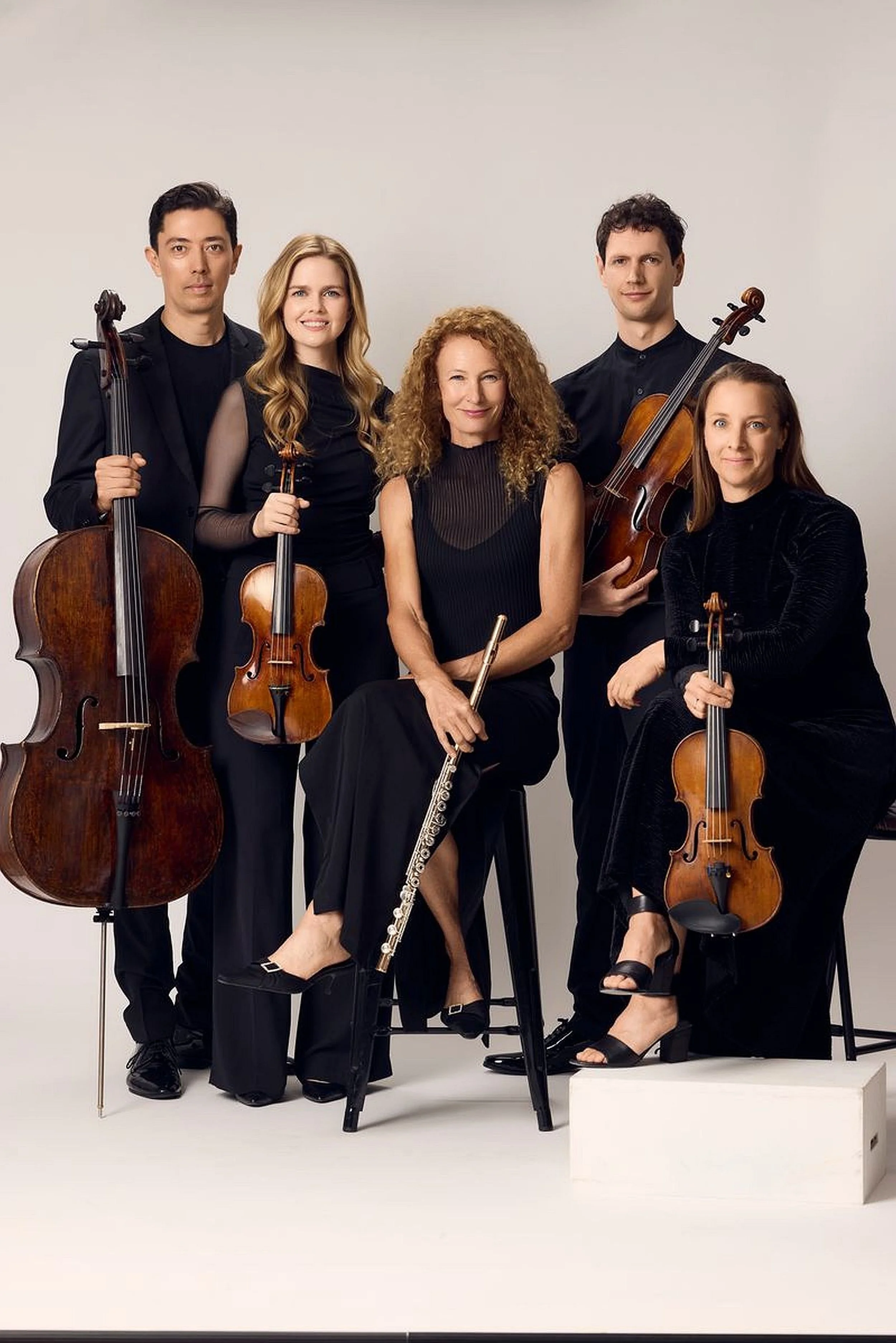
The Elouan Quartet with Bridget Douglas, flutist (centre).
Photo supplied
The Elouan Quartet recently toured two interesting, well-curated programmes to 11 regional chamber music centres with flutist Bridget Douglas as part of Chamber Music New Zealand’s “In Partnership” series.
The name "Elouan" is a French (Breton) boy's name meaning "light" or "bright" and their performances certainly brought those qualities to the stage. I was able to hear both programmes, first in their very well-attended Sunday afternoon concert for the Wellington Chamber Music Trust and a week later in a concert for the Waikanae Music Society.
When composers write for a string quartet and flutist, the wind instrument is often treated as featured soloist, the quartet as an ensemble, the two in concerto-like conversation. American composer Amy Beach's lovely and romantic Theme and Variations for flute and string quartet, composed in 1916, takes this approach, opening with the strings presenting the work's theme, drawn from one of Beach's own songs. When the flute enters in the first variation, it has an exotic melodic line reminiscent of Debussy's famous solo for flute, Syrinx, written three years earlier.
The five fine musicians of this ensemble are all members of the NZSO. They all contribute to other chamber ensembles, including the Ghost Trio (cellist Ken Ichinose), the Amici Ensemble (violinist Anna van der Zee and violist Alexander McFarlane) and Stroma (Douglas, van der Zee and Ichinose). 1st violinist Jessica Oddie had extensive chamber music experience overseas, as did McFarlane, before taking up their roles with NZSO. The Elouan Quartet was formed just a few years ago.
Throughout Beach’s work Douglas’s melodious flute line was compelling and the string playing crisp, with lovely solos from individuals. The performance occasionally lacked the close listening and exquisite balance chamber music requires, but it was a nice account of a work that deserves to be better known.
Composer Salina Fisher is one of our brightest young composing talents and it was a pleasure to hear again her Mata-Au for string trio. Commissioned by the At the World's Edge Festival in 2021, when Fisher was the Central Otago festival's composer-in-residence, in this performance the shifting watery textures of the Clutha River were beautifully and thoughtfully evoked by the musicians.
Few in the audience would have heard of American composer Arthur Foote, who, like Beach, was a member of a group of composers known as the “Boston Six”. His Night Piece for flute and string quartet was composed in 1918, music belonging perhaps to the Romantic period in its lush, sometimes chromatic harmonies. It’s attractive and approachable, the sinuous flute line above the sometimes misty texture of the folk-like melodies of the strings suggesting the influence of French composers.
After the interval the Elouan Quartet played Beethoven’s String Quartet in B-flat major, Opus 18 No 6. In this performance, and in Beethoven’s late String Quartet in F Opus 135 a week later in Waikanae, it was clear they feel an strong affinity for Beethoven’s music. In the earlier work, the heritage of the classical quartets of Haydn and Mozart is apparent and they found the conversational approach of a true quartet, Oddie leading decisively, Ichinose securing the other corner of the texture strongly, the whole group playing with a fine sense of ensemble and musical understanding. In the slow introduction to the final movement, “La Malinconia”, they leaned thoughtfully into Beethoven’s harmonic shifts, and although the Allegretto that follows was not impeccably tidy, the work raced to its Prestissimo ending with unflagging momentum.
Douglas then rejoined the ensemble to end the Wellington concert with Alberto Ginastera’s Impresiones de la Puna for flute and strings. Drawing on the indigenous folk music of Argentina and the Andes, the work was written when the Argentinian composer was just 18 and features the flute in lovely solo sections with bird-song like flourishes. The central love song, Canción, continues the conversation between flute and strings and the work ends with a bouncing Danza, rapid flute with pizzicato accompaniment before the 1st violin takes over the theme with a flute descant above. It all danced to a dramatic ending and an enthusiastic ovation from the large audience.
The Elouan’s Waikanae concert began with a substantial work by Australian composer Elena Kats-Chernin, whose colourful music draws on her ethnic background. Born into a Jewish family in what is now Uzbekistan and growing up in Russia, she drew on Russian folk material for her Night and Now for flute and string quartet (2021), a work that began life as a flute concerto in 2015.
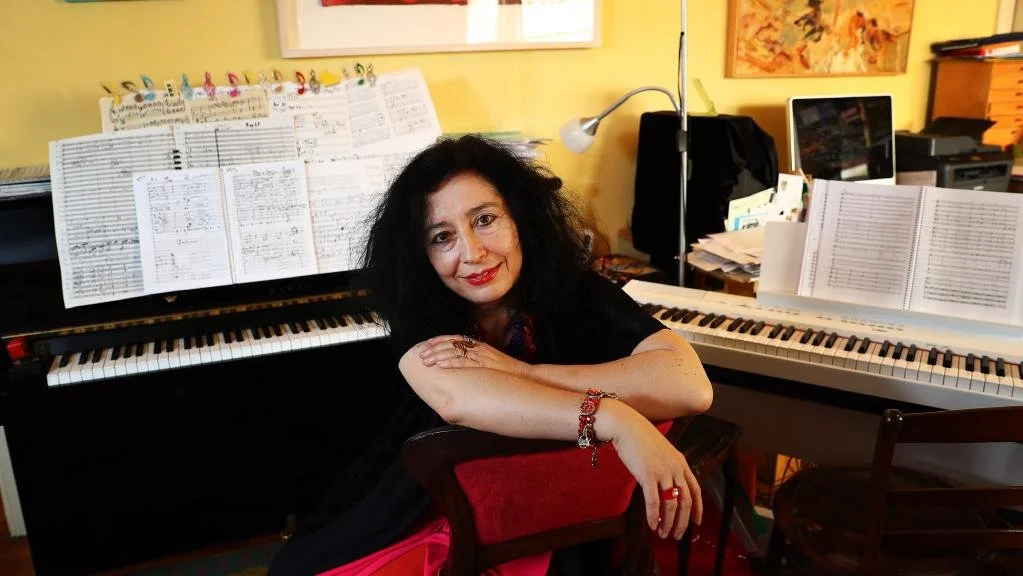
Australian composer Elena Kats-Chernin
“her Night and Now for flute and string quartet draws on Russian folk material.”
Douglas brought her virtuosity to this performance, the flute part wide-ranging against accompanying strings, some well-managed textural complexity and a beautifully flexible cadenza at the end of the 2nd movement. The third movement rondo is a Tarantella, a bouncing movement, involving all members of the ensemble in a light-hearted conclusion to the work.
Mozart’s Flute Quartet in D major K.285 was a lovely choice for this programme and offered a more equal relationship between flute and string trio. The four players responded to Mozart’s typical ensemble writing with style and élan, finding good rapport and balance in spite of the dry acoustic of the Waikanae Memorial Hall. The Adagio second movement is particularly beguiling, and Douglas’s natural musicianship brought perfect phrasing to the graceful flute melody, the strings in sensitive accompaniment.
In both programmes the Elouan Quartet and Douglas introduced their audiences to little known composers, carefully chosen to appeal and surprise. New Zealand composer and clarinetist Ken Wilson (1924-2012) was a founder member of our national orchestra, now the NZSO. A much-admired album of his music, Ken Wilson: Music for Woodwinds on the Atoll label is well worth checking out and it includes the finely-crafted Introduction, Theme and Variations for A flat piccolo and strings included in this programme.
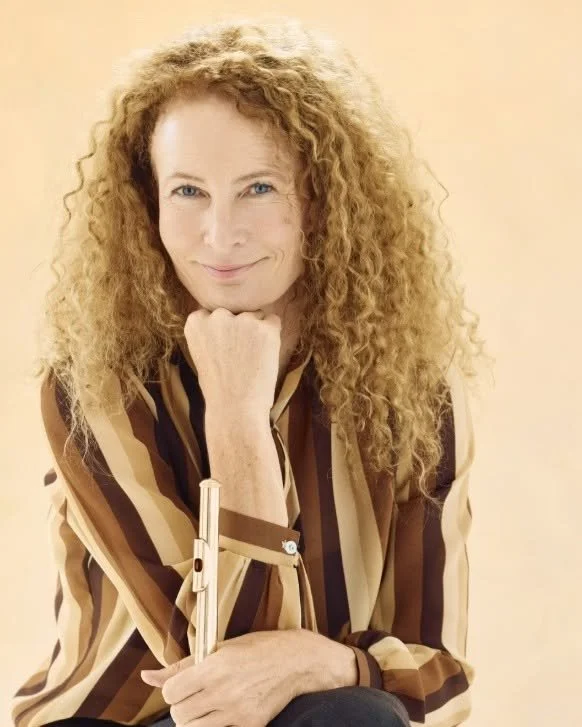
Flutist Bridget Douglas
“…playing with virtuosity and lovely flexibility.”
Photo supplied
Douglas entertained the audience with the saga of tracking down an A flat piccolo – with detective work she had eventually found the one that was played by flutist Richard Giese, the work’s commissioner, for its premiere. Lower in pitch than the traditional orchestral piccolo, it proves a fine solo instrument and the work itself a very attractive composition. From opening solos from cello and viola against violin harmonics, it continues with a folky piccolo entry and a jazzy rhythmic section, maintaining its sprightly charm and rhythmic zest through contrasting variations to a splendid final flourish.
As mentioned above, the Elouan Quartet seems to bring enhanced ensemble balance and rapport to Beethoven’s music. For this programme they chose Beethoven’s last full string quartet, his Opus 135 in F, actually his final complete composition. Like all the so-called Late Quartets, it is occasionally puzzling, heading off in unexpected directions, with a strange, wild 1st violin frenzy in the 2nd movement accompanied by a long ostinato from the other strings. The “acceptance and peace” mentioned by Ichinose in his introduction is found in the third movement, Assai lento, a nostalgic cavatina with four quiet variations.
Much has been written about the words Beethoven annotated to the score for the 4th movement. “Der schwer gefasste Entschluss” (“The hard-won resolution”) he wrote at the beginning of the movement, and then, above a questioning three-note motif, “Muss es sein?” (“Must it be?). Later, two violins answer “Es muss sein!” (“It must be!”). It’s tempting to think of Beethoven at the end of his life questioning his fate, but he wrote elsewhere that he completed the last movement, which had been giving him trouble, “frankly because I had pledged my word and I needed the money. You can see from the motto ‘Es muss sein’ that I wrote it with reluctance.”
The Elouan Quartet’s fine performance of this intriguing work by the master revealed no reluctance, however, and their final movement was full of light energy interspersed with emphatic moments, fierceness shifting to a fleet display and a strong sense of commitment throughout to the music and its composer.
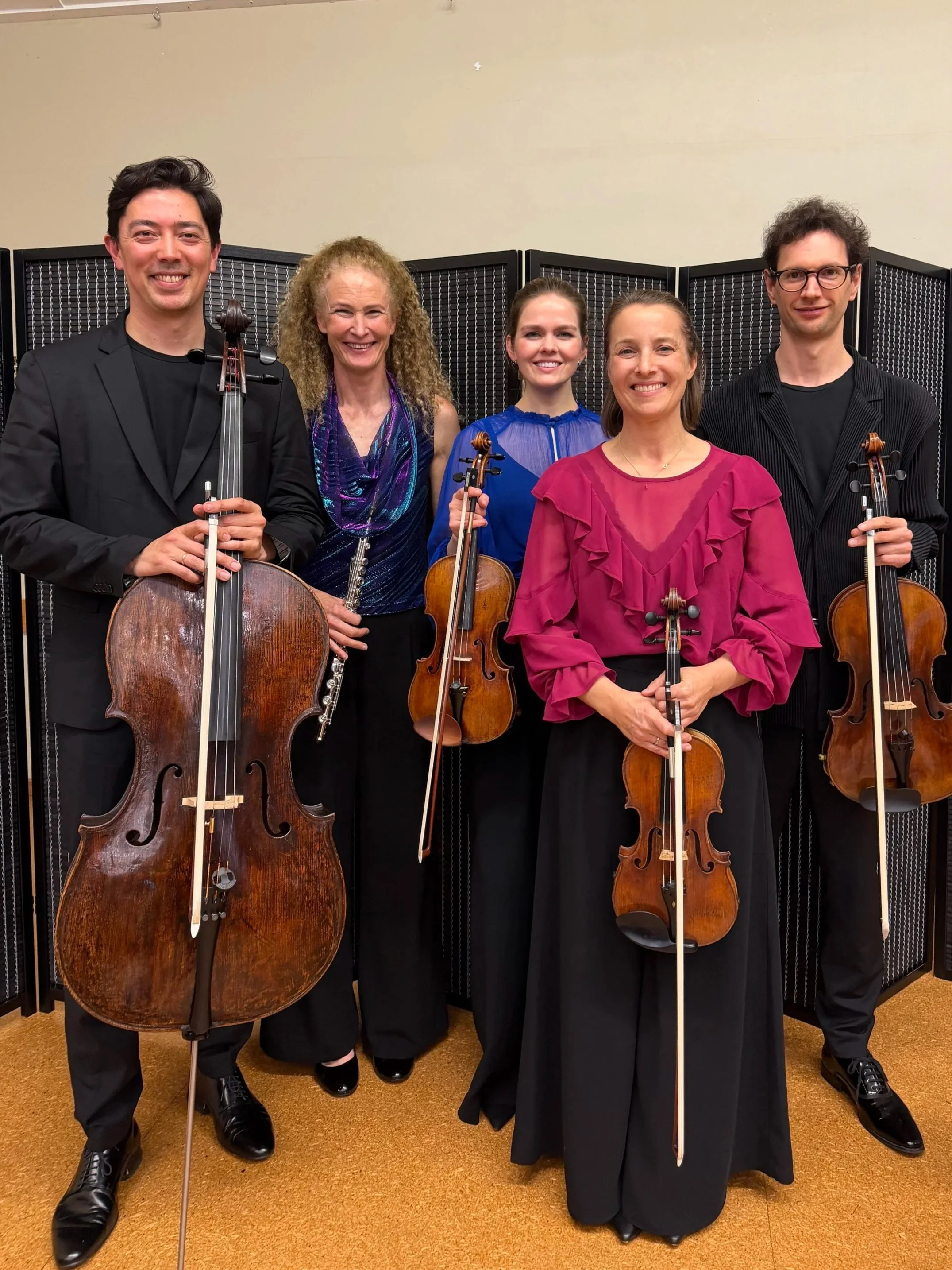
The Elouan Quartet and Bridget Douglas after their Waikanae concert
“…a beautifully-constructed programme that delighted the audience.”
Photo credit: Elizabeth Kerr
The Waikanae programme ended in a light encore-like mood with Astor Piazzolla’s “Nightclub 1960” from his 1985 work Histoire du Tango. This movement marks a period when tango absorbed the rhythms and spirit of the Brazilian bossa nova. Originally written for flute and guitar, this arrangement with string quartet offered more seductive playing by Douglas and a lovely free sense of enjoyment from the Elouan Quartet, completing a beautifully-constructed programme that delighted the audience.
The Elouan Quartet with Bridget Douglas, flute, in Chamber Music New Zealand’s In Partnership series, Wellington Chamber Music Society 12 July, 2026 and Waikanae Music Society 19 July, 2026.