
NZSO, Gemma New and James Ehnes: whimsy, passion and grandeur
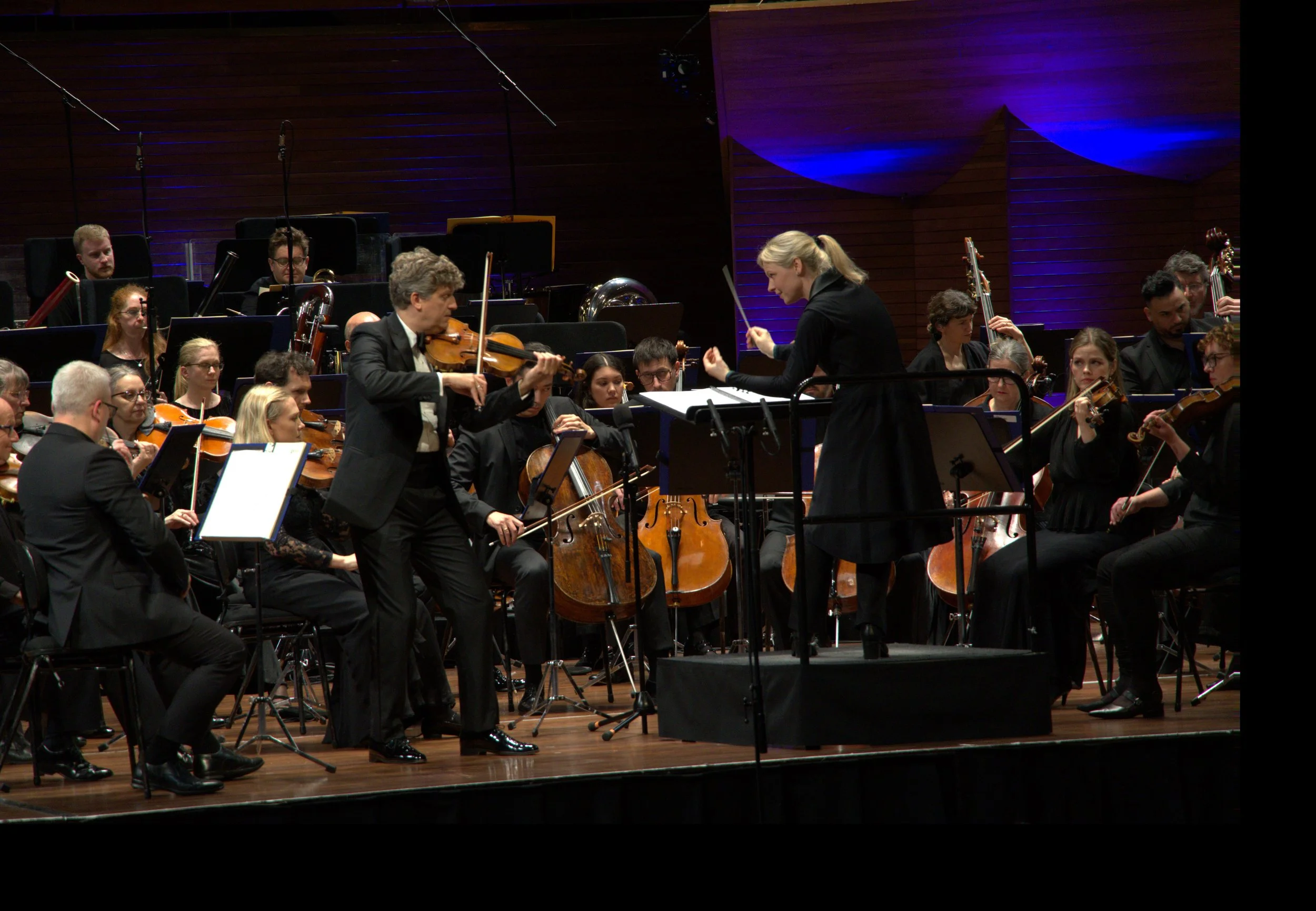
Violinist James Ehnes, conductor Gemma New and the NZSO
Photo credit: NZSO
I'm an unapologetic fan of Mahler's music, especially his symphonic writing. For me, his rich, harmonically-saturated counterpoint, almost naive use of charming Viennese melodies and brilliantly colourful orchestration all contribute to my enthusiasm.
But perhaps, as with many great composers, I’m captured most by his emotional scope. “Life is complicated,” his music tells us as he brings many threads together in moving and satisfying architecture. His symphonies touch us with guileless simplicity while thrilling us with his grand multiplicity of ideas.
The NZSO seems to have a particular affinity with Mahler's music, and over the past two-and-a-half decades we've heard most of his nine symphonies. Just this month the orchestra joined forces for the first time with the Dunedin Symphony Orchestra in its home city for a performance of Mahler’s huge 2nd Symphony, called "Resurrection". Under the baton of James Judd, the acclaimed performance, scheduled to celebrate the DSO's 60th anniversary, included massive orchestral forces, soloists and a choir of 150 voices.
Meanwhile, a few days ago in Wellington and Christchurch, Maestra Gemma New conducted the NZSO in Mahler's first symphony. New has proven her depth of understanding of Mahler’s symphonic scope in recent years with the Orchestra, leading fine and insightful performances of his 3rd, 5th and 6th symphonies.
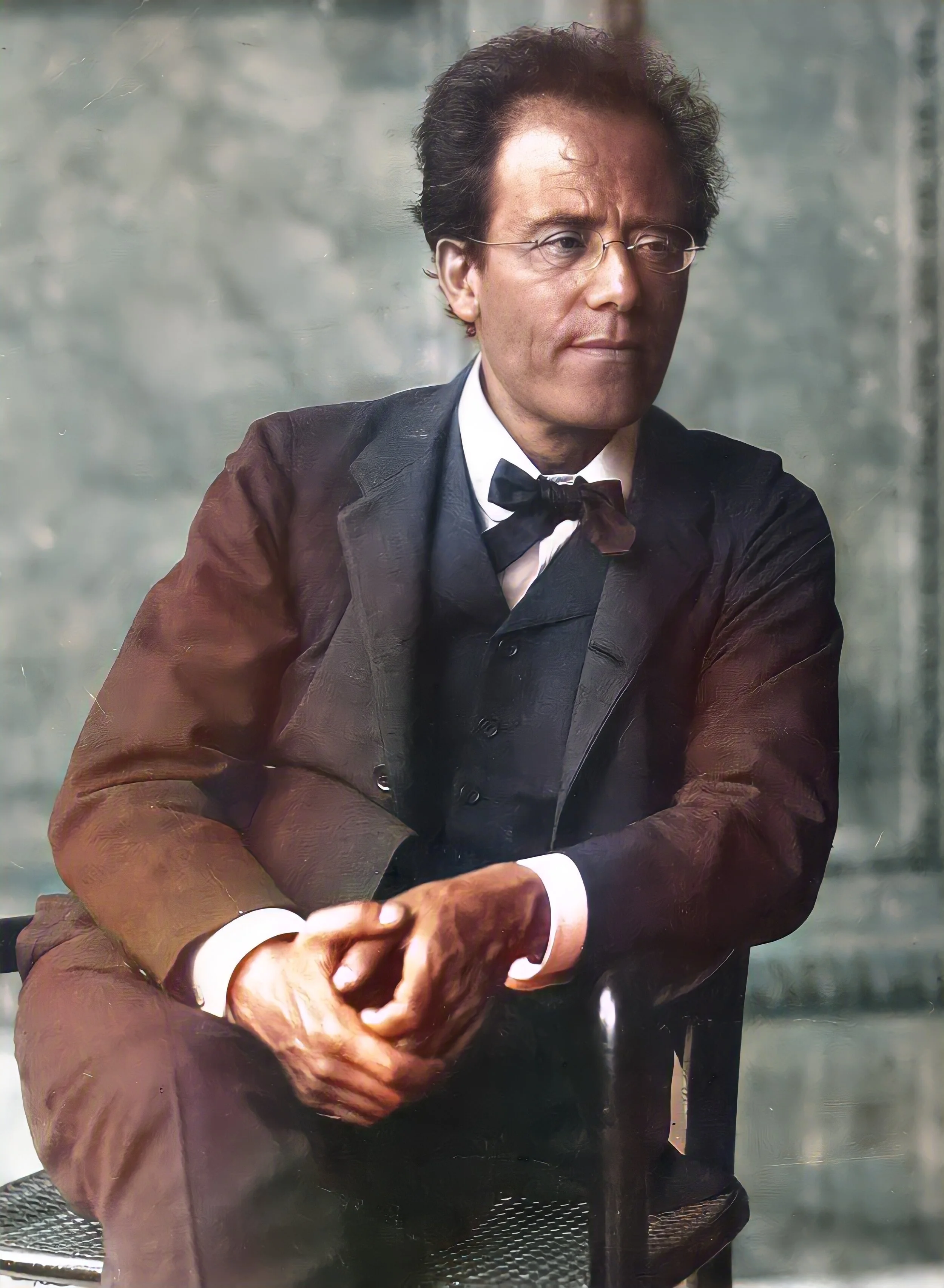
Composer Gustav Mahler (1860-1911)
“… his symphonies capture us with emotional breadth and creative genius.”
When Gustav Mahler composed his Symphony No 1 in D major, he was 28 years old, and already established as a conductor. He understood the capabilities of the big instrument called an orchestra. His first movement, portraying the “awakening of nature”, begins very softly and on the podium New creates and holds a great atmosphere as the huge edifice unfolds slowly from a first quiet sustained high “A” in the strings.
Mahler’s imaginative genius is immediately evident, an off-stage choir of trumpets echoing behind the texture, a gorgeous lightness in the string playing, lovely work from the French horns, the movement beguiling in its apparent musical simplicity. It’s about nature, so of course there’s birdsong from the winds – is that a cuckoo? – and climaxes build from big, broadbrush gestures with sustained low brass and high violins.
The second movement scherzo is almost humorous in its Viennese grace and energy, New letting it dance through a lovely ländler, a touch of oompapa, a gorgeous waltz. Then, changing mood in the third movement, Mahler brings us both the darkness of a funeral march and the huge thematic and emotional variety that displeased some early critics of the work.
The movement opens with a solo double bass theme, high in the instrument’s range, and beautifully played by section principal Joan Perearnau Garriga. We recognise it as a minor key version of “Frère Jacques” and Mahler the contrapuntist develops it as a kind of round for many orchestral colours, its lugubrious pace evoking the funeral march Mahler originally intended. There’s a lot going on, but New’s great musical timing and klezmer-like flexibility convince us we have to allow this music its Viennese whimsy. Mahler’s tunes are never syrupy, flavoured as they are with haunting, acidic harmonies, and droll accompanying pizzicato.
The stormy final movement – “from the inferno to paradise” – opens with a mighty sound, showing off the NZSO’s great wind and brass playing, so essential to Mahler’s grand conception. His big tunes have unexpected shifts and corners, decorated by woodwind chirps, while the strings carry the emotions with a sobbing quality full of little hesitations. The music almost resolves into a lively middle section of counterpoint, but where is the harmony taking us? The tempo broadens, the tension increases and finally in a thrilling moment horns and trombones stand to pour out a “paradise chorale”, leading the work from darkness to a triumphant ending over rolling drums. The audience was delighted, many standing to express their appreciation of this finely nuanced performance of a magnificent symphony.
The concert began with a short work by another musical master, British composer Thomas Adès. One of the brightest stars in the contemporary composing universe, Adès is perhaps not yet well known to New Zealand audiences, although some may have encountered his operas The Tempest and Powder her Face in the Met Opera Live series, and the NZSO played his work Polaris under James McMillan in 2017.
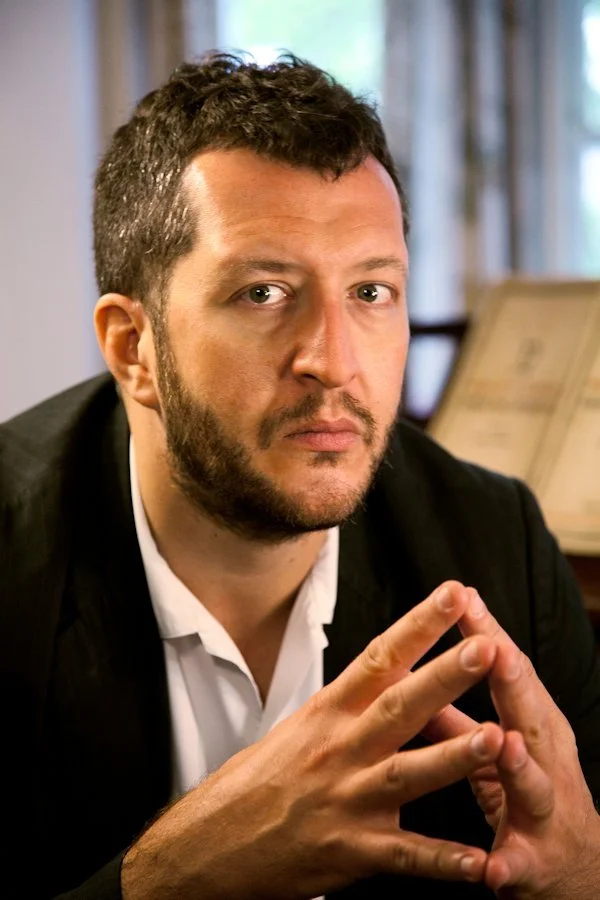
British composer Thomas Adès (b.1971)
“…his short work The Origin of the Harp is beautiful, ethereal and sometimes puzzling.”
The NZSO’s current – and, I believe, regrettable – practice of providing only the skimpiest of printed programme information, with well-written on-line notes only slightly more detailed, meant we were offered no information at all about Adès beyond his birthdate, 1971. We were not told that this short composition, The Origin of the Harp, was originally written by the young Adès in 1994 for a chamber ensemble of ten musicians, and that this orchestration was commissioned by the Scottish Chamber Orchestra and other groups in 2024. New herself conducted the German premiere of the orchestrated version that year.
Understanding that the composition was originally created for a 10-player ensemble by a young composer exploring his harmonic language might have helped the audience understand a beautiful, ethereal and sometimes puzzling work. We are told in the notes and from the podium that the work was inspired by a painting of a water nymph transformed into a harp.
From a magical opening the colourful music flows freely around New’s steady beat of six to a bar, the timbres shifting from woodwind melody to string harmonics to vibraphone and gong. A dark second section introduces low sounds from strings, bassoon, and contrabassoon, with deep growls and sudden explosions. It’s edgy, strange music, Adès’ writing complex and many-layered with subtle percussion effects, using wood and shell chimes, rain stick and African mbira alongside more conventional instruments.
The final section is fleet, little plucked sounds from strings and piano filling the space like stars in the sky – the harp of the story – before a poignant cello solo and more underworld growling lead to an abrupt ending. New then held the orchestra and audience in silence, perhaps acknowledging the transformation of the nymph.
This concert, called “Titan” after an early name for Mahler’s 1st Symphony, was an example of thoughtful programme curation. Between Adès and Mahler the audience was introduced to outstanding Canadian/American violinist James Ehnes, making his debut with the NZSO playing Erich Korngold’s Violin Concerto in D major.
I say “introduced”, but in fact the programme offered no information about the soloist at all, not even his nationality or birthdate. Ehnes celebrated his 50th birthday this year and you can find out more in my recent profile of this acclaimed musician (see link below).
The concerto is dedicated to Alma Mahler-Werfel, Mahler’s widow. Mahler had been an early mentor of Korngold, an Austrian Jewish composer who left Vienna in 1934 for California, where he fell into the embrace of Hollywood. He wrote numerous successful film scores in his romantic style and it was not until the end of the war in 1945 that he returned to concert music with this violin concerto.
Korngold drew on thematic material from his film scores for the work – in fact, it’s possible to allocate each musical theme to a Hollywood production. The result is hyper-romantic music that can seem a little too cloyingly heart-on-the-sleeve for some of us, though Ehnes’ performance of a work he has loved and played since his twenties was enormously persuasive. I doubt you’ll ever hear a better performance of Korngold’s concerto.

Violinist James Ehnes
“…a big, extrovert sound, with marvellous control of his violin and many dynamic subtleties.”
Photo credit: Ben Ealovega
Ehnes usually plays his own Stradivari violin but for his New Zealand performances, including a terrific Mozart concerto with the Auckland Philharmonia earlier this month, he has chosen to use another fine, rich-toned historical instrument, by Guarneri. Korngold’s first movement is full of gorgeous romantic melody, and both soloist and the NZSO revelled in its lush beauties. Ehnes has a big, extrovert sound, with marvellous control of the violin and many dynamic subtleties. There’s no conventional first movement cadenza but a solo section which he played with exquisite clarity and variety.
In spite of its title, there is no harp in Adès’ work, by the way, but this programme, perhaps as a little joke, features the instrument in both the Korngold and Mahler, beautifully played by Ingrid Bauer. It contributes to the lovely orchestral colours of the second, slow concerto movement, Ehnes’ song-like melodic line soaring over the textures and finding the quietest pianissimo when needed. New is, as always, a fine accompanist, making space for lots of rubato in Ehnes’ playing, in music almost bluesy in its emotional appeal.
The real show-off movement in Korngold’s Violin Concerto is the fast and fancy third. Relaxed pizzicato strumming across the strings, brilliant spiccato bowing, and rapid solo variations on the Hollywood themes from the orchestra showed the virtuosity of this marvellous violinist. New and the orchestra also captured the atmosphere of the movement, with great playing from winds and harp, well-balanced solo/tutti exchanges and broad brass sections. Korngold resolves it all in a mad gallop to the finish, Ehnes dazzling to the last and thrilling the audience.
Then came one of the memorable moments of the concert. Responding to the enthusiastic ovation, Ehnes played a generous and perhaps surprising encore by Belgian composer Eugene Ysäye, considered the greatest violinist of his time. His fiendishly difficult Sonata No 3, “Ballade” left the audience bewitched and the romantic excesses of Korngold far behind.
Ysäye’s single movement Sonata, dedicated to violinist-composer George Enescu, is a kind of fantasia that begins with a slow recitative-like section before the virtuosic fireworks begin. One writer has described it as “virtual chamber music packed with multi-voice textures, contrapuntal devices, simultaneous melody and accompaniment, all rendered by amazing sleight of hand by a soloist.”
Ehnes was staggering for both his control of the demanding double-stopping and other technical marvels and the emotional depth he found in this passionate music. It was an auspicious debut with the NZSO, and his return will undoubtedly be welcomed.
NZSO “Titan”: music by Thomas Adès, Erich Korngold and Gustav Mahler, Gemma New (conductor) James Ehnes (violin) Wellington 22 May, 2026.
You can read a Five Lines profile of violinist James Ehnes here